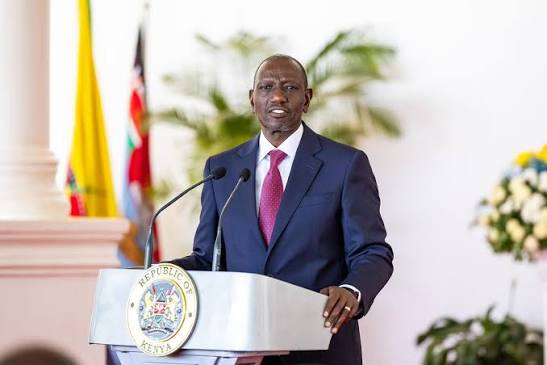
President William Ruto
The president’s order to expel foreign traders from Kenya’s markets is as much an election calculation as it is an economic policy — and it signals how the next eleven months will be fought
By James Mwangi
President William Ruto yesterday ordered all foreign nationals engaged in hawking and small-scale retail trade to shut down their businesses by Monday, September 7, framing the directive as a protection of Kenyan entrepreneurs and signalling the opening chapter of what promises to be the most consequential electoral season in a generation.
Speaking at State House on Wednesday, September 2, before an audience of Micro, Small and Medium Enterprise traders, Ruto was unambiguous. “It cannot be that a person comes from China or elsewhere to be a hawker or open a small shop,” he said, drawing loud applause from the traders assembled before him. The head of state directed the government to begin the crackdown on September 7, arguing that Kenya’s efforts to attract investment were never designed to open the door to foreign petty traders. “We have made efforts to improve the economy. We have not improved investor confidence for hawkers to come to Kenya,” he said.
The announcement was swift, sweeping and deliberately populist. The directive is expected to affect foreigners engaged in small-scale trading, although the president did not provide a detailed list of businesses covered by the order or outline the agencies that will enforce it — leaving serious questions about how the September 7 crackdown will be implemented, how authorities will identify affected traders and what legal framework will govern enforcement.
Those questions matter. The government is pushing to accelerate the Local Content Bill, 2025, through parliament, which would give the directive a legal foundation by identifying categories of business that foreigners would not be permitted to operate. “We have a Bill in Parliament on Trade. In that Bill, we have proposed that there should be businesses that foreigners should not do here in Kenya, by law,” Ruto said. Until that bill passes, the order rests on presidential diktat rather than statute — a distinction that legal observers say will matter when enforcement begins on the streets of Nairobi, Mombasa and Kisumu.
The political timing is impossible to ignore. Kenya is scheduled to hold its next general elections on August 10, 2027, and although the polls are still nearly a year away, informal campaigning is already well underway as new political alliances take shape. Ruto, facing a restless electorate and a fractured coalition, needed yesterday’s announcement for precisely the reason it worked in the hall: it was direct, it was emotive and it told the small trader, the jua kali artisan and the market woman that the president was on their side.
The political landscape Ruto must navigate between now and August 2027 is formidable. Opposition leaders joined Gen Z demonstrators as recently as June 25, marking the anniversary of mass anti-government protests in 2024 and 2025, during which at least 127 people were killed by security forces. That death toll has not been forgotten. The generation that took to the streets two years running is now an organised, if loosely coordinated, political force that no presidential candidate can afford to dismiss.
This will also be the first election since 1997 in which Raila Odinga will not feature on the ballot, following his death in October 2025. Odinga’s absence has redrawn the electoral map in ways that are still being calculated. Internal divisions have since emerged within the Orange Democratic Movement, one of the main opposition parties, as competing factions contend for the political inheritance of a leader who spent three decades as the defining figure of Kenyan opposition politics.
Cracks are also emerging within Ruto’s own broad-based government, where legislators allied to his United Democratic Alliance and Oburu Oginga’s ODM are already clashing over a yet-to-be-formulated power-sharing agreement ahead of 2027. The Naivasha parliamentary retreat, convened to paper over those differences, produced photographs of handshakes but, according to insiders, little of substance. The centre, as one senior legislator put it privately, is holding — but only just.
What many political analysts are calling “Season II” of the fallout between Ruto and his predecessor Uhuru Kenyatta is also unfolding against the backdrop of 2027 calculations, with the president’s allies increasingly alleging that Kenyatta is quietly sponsoring opposition to the Kenya Kwanza administration. Kenyatta has not publicly responded to those allegations, but his movements and associations have been watched with the intensity that only a high-stakes election year produces.
The opposition’s problem is not simply choosing the most popular candidate. It must construct an agreement that supporters of unsuccessful aspirants can accept without feeling humiliated, excluded or politically orphaned — and that requires more than hotel meetings and photographs of leaders holding hands. The names most frequently mentioned — Kalonzo Musyoka, former Interior Cabinet Secretary Fred Matiang’i and impeached former Deputy President Rigathi Gachagua — represent constituencies that do not naturally belong under one roof. Raila’s death further complicated the landscape by removing the one opposition figure who had repeatedly held together constituencies that did not naturally belong in the same political home.
Into this fractured political terrain, Ruto has now introduced a trade directive that simultaneously appeals to economic nationalism, positions him as the champion of the hustler economy he built his 2022 campaign upon, and generates the kind of visible, immediate action that drowns out the noise of coalition tensions and governance deficits. The move follows Tanzania’s decision in 2025 to restrict non-citizens from operating in a range of small businesses — restrictions that affected Kenyan traders in Tanzania and prompted bilateral discussions between the two governments. Kenya’s response to that episode, which included lobbying for exemptions for its own traders, now sits awkwardly against Ruto’s sweeping directive, raising questions about reciprocity and regional economic integration that his government has yet to address.
At present, the divisions and lack of homogeneity within opposition constituencies give Ruto an advantage as the most organised political actor heading into 2027. Kenya’s electoral landscape will, for the first time, be shaped by three distinct forces: the incumbency, traditional opposition elites and a mobilised Gen Z demographic acting as a powerful third-way force. How those three forces align, collide and ultimately configure themselves will determine whether Ruto secures a second term or becomes the first sitting president in Kenya’s multiparty era to lose a re-election bid.
Yesterday’s announcement at State House was a reminder of how that contest will be waged — not only in parliament or in party boardrooms, but on the pavements of Nairobi, in the market stalls of Gikomba and in the small shops of every trading centre from Moyale to Mombasa. The hawker directive is, at its core, a political manifesto delivered in the language of the street — and in the eleven months before August 2027, there will be many more.
Similar Posts by The Mt Kenya Times:
- Mt Kenya Times ePAPER October 19, 2026
- DCP takes healthcare pledge to Murang’a heartland
- Sifuna bets his political life on a presidential run
- Ruto turns Nandi rally into opposition assault as 2027 battle lines harden
- Kenya’s Ebola cases climb to eight as outbreak spreads beyond health workers
About the Author