The acid of anything goes: How moral relativism devours the marrow of principle
 The Mt Kenya Times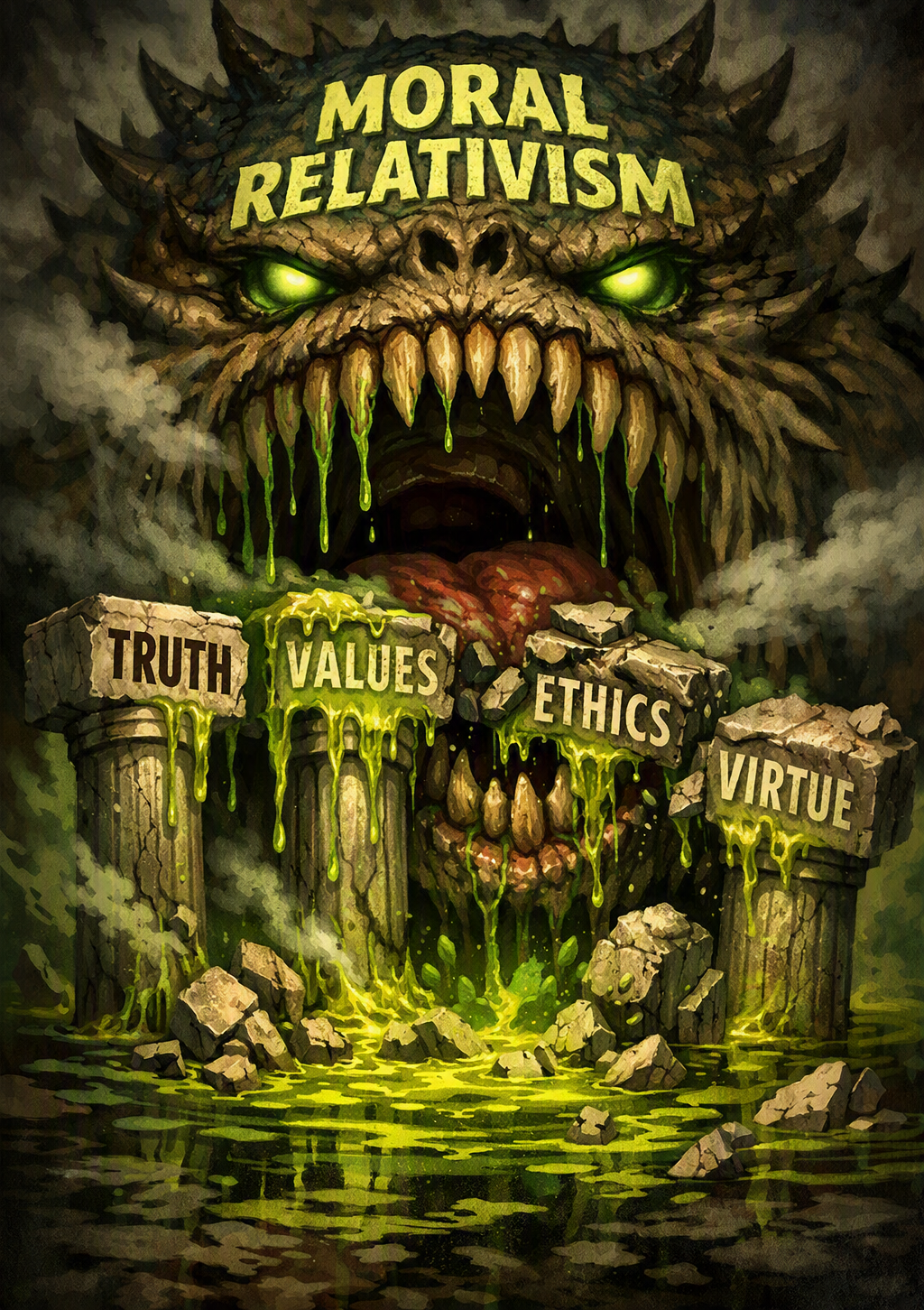
In 2025, the Cultural Research Center at Arizona Christian University reported that two out of three American adults reject or doubt the existence of absolute moral truth. Nearly two-thirds lean toward some form of relativism whether individual, cultural, or emotive when asked to ground right and wrong. This is not a fringe academic posture. It is the majority climate. And it is the quiet catastrophe of our age.
Moral relativism does not merely disagree with fixed standards; it dissolves the very possibility of them. It whispers that every culture’s code is equally valid, that every personal “truth” deserves equal standing, that judgment itself is the only remaining sin. What begins as a plea for tolerance ends as a solvent poured over the bones of duty, honesty, courage, and fidelity. The result is not liberation. It is a slow, systematic hollowing.
Consider the experimental evidence. In controlled studies published in the Journal of Experimental Social Psychology, participants exposed to relativist arguments those that framed morality as subjective and culture-bound were significantly more likely to cheat on a subsequent task and more willing to consider petty theft. Those given absolutist framings showed the opposite restraint. The mere suggestion that right and wrong are negotiable lowered the internal barrier. The mind, once told that the line is movable, moves it.
This is not abstract philosophy. It is the lived weather of contemporary life. When 55 percent of Americans tell Pew researchers that whether something is right or wrong “often depends on the situation,” they are not describing careful contextual reasoning. They are describing a worldview in which the situation always has the final vote. Situations, after all, are infinitely elastic. Need becomes justification. Desire becomes right. Power becomes the only remaining metric.
The cost appears in the texture of ordinary existence. Trust erodes because trust requires shared expectation that certain acts are simply off-limits, regardless of convenience. Promises thin. Integrity becomes a lifestyle choice rather than a non-negotiable. The person who still insists that some things remain wrong lying under oath, abandoning the vulnerable, treating another human as disposable is increasingly cast as the rigid one, the judgmental one, the problem. Relativism does not merely permit moral failure; it pathologizes moral clarity.
I have watched this solvent work. I have watched communities once held together by unspoken agreements about honesty and mutual obligation fracture into competing narratives, each claiming equal legitimacy. I have watched young people raised on the gospel of “your truth” discover, too late, that a society of competing truths cannot sustain the institutions that once protected the weak. And I have felt the personal weight of it: the long adherence to standards that the surrounding culture no longer honors, the quiet fidelity that receives no applause and often invites quiet contempt. All through, nothing has been forthcoming for me in the currency the age prizes recognition, ease, the reward of going along. The principles held, and the ledger stayed empty of the expected dividends.
Even so emptiness of reward does not empty the principle. That is the precise point relativism cannot grasp. A principle that requires external payoff is not a principle; it is a transaction. The moral law, if it is real, does not consult the market of personal advantage. It stands whether the standing costs or pays. The relativist imagines that by making morality contingent, we free the individual. In truth we free the predator. When every boundary is provisional, the person with the greatest appetite or the sharpest rhetoric redraws the map for everyone else.
History offers no comfort to the relativist’s optimism. Societies that treated moral claims as mere local custom have not flourished in sustained justice; they have oscillated between soft anomie and hard coercion. When shared standards collapse, power fills the vacuum. The language of tolerance becomes the language of the strong, who redefine harm and redefine truth to suit the moment. The weak discover that “your truth” offers no shield once the stronger party decides otherwise.
Intellectual honesty requires us to name the contradiction at the heart of the relativist position. The claim “there are no absolute moral truths” is itself advanced as an absolute. The demand that we must not judge is itself a judgment. The insistence that every culture’s morality is equally valid collapses the moment one culture practices systemic cruelty and another practices restraint; the relativist must either pretend the two are indistinguishable or smuggle in a non-relative standard to condemn the cruelty. In practice, most do the latter while denying they are doing it. The result is not consistency but selective absolutism absolutes for the preferred causes, relativism for everything that inconveniences them.
Deep insight arrives when we notice what relativism actually protects. It does not protect the marginalized so much as it protects the uncommitted. It offers a permission structure for those who wish to keep their options open, who prefer the comfort of never being finally accountable to a standard larger than themselves. It flatters the modern self by placing that self at the center of the moral universe. And it exacts its price in the currency of character. Character is formed by the repeated choice to honor the harder right over the easier wrong. When the harder right is redefined as optional, character thins. Over a generation, the thinning becomes cultural.
The data on moral perception already registers the damage. In a 25-country Pew survey, the United States stood alone as the place where a majority of adults judged their fellow citizens to have bad morals and ethics. That finding is not proof of American exceptionalism in vice; it is evidence of a society that has lost confidence in the very category of moral evaluation. When the measuring rod itself is declared relative, people stop trusting the measurements and stop trusting one another.
What, then, is the alternative? Not a brittle legalism that ignores circumstance, but a recognition that circumstance does not create the standard; it only tests our fidelity to it. Courage remains courage whether convenient or not. Honesty remains honesty when it costs. Loyalty remains loyalty when it is difficult. These are not cultural artifacts. They are the conditions under which human beings of any culture can live without constant fear of predation by the clever and the strong.
The relativist will object that such language is imperial, that it imposes one vision on others. The objection confuses the existence of a standard with the right to enforce it by force. One can hold that certain acts are wrong in every culture without claiming the right to conquer those cultures. The alternative pretending that cruelty becomes kindness when the local consensus says so is not humility. It is moral abdication dressed as sophistication.
I write this not from the safe high ground of someone who has never failed the standard. I write as one who has felt the temptation to lower the bar precisely because the bar has offered no personal dividend. The temptation is real. The age makes it elegant. Yet the moment one yields, the acid begins its work. Principles that survive only when rewarded are not principles. They are preferences with better marketing.
Moral relativism will continue to eat. It will eat the language of obligation until only the language of preference remains. It will eat the capacity for shame until only the capacity for offense remains. It will eat the possibility of shared moral education until each generation must reinvent the wheel of decency from the rubble of the last. And it will do so while congratulating itself on its enlightenment.
The refusal to join the feast is not nostalgia. It is the quiet, stubborn insistence that some things remain true even when the majority votes otherwise, even when the ledger stays empty, even when nothing is forthcoming. That insistence is not popular. It is not rewarded. It is simply necessary. Without it, the word “good” itself becomes a hollow sound, and the human project collapses into the endless negotiation of appetites. The relativist calls that freedom. The rest of us, if we still have the courage, call it by its older and truer name: the slow death of the soul.
The writer is a social commentator
Similar Posts by The Mt Kenya Times:
- JJ Gabriel asks to leave Manchester United
- From free transfer to court fight: Mbappé ordered to pay PSG
- Why emotional intelligence matters more than academic scores
- Mt Kenya Times ePAPER September 15, 2026
- Court ruling clips Kenyatta’s wings at the worst possible moment
About the Author