The paradox of inclusion: Kenya’s progressive disability laws and the persistent reality of exclusion
 The Mt Kenya Times
By Fredrick Kipchumba Chelimo – PWD
Email; fkipchelimo@yahoo.com
“A nation cannot claim to have achieved equality when its citizens must beg for rights already guaranteed by the Constitution. The true measure of inclusion is not the promises made in government offices, but the dignity, opportunity and justice experienced by every citizen, regardless of ability or disability.”
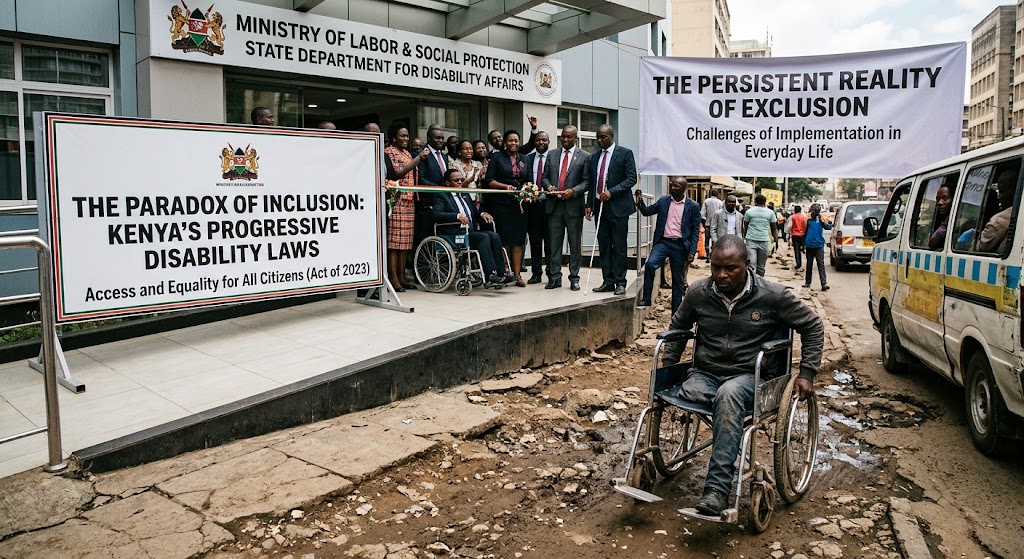
Kenya stands at a defining moment in its pursuit of disability inclusion. Over the years, the country has established an impressive legal and policy framework to protect persons with disabilities, drawing strength from constitutional guarantees, international conventions and legislative reforms. Yet beneath this progressive architecture lies a painful contradiction: while inclusion is celebrated in official speeches, policy documents and public forums, exclusion continues to shape the daily experiences of many persons with disabilities. The challenge is no longer simply whether Kenya recognises disability rights, but whether it possesses the institutional commitment, political courage and collective determination to translate those rights into tangible improvements in people’s lives.
For a person who cannot access a public office because of inaccessible infrastructure, secure employment because of discrimination, afford essential healthcare or obtain an empowerment grant promised by government, constitutional protection can feel frustratingly distant. Such a citizen does not experience inclusion through declarations or ceremonial recognition. Inclusion becomes real when a hospital provides accessible and affordable treatment, an employer evaluates competence rather than impairment, a public institution offers reasonable accommodation, and an entrepreneur receives the support necessary to build a sustainable livelihood. Where these ordinary expectations remain unmet, the distance between legal promises and lived reality becomes an indictment of implementation.
The Constitution of Kenya, 2010, provides a firm foundation for confronting this injustice. Article 27 guarantees equality and freedom from discrimination, while Article 54 establishes specific protections for persons with disabilities, including access to education, public places, transportation, information and appropriate means of communication. Kenya’s ratification of the United Nations Convention on the Rights of Persons with Disabilities and enactment of the Persons with Disabilities Act, 2025, further reinforce the country’s commitment to dignity, accessibility, participation and equal opportunity. These are substantial achievements, but legislation alone cannot dismantle prejudice, release delayed funding or compel institutions to act unless implementation is accompanied by effective oversight and accountability.
Another concern is the statistical invisibility of disability. Kenya’s 2019 census recorded approximately 2.2 per cent of the population aged five years and above as having disabilities, considerably below the World Health Organization’s global estimate that approximately 16 per cent of the population experiences significant disability. Differences in definitions and measurement methodologies caution against direct comparison, but the disparity raises important questions about identification, reporting and planning. When disability is inadequately measured, the needs of affected citizens risk being overlooked in public budgets, development programmes and political priorities. Reliable, disaggregated data is therefore essential to ensuring that policy responds to actual circumstances rather than incomplete assumptions.
Political representation presents another dimension of the problem. Although persons with disabilities increasingly participate in elected, nominated and appointed positions, representation alone does not guarantee effective advocacy. The presence of a representative becomes meaningful when it influences decisions, secures resources, challenges discrimination and holds duty-bearers accountable. Representatives must serve their constituencies rather than subordinate community interests to partisan loyalty. Equally, persons with disabilities must evaluate their leaders by demonstrable achievements, not merely by political affiliation or the symbolic significance of their appointments. Representation without accountability risks becoming an attractive façade behind which exclusion remains undisturbed.
The controversy surrounding disability-related funding illustrates this distinction. Reports concerning Nakuru County in September 2026 raised questions about the disbursement of approximately KSh27.5 million reportedly allocated for persons with disabilities during the 2025/2026 financial year. Subsequent commitments to operationalise the fund highlighted the importance of distinguishing between announced allocations, actual disbursements and measurable benefits. Similar concerns about participation, representation and the delivery of disability-related commitments have emerged in Uasin Gishu and elsewhere. Such concerns demand verification and transparent investigation, rather than premature conclusions. Nevertheless, the underlying principle is undeniable: public resources intended for vulnerable citizens must be traceable, accessible and delivered within reasonable timelines. Citizens should not have to demonstrate in the streets, petition institutions or contemplate litigation merely to obtain answers about their lawful entitlements.
Employment and economic empowerment reveal further gaps between policy and practice. The five per cent employment reservation for persons with disabilities remains an important instrument for advancing inclusion, yet reported compliance gaps among assessed public institutions demonstrate the limitations of relying on policy commitments without effective enforcement. The Access to Government Procurement Opportunities programme similarly creates opportunities for enterprises owned by persons with disabilities, women and youth, but practical barriers can prevent eligible businesses from competing effectively. Additional expenses associated with accessible transport, assistive technology and reasonable accommodation compound these disadvantages. Genuine empowerment must therefore extend beyond eligibility on paper to practical access, fair competition and sustainable economic independence.
However, the responsibility for transforming this situation cannot rest on government alone. Kenya’s disability community must confront the consequences of fragmentation and build a stronger national consensus around shared priorities. Persons with disabilities experience different challenges according to their impairments, age, gender, economic circumstances and geographical location. These differences are legitimate and must be respected. Nevertheless, they should strengthen rather than weaken collective action. Whether the concern is mobility, communication, intellectual disability, psychosocial disability, healthcare, education or economic opportunity, the common demand remains the same: dignity, equal protection and meaningful participation in national development.
Kenya urgently needs a united, inclusive and independent disability movement capable of speaking with one synergised voice. Grassroots organisations, caregivers, advocacy networks, elected representatives and individual persons with disabilities must coordinate evidence-based advocacy, demand transparent resource allocation and hold public institutions accountable. Unity should not suppress disagreement or individual independence; it should enable diverse experiences to inform a common national agenda. From the smallest ward to the highest levels of government, the disability community must insist that rights are delivered, commitments are honoured and lawful entitlements are not subjected to undue or unexplained delays.
Equally important is the performance of institutions established to protect disability rights, particularly the National Council for Persons with Disabilities. Their mandates must be matched by adequate resources, effective oversight and the capacity to challenge non-compliance. Persistent implementation gaps warrant difficult but necessary questions: are these institutions overwhelmed by their responsibilities, constrained by inadequate resources, weakened by institutional inertia, or, in particular instances, affected by conflicts of interest? Such concerns require evidence-based investigation, not blanket accusations. Institutions entrusted with protecting rights must demonstrate their effectiveness through timely responses, transparent decisions and measurable outcomes.
Ultimately, Kenya must move from ceremonial inclusion to enforceable accountability. National and county governments should publish accessible reports detailing disability-related allocations, disbursements, procurement, beneficiaries and outcomes. Employment obligations must be enforced, public infrastructure made accessible, and persons with disabilities meaningfully involved in decisions affecting their lives. Their organisations must also embrace responsible leadership, internal accountability and sustained collaboration.
The paradox of inclusion will persist for as long as progressive laws coexist with preventable exclusion. Kenya’s ultimate test is whether it can transform constitutional promises into everyday realities while recognising persons with disabilities as equal citizens, not passive recipients of charity. The task demands responsible leadership, credible institutions and a disability community united in purpose and independent in judgement.
“Inclusion becomes real when rights are delivered without begging, institutions answer without evasion, and persons with disabilities stand together—not as competing voices seeking political favours, but as equal citizens demanding the dignity, opportunity and justice that the Constitution already guarantees.”
Similar Posts by The Mt Kenya Times:
- Mt Kenya Times ePAPER October 27, 2026
- Sifuna draws hope from Serbia and Brazil as Kenya’s 2027 race heats up
- Uhuru calls for unity as he marks 65th birthday
- Kenya establishes international crimes division: Justice delayed, but will it be delivered?
- World marathon champion Jepchirchir suspended in fresh blow to Kenya’s clean sport drive
About the Author