The Traoré Effect: A Blueprint For African Sovereignty, Accountability, And Renaissance
 The Mt Kenya Times
Captain Ibrahim Traoré of Burkina Faso
By Silas Mwaudasheni Nande
Introduction
Africa stands at a critical juncture where decades of post-independence dreams are being reexamined. The emergence of Captain Ibrahim Traoré of Burkina Faso has ignited ideological waves now referred to as the “Traoré Effect.” This effect represents more than the actions of a military-led government—it encapsulates a vision for African self-determination, urgent governance, youth-led leadership, and continental solidarity.
Born out of frustration with corruption, neocolonial entanglements, and inefficiency, the Traoré Effect presents an alternative model. It asserts that bold leadership and indigenous solutions can reorient Africa’s trajectory toward dignity and development. This analysis explores why Africans must adopt the principles embodied by the Traoré Effect—not necessarily its militant methods—to usher in a renaissance rooted in sovereignty, accountability, and cultural pride.
Historical Context: The Legacy of Sankara and the Rise of Traoré
In 1983, Thomas Sankara became president of Burkina Faso and immediately embarked on one of the continent’s most radical transformations. His governance emphasized self-reliance, anti-imperialism, and cultural reclamation. He renamed the country from Upper Volta to Burkina Faso, meaning “Land of Upright People.” His assassination in 1987 left a vacuum and immortalized his image as a martyr for African emancipation.
Ibrahim Traoré, rising to power in 2022 at just 34, invokes Sankara’s legacy – but with a modern twist. Unlike Sankara’s civilian revolution, Traoré operates from a military framework. However, both figures share ideological parallels: the rejection of foreign domination, emphasis on national pride, and urgency in reforms. Traoré’s speeches mirror Sankara’s rhetorical conviction, and his swift policy decisions echo Sankara’s ambition.
This historical parallel matters. It suggests that African transformations may be cyclical, but they are becoming more assertive with each iteration. Traoré inherits a legacy but also reinterprets it for 21st-century dynamics, especially with respect to geopolitical shifts and technological mobilization.
Governance Crisis in Africa: Why the Status Quo Is Failing
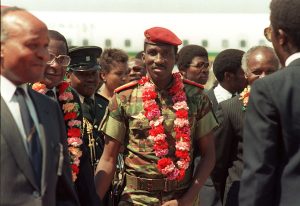
Captain Thomas Sankara, President of Burkina Faso, arrives 31 August 1986 in Harare for the 8th Summit of Non-aligned countries. Sankara was killed in October 1987 in a coup d’etat in which President Blaise Compaoré, his former comrade-in-arms, took power. In 1983, Compaoré helped his boyhood friend seize power from then President Jean-Baptiste Ouedraogo. / AFP / ALEXANDER JOE (Photo credit should read ALEXANDER JOE/AFP via Getty Images)
Many African nations are trapped in governance systems that fail to respond to public needs. Democratic stagnation, entrenched elites, and external interference have hollowed institutions. Elections become rituals devoid of real accountability, and state capacity suffers under bloated bureaucracies.
The Traoré Effect arises as a counter-narrative to this disillusionment. Its core philosophy is urgency. When Traoré took power, he immediately refocused national priorities-from counterterrorism to mining reforms – without waiting for months of parliamentary negotiation.
This swiftness appeals to citizens across the continent who feel excluded by slow-moving democratic processes. While procedural democracy is vital, there is a growing sentiment that Africa needs decisiveness. The Traoré model argues that governance must act – especially in contexts of insecurity and poverty – before legitimacy is lost.
It does not suggest abandoning democracy but reforming it: infusing it with energy, responsiveness, and direct leadership. Africans crave leaders who move with urgency and clarity, not political gridlock.
Resource Nationalism and Economic Sovereignty
One of Traoré’s most impactful reforms is his assertion of control over Burkina Faso’s gold mines. Historically, African nations have been resource-rich yet profit-poor. Foreign companies extract minerals, while locals see little benefit. Traoré flipped this narrative by nationalizing select mines and demanding fair taxation from private extractors.
This resource nationalism, central to the Traoré Effect, is a model for other African nations. It prioritizes beneficiation, local job creation, and reinvestment into national economies. Instead of raw exports, nations must refine, tax, and utilize their wealth for domestic development.
For countries like the Democratic Republic of Congo, Nigeria, and Angola, this model offers inspiration. Africa holds 30% of global mineral reserves. If governed strategically, it could fund infrastructure, education, and healthcare – not foreign balance sheets.
But adoption requires more than political will, it needs institutional capacity. African governments must invest in mining regulation, fiscal transparency, and legal enforcement. The Traoré Effect does not simply advocate seizure – it demands accountability and economic vision.
Anti-Western Sentiment and Geopolitical Realignment
Traoré’s Burkina Faso exited military partnerships with France, expelled foreign troops, and adopted a nonaligned diplomatic stance. This sparked debates about Africa’s geopolitical future.
The Traoré Effect promotes a recalibration, not isolation. Africans have grown wary of Western aid’s strings, military interventions, and exploitative trade. Traoré’s approach is to seek partnerships that respect sovereignty, whether with Russia, China, or pan-African neighbors.
This shift aligns with a global trend. The BRICS bloc, African Continental Free Trade Area, and South-South cooperation signal changing allegiances. Africans must adopt foreign policies that prioritize dignity, mutual interest, and resilience.
But the danger lies in exchanging one dependency for another. Traoré’s pivot to Russia is pragmatic, but it must be balanced. The goal should be diversification, not polarization. Africans must learn to negotiate, on equal footing, with all global actors. The Traoré Effect reminds leaders: sovereignty begins with self-respect.
Youth Empowerment and Generational Shift
At 34, Traoré symbolizes Africa’s youth taking charge. With over 60% of Africans under 25, this is not just symbolism, it’s statistical destiny. Yet many young people face exclusion from politics, underemployment, and disenfranchisement.
Traoré’s leadership challenges this norm. He presents youth not as a liability but a solution. His military background does not negate his generational voice, it amplifies it. He speaks the language of urgency, digital mobilization, and civic pride.
The Traoré Effect inspires young Africans to organize, speak out, and demand accountability. It shows that power can shift—but only if they act. Across universities, social movements, and digital platforms, young Africans are citing Traoré as proof that leadership is possible.
To adopt this model, African nations must invest in youth: through education reforms, leadership programs, and civic spaces. Let the next leaders be trained not marginalized. Let politics be responsive, not geriatric. The Traoré Effect is a generational call to arms, not of weapons, but of will.
Cultural Reclamation and Symbolic Resistance
Traoré’s regime has emphasized cultural pride, renaming institutions, and resisting colonial symbols. This reflects an ideological shift toward narrative sovereignty, where Africans tell their own story.
Colonial legacies still permeate African institutions, from legal systems to educational curriculums. The Traoré Effect asserts that decolonization must be symbolic and structural. By embracing indigenous languages, honoring historical heroes, and rejecting imposed norms, Africans reclaim identity.
Burkina Faso, under Traoré, launched media campaigns to promote local music, dress, and history. It’s not mere aesthetics, it’s psychological liberation. Africans must feel proud, not apologetic, about their heritage.
Adopting this requires curricular reform, cultural funding, and media regulation. African artists, writers, and educators must lead a renaissance of pride. The Traoré Effect reminds us: sovereignty is not just geopolitical, it is cultural.
Risks of Militarism and Authoritarian Drift
While the Traoré Effect offers boldness, it also carries risks. Military takeovers can breed repression, silence dissent, and weaken institutions. Romanticizing coups may undermine democracy.
Traoré’s government has faced criticism over press restrictions and political arrests. Though intentions may be noble, unchecked power is dangerous. Africans must learn from history: centralized authority without transparency invites abuse.
The challenge is balance. Can urgency coexist with accountability? Can centralized decisions respect rights? Adopting the Traoré Effect must include safeguards: independent media, civic watchdogs, and legal recourse.
Democracy must evolve, but not disappear. The Traoré model should inspire reforms, not authoritarianism. Let it be bold, but also bound.
Institutional Reform: Making Democracy Work for Africa
Democracy in Africa is often performative, elections without governance, constitutions without capacity. Traoré’s model urges reform: not abandonment, but adaptation.
Africa must streamline bureaucracy, digitize service delivery, and enhance parliamentary efficiency. Civic education must be prioritized, and corruption fiercely punished.
Traoré’s emphasis on action should be institutionalized. Let African democracies deliver roads, schools, and safety, not just speeches. Institutional reform means bridging the gap between policy and progress.
Countries like Rwanda, Ghana, and Mauritius show that democracy can work, if designed for local realities. The Traoré Effect must evolve into systems, not saviors. Africans must trust institutions more than individuals.
The Traoré Effect stands out as a bold, sovereignty-driven leadership model that contrasts sharply with more conventional African governance styles. Let’s break down how it compares to other prominent models:
Traoré Effect vs. Traditional Post-Colonial Leadership
Key Traits of Traditional Models
- Reliance on Western aid and military partnerships
- Long-standing incumbency with limited youth representation
- Bureaucratic inertia and slow policy implementation
Traoré’s Contrast
- Expulsion of French troops and rejection of neocolonial influence.
- Youth-led governance (Traoré became president at 34).
- Rapid reforms in mining, security, and cultural identity.
Impact: Traoré exposes the stagnation of older regimes and pressures entrenched leaders to reform or risk irrelevance.
Traoré Effect vs. Democratic Reformist Models (e.g., Abiy Ahmed of Ethiopia)
Abiy Ahmed’s Model
- Emphasis on institutional reform and liberalization
- Nobel Peace Prize for regional diplomacy
- Initial media openness and political inclusivity.
Traoré’s Model
- Pragmatic militarism with anti-Western rhetoric
- Focus on resource nationalism and Pan-African alliances
- Symbolic cultural reclamation (e.g., banning colonial-era attire).
Comparison: While Abiy’s model leans on diplomacy and gradual reform, Traoré’s is more radical and immediate—prioritizing sovereignty over global approval.
Traoré Effect vs. Revolutionary Ideological Models (e.g., Thomas Sankara)
Sankara’s Legacy
- Marxist-Leninist principles and Pan-Africanism
- Radical social reforms (gender equality, health campaigns)
- Anti-corruption and personal austerity.
Traoré’s Continuation
- Echoes Sankara’s anti-imperialism and youth mobilization
- Adds modern geopolitical realignment (e.g., Russia partnerships)
- Less ideological, more pragmatic in execution.
Insight: Traoré modernizes Sankara’s vision, adapting it to current security and economic realities while maintaining symbolic continuity.
Traoré Effect vs. Technocratic Leadership (e.g., Paul Kagame of Rwanda)
Kagame’s Model
- Data-driven governance and infrastructure development
- Strong central control with economic liberalization
- International partnerships and branding of Rwanda as a tech hub
Traoré’s Model
- Emphasis on indigenous solutions and cultural pride
- Rejection of Western development models
- Focus on military-led security and resource control
Contrast: Kagame’s technocracy seeks global integration; Traoré’s model seeks continental autonomy and ideological independence.
The Traoré Effect as a Continental Catalyst
Traoré’s ideology now influences regional blocs. Burkina Faso, Mali, and Niger formed the Alliance of Sahel States, a symbol of integration beyond foreign alliances.
Across Africa, civil society is debating Traoré’s ideas. Youth groups cite his speeches. Parliaments study his policies. The African Union, once dormant, is reconsidering reforms.
This continental momentum is strategic. Pan-Africanism, long a dream, finds new fuel. From free trade to collective defense, the Traoré
Similar Posts by The Mt Kenya Times:
- AI Curse or boon: The Future of Intelligence: Artificial or Emotional?
- Dr. Ekrah Ndung’u wins TVET advocacy award after 12 years
- Mt Kenya Times ePAPER October 17-18, 2026
- Ruto bets billions on Kerio Valley — with one eye on 2027
- Ruto’s health ministry kills Murang’a’s digital hospitals
About the Author