The Mt Kenya Times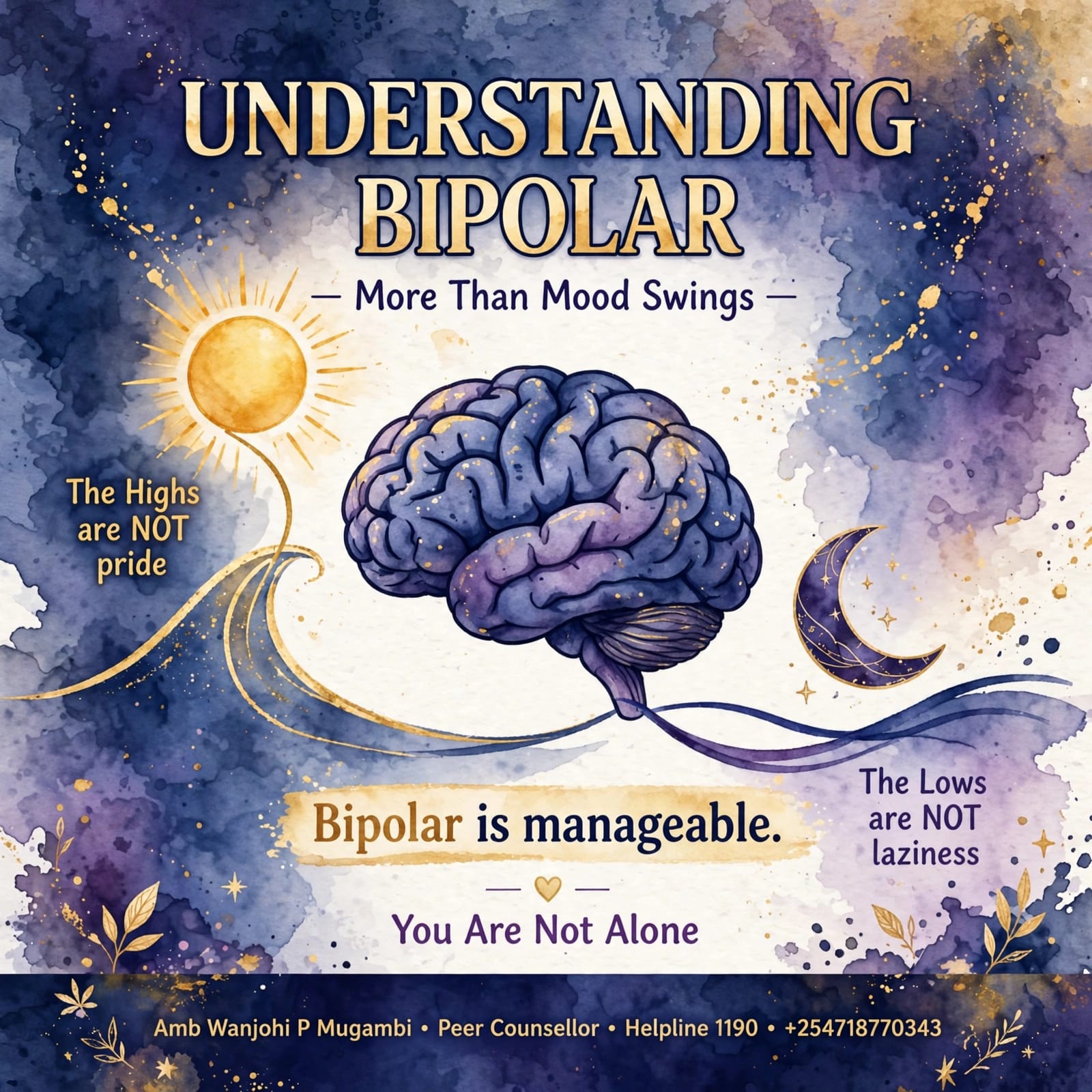
Bipolar disorder is a serious, treatable medical condition — not witchcraft, not weakness, and not a life sentence.
By Wanjohi P. Mugambi
Bipolar disorder is a mental health condition in which a person’s mood, energy, thinking, and behaviour shift in extreme ways. These are not ordinary daily fluctuations. They are intense, they last days or weeks, and they disrupt school, work, family, and friendships. Many Kenyans say someone has “mood swings” when they seem happy one day and low the next. Bipolar disorder is far more serious than that.
Think of mood as a radio dial. For most people, the volume moves gently up and down. For someone with bipolar, the volume shoots to its loudest extreme — then drops to complete silence. There is no middle ground, and no easy way to turn it down.
The high side
The first phase is called mania, or in milder form, hypomania. The person feels invincible — bursting with energy, needing little or no sleep. Thoughts race. They talk rapidly, laugh loudly, and draw up enormous plans overnight. They may feel like a prophet, a king, or a millionaire. In this state, they might spend all their money in a single day, launch multiple businesses simultaneously, become intensely irritable when interrupted, or engage in risky behaviour — gambling, reckless driving, or unsafe sex. It looks like euphoria. Underneath, the brain is exhausted from running too fast.
The low side
The second phase is depression. The energy vanishes entirely. The same person who was unstoppable now cannot get out of bed. The world turns grey. Deep sadness sets in — emptiness, worthlessness, a creeping feeling that nothing and no one matters. Things they once loved — football, music, church, friends — bring no joy. They sleep too much or too little. They eat too much or hardly at all. They withdraw. Some begin to feel the world would be better without them. This is not laziness. This is not attention-seeking. This is the low phase of bipolar, and it causes genuine, serious suffering.
The different forms
Bipolar disorder takes several forms. Bipolar One involves full manic episodes of high intensity, sometimes requiring hospitalisation, alongside severe depressive lows. Bipolar Two features less intense highs — hypomania — but very deep and prolonged depressive periods. Cyclothymia is a milder form in which highs and lows cycle repeatedly over years without reaching full manic or depressive severity.
One truth matters above all: bipolar disorder is not witchcraft. It is not a curse. It is not madness. It is a medical and psychological condition — like diabetes or hypertension — and it can be managed with the right support.
What causes it
No one chooses bipolar disorder, and no single cause explains it. Brain chemistry plays a central role — when the chemicals that regulate mood fall out of balance, the effects can be dramatic. Family history is another factor; if a close relative lives with bipolar, the vulnerability can be inherited, though it is not inevitable. Life stress and trauma also matter significantly. Many young Kenyans carry enormous pressure — exam results, unemployment, heartbreak, bereavement, domestic violence, childhood abuse — and these experiences can trigger the condition in someone already predisposed to it. Substance use is a fourth factor. Alcohol, cannabis, miraa, and other substances interfere with brain chemistry, amplify mood instability, and make recovery considerably harder.
Stigma causes its own damage
Misunderstanding fuels stigma, and stigma causes its own harm. Words like “amechizi” or “amepagawa” wound people more deeply than the illness itself. Because of those words, many young Kenyans hide their pain, suffer alone, and fear losing jobs, relationships, or their standing in the community.
The truth is this: a person with bipolar disorder is not violent by nature. Most are creative, loving, gentle, and hardworking. They are not possessed. They are not weak. What they need is not judgement but understanding.
What triggers an episode
Several things can push the brain into a high or low: insufficient sleep, sustained stress without rest, heavy alcohol use, stopping medication abruptly, prolonged isolation, persistent conflict at home, or the relentless pressure of comparing one’s life to curated images on social media. Recognising these triggers is an important part of managing the condition.
How to support someone with bipolar
If you live with or care for someone with bipolar disorder, your response matters. Do not shout at them or gossip about their condition. Sit with them. Listen without rushing to fix things. Avoid phrases like “stop pretending,” “be strong,” or “just pray harder.” Instead, say: “I am here. I see you are struggling. Let us walk through this together.” Help them maintain a simple daily routine — consistent sleep times, regular meals, gentle movement. Encourage them to keep a mood diary, recording how they feel each day. Patterns in that diary can help them notice when a shift is approaching. And if they express thoughts of self-harm, do not leave them alone. Stay, listen, and connect them to professional help immediately.
Three pillars of healing
Bipolar disorder is treatable. People living with it become teachers, business owners, parents, pastors, and leaders. They live full, meaningful lives when they receive the right support.
The first pillar is counselling and talking therapy. A safe, non-judgmental space to speak openly allows a person to understand their triggers, develop coping tools, and learn to manage racing thoughts and negative thinking. Family counselling is equally valuable — when family members understand bipolar, conflict often gives way to support.
The second pillar is daily lifestyle. The brain responds well to routine. Sleeping and waking at consistent times, avoiding heavy alcohol and substance use, eating regular balanced meals, and staying physically active — even a daily thirty-minute walk — all contribute to mood stability. Staying connected to community — a church group, a youth group, or a peer support network — is equally important. Isolation feeds bipolar disorder. Connection helps contain it.
The third pillar is medical support. A psychiatrist may prescribe mood stabilisers to help prevent extreme highs and lows. These are not sedatives. They are tools to restore chemical balance in the brain. Stopping them suddenly, even when feeling well, can be dangerous. Feeling better is confirmation the treatment is working — not a signal to stop.
When to seek urgent help
Seek help immediately if someone expresses a wish to die or disappear; if they have not slept for three or more days and are engaging in dangerous behaviour; if they have stopped eating, bathing, or functioning for weeks; or if they are hearing voices or seeing things others cannot. These are emergencies. In Kenya, call the counselling helpline on 1190, the gender-based violence line on 1199, or go directly to the nearest hospital.
If your moods swing hard and you do not know why, hear this clearly: you are not alone, you are not cursed, and you are not beyond help. Many have walked this road and found stability and joy again. The first step is simply to talk.
ULTO Counselling Centre, led by Wanjohi P. Mugambi, offers individual counselling, group sessions, youth mentorship, and peer support. Contact: +254718770343 or ambwanjohi.pmugambi@gmail.com
Similar Posts by The Mt Kenya Times:
- Kenya won the right to host the world: Now it must prove it can
- Pride And Prejudice: A Timeless Study Of Love, Pride And Society
- Millions of Kenyans are going hungry: Where is the government’s food security plan?
- Uhuru Kenyatta and the six-month rule: Is this about democracy, power or fear?
- JJ Gabriel asks to leave Manchester United
About the Author