
Mourners gather at Gilgil Stadium on Friday, 12 June 2026, for the national send-off of the 16 girls who perished in the Utumishi Girls Academy dormitory fire.
Sixteen families say goodbye at Gilgil Stadium as a nation mourns its daughters and vows — again — that this must never happen again
By MKT Reporter
Kenya held a national requiem mass for the 16 girls killed in the Utumishi Girls Academy dormitory fire on Friday as Gilgil Stadium filled with hundreds of mourning families, government leaders, and a nation still struggling to comprehend how children could be burned alive in their beds.
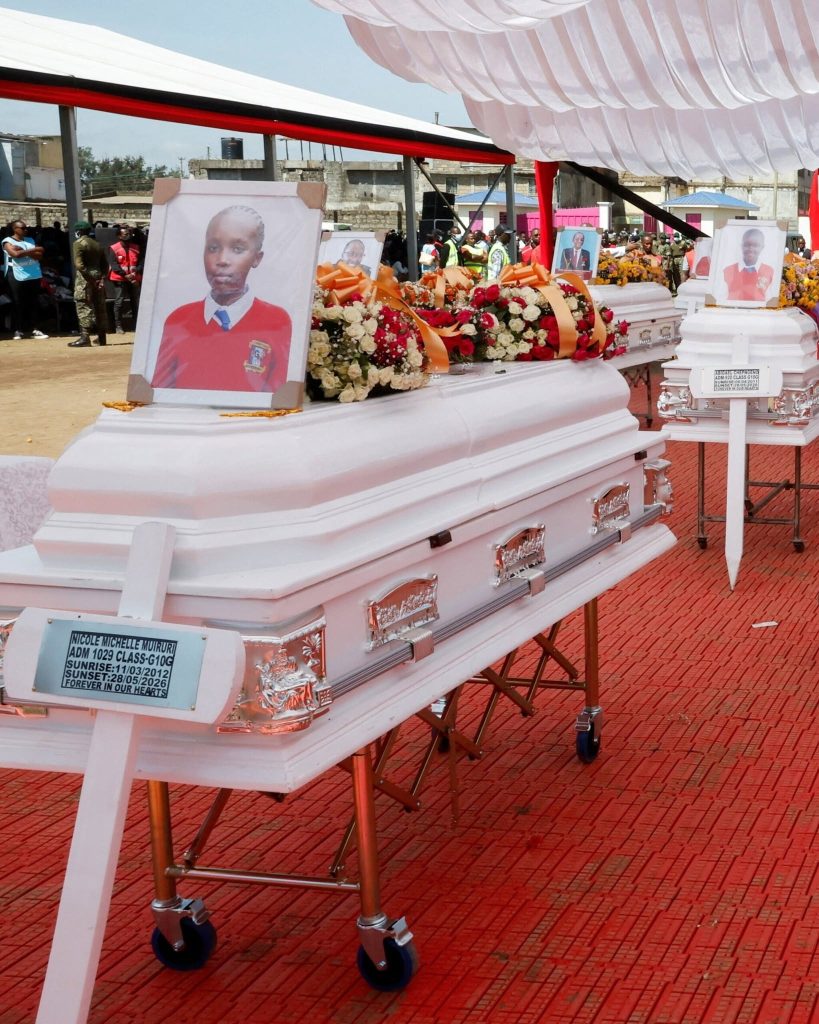
One by one, the girls departed Naivasha Hospital Mortuary in the early hours of Friday morning, each making the painful final journey from the place where their young lives had been extinguished in the predawn hours of 28 May. Their remains were adorned with flowers and topped with their portraits — lined up before families, schoolmates, community members, and leaders who gathered to call for justice.
The fire broke out at approximately 1 a.m. on 27 May 2026 in the two-storey Meline Waithera dormitory at Utumishi Girls Academy in Gilgil, Nakuru County, around 120 kilometres northwest of Nairobi. The dormitory housed approximately 220 students and contained 135 bunk beds. Emergency response teams extinguished the blaze at roughly 3 a.m. By then, 16 students were dead and 79 others injured — many hurt while desperately trying to escape through a dormitory that gave them nowhere to run.
CCTV footage reportedly shows six students — all girls at the same school — entering the dormitory around 12:10 a.m., pouring paraffin on a mattress near the exit, lighting it with a matchstick, and leaving. The fire spread quickly. A locked emergency exit prevented many from escaping. Nine students have since been arrested and charged in connection with the tragedy.
The legal process will take its course. But on Friday, in Gilgil, the only business was grief.
School captain Abigael Wanjiku stood before the stadium and eulogised her classmates as “friends, study partners, teammates and companions.” “The pain of losing them is one that we will carry for a long time,” she said. Her words, delivered with a composure that belied their weight, silenced the crowd. These were not statistics. They were girls who had slept in the same dormitory, eaten at the same tables, and shared the ordinary texture of adolescent life — until it was violently ended before dawn.
Grace Wacheke, who lost her own child in the fire, used her moment at the podium not only to grieve, but to appeal to parents everywhere. “Parents, let us create time for our children,” she said — three words that carried, in their simplicity, the full weight of what it means to send a daughter far from home and trust that she will be safe.
First Lady Rachel Ruto, who led the national delegation as chief guest, urged the country to honour the fallen girls through action rather than condolence. “Our children are our greatest treasure. Their safety, well-being and dignity must remain at the centre of everything we do,” she said. President Ruto was absent from the ceremony, spending part of the day at State House hosting grassroots leaders from Marsabit County. His message to the bereaved was read on his behalf by Education Cabinet Secretary Julius Ogamba.

That message carried the weight of a national promise. “To every Kenyan parent who sends a child to school in trust, I make this promise: We will not rest until our schools are places of safety, and we will take every measure so that no family ever again bears this sorrow,” Ruto said.
Kenya has heard such promises before. The Education Ministry had already closed more than 300 schools following a 2024 fire that killed 21 boys in central Kenya. Yet less than two years later, 16 more children were being sent home from Gilgil, taken by a fire that should never have been possible.
The school’s founder, Edward Mbugua, called for greater investment in quality day schools nationwide, arguing that regional disparities in school quality force families to send daughters hundreds of kilometres from home. “If every region had good schools, there would be no need for students to travel across the country in search of education,” he said.
The presiding bishop asked a question that cut through the solemnity of the service: how much longer would Kenyan children and families continue to suffer from school fires? It is a question that has been asked before — after every tragedy, every inquiry, every promise of reform — and answered, so far, with more fire.
Even the date of the send-off had been a source of pain. Families initially told the service would be held on 17 June reacted with fury — nearly three weeks was too long to wait. Gilgil Deputy County Commissioner Stanley Mutai confirmed the date was brought forward after listening to the bereaved. “After consultation, the requiem mass will be on Friday. We hope to conclude by noon to allow families to travel with the remains of their loved ones in good time,” he said. To the very end, these families had to fight for their daughters.
By afternoon, fifteen hearses moved out of Gilgil Stadium in fifteen different directions — each carrying a girl back to the home she had left full of promise.
They came to Utumishi to learn. They deserved to come home alive.
Similar Posts by The Mt Kenya Times:
- Mt Kenya Times ePAPER October 1, 2026
- Museveni backs Lamu but keeps Uganda’s money at home
- Sifuna’s party wins its name — and Kenya’s opposition race begins in earnest
- Lamu’s $16B gamble: Africa’s biggest refinery divides the region
- Ruto launches KSh2.2 trillion Lamu refinery in East Africa’s biggest energy bet
About the Author