Waititu’s graft bill rises to KSh74.5M as court adds money laundering fines
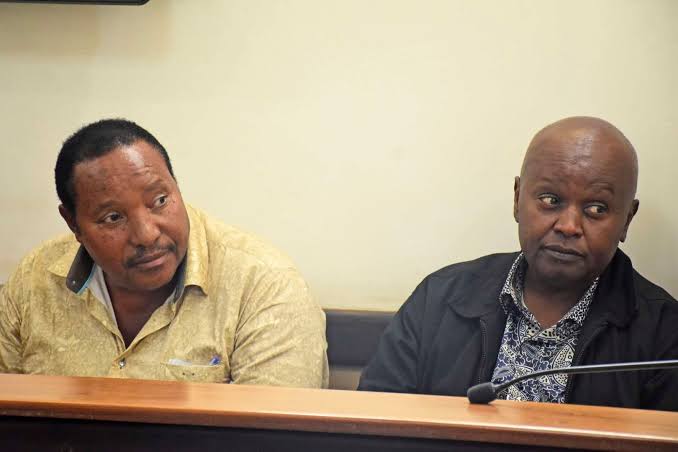
Ferdinand Waititu, the former Kiambu governor and contractor Charles Chege in court on Monday, November 2, 2026
A former governor’s corruption reckoning deepens — and with it, a pointed warning to Kenya’s political class ahead of 2027.
By David Kimani
Ferdinand Waititu, the former Kiambu governor, on Monday had his total financial penalty in a KSh588.7 million corruption case rise to KSh74.5 million after the Milimani Anti-Corruption Court imposed an additional KSh21 million in fines across three money laundering counts.
Milimani Anti-Corruption Chief Magistrate Harrison Barasa handed down the sentence on Monday, 2 November 2026, fining Waititu KSh10 million on Count 10, KSh6 million on Count 11 and KSh5 million on Count 12, with default imprisonment of five, four and two years respectively should he fail to pay. The three sentences will run concurrently with the 12-year custodial term previously imposed.
“On Count 10, Ferdinand Waititu Babayao is fined KSh10 million, in default imprisonment of five years,” Magistrate Barasa ruled from the bench.
The fresh penalties follow a High Court decision on 14 October 2026, in which Judge Rose Ougo set aside the lower court’s acquittal on the money laundering charges and convicted Waititu alongside his wife, Susan Wangari, contractor Charles Chege and Beth Wangeci on all three counts. Judge Ougo directed that the money laundering sentences run concurrently with those already imposed at trial court level. “The sentence the Chief Magistrate imposes for the money laundering counts shall run concurrently with those imposed for the ACECA counts,” she ruled.
The three counts relate to specific sums the court found were laundered. On Count 10, Waititu and four co-accused were convicted of laundering KSh12.41 million. Count 11 concerned KSh7.21 million involving Waititu and five others. Count 12 involved KSh6 million shared among Waititu and four co-accused — transactions the court found were deliberately structured to obscure their origin.
The KSh21 million in fresh fines pushes Waititu’s cumulative financial penalty from KSh53.5 million to KSh74.5 million. He was previously ordered to pay KSh53.5 million or serve 12 years in jail after being found guilty of corruption related to the KSh588 million road tender. Monday’s ruling adds a further financial sting without extending the custodial sentence beyond what the High Court’s concurrency direction permits.
The case has its roots in Waititu’s tenure as Kiambu’s second governor between 2017 and January 2020. Investigations by the Ethics and Anti-Corruption Commission established that once funds were paid by the Kiambu County Government, a total of KSh25.6 million was remitted to entities associated with Waititu. In July 2019, twelve suspects were arrested and arraigned at the Nairobi Milimani Anti-Corruption Court, where they pleaded not guilty. The prosecution called 32 witnesses and produced 149 documentary exhibits in support of its case. What began as an investigation into a single road tender ultimately unravelled a broader web of financial misconduct touching the governor’s office, his wife, a contractor and several county officials.
In December 2025, the Anti-Corruption Court separately ordered the forfeiture of assets valued at approximately KSh131.2 million in a case concerning unexplained wealth. The Ethics and Anti-Corruption Commission is also pursuing a civil case seeking to recover KSh170 million from Waititu and Testimony Enterprises Limited as alleged proceeds of corruption. That civil suit remains pending, meaning Waititu’s legal exposure is far from exhausted.
The court also barred Waititu, his wife and other co-convicts from holding public office for ten years. That disqualification carries particular political weight. Kenya’s electoral cycle is accelerating rapidly towards the August 2027 General Election, and Kiambu — one of the country’s most populous and economically significant counties — now faces a leadership contest without its most prominent recent figure on the ballot. Waititu himself attempted to frame his prosecution as political persecution. While presenting his defence in August 2024, he alleged that the corruption charges were fabricated owing to his strong support for President William Ruto during the 2022 succession politics, claiming the case was a political witch-hunt orchestrated to force him from office. The court found those claims unpersuasive and the conviction stood.
The broader pattern of accountability emerging from Kenya’s judiciary carries its own significance. Waititu became only the second governor in Kenya’s history to be convicted of corruption, after Samburu’s Moses Lenolkulal was sentenced to four years for corruptly pocketing more than KSh83 million from his county government. High-profile figures including former Migori Governor Okoth Obado, former Muranga Governor Mwangi wa Iria, former Busia Governor Sospeter Ojaamong and former Nairobi Governor Evans Kidero are among those facing graft charges, illustrating how corruption became structurally embedded in county governance in the years following devolution in 2013. The Waititu case, arriving at this particular political moment, adds pressure on the judiciary to demonstrate that accountability is applied consistently rather than selectively.
Legal analysts watching the proceedings note that Monday’s ruling matters not merely for its financial quantum but for what it establishes procedurally. The High Court’s reinstatement of the money laundering convictions — overturning a lower court acquittal — signals a willingness by the appellate bench to apply rigorous scrutiny to anti-corruption proceedings. That scrutiny has historically been inconsistently applied in Kenya, where high-profile prosecutions have on occasion stalled or collapsed at critical procedural junctures. The Ougo ruling suggests the courts are prepared to correct those failures when they occur, a development that lawyers and civil society observers have cautiously welcomed.
The Ethics and Anti-Corruption Commission, for its part, has invested considerable institutional resources in the Waititu prosecution over seven years. The case tested the commission’s resolve through multiple procedural challenges, a change of magistrates, defence applications and an acquittal that the High Court subsequently reversed. That the prosecution has reached this point — with convictions sustained, fines escalating and asset forfeiture orders in place — represents one of the more complete accountability outcomes the commission has secured against a sitting or former governor.
For Waititu personally, the arithmetic is now sobering. Between the KSh74.5 million in court-imposed fines, the ten-year bar from public office, the KSh131.2 million in forfeited assets and the pending KSh170 million civil recovery suit, his total financial exposure approaches KSh376 million — every shilling traceable to decisions made from the governor’s seat in Kiambu between 2017 and 2020.
With Kenya’s political season intensifying and anti-corruption accountability emerging as a defining electoral theme for 2027, the Waititu case now functions as a live stress test of institutional resolve. The question it poses is not whether the courts convicted one former governor — they did — but whether the system that convicted him can sustain that standard when the next politically connected accused steps into the dock.
The bill for Kiambu’s stolen millions is still being tallied — and the ledger is not yet closed.
Similar Posts by The Mt Kenya Times:
- Mt Kenya Times ePAPER November 4, 2026
- Kenya discharges first five Ebola patients as outbreak response gains ground
- Mt Kenya’s UDA exodus: How Ruto lost the region that made him president
- Autopsy finds stab wounds killed Regina Re’s 86-year-old mother
- Kenya’s Okowa wins full ICJ term in historic diplomatic victory
About the Author