Who is a Poet? A Case Study of Kagayi’s “For My Negativity” and “No Speaking Vernacular”
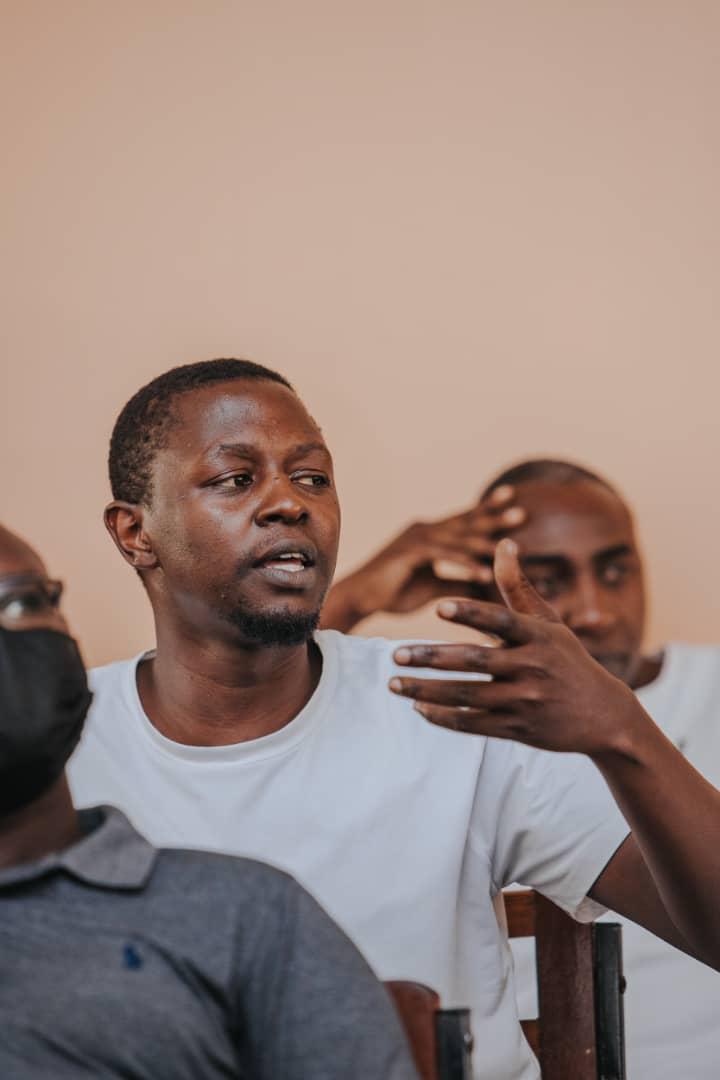
Kagayi Ngobi at the launch of 'Sexual Perceptions, Culture and the Law' 2022

 In this column, our editor, Nassur Tab’an El-Tablaz brings you a weekly review of Ugandan literary works through the lenses of Zziwa Zinabala, an ardent advocate of Ugandan Literature. Zziwa is a well read Ugandan poet and playwright well known for his poetic play, The Muchwezi, the Flower and the Suitor. This week we delve into the contentious debate of Who a Poet is.
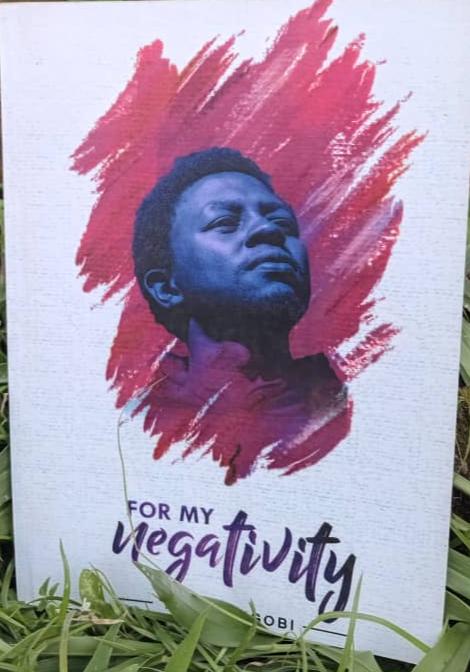
On 15th June, 2023, I met Kagayi at the National Theatre. He sold me his performance poetry collections, For My Negativity and No Speaking Vernacular. Extensively, we had a wonderful talk for about 45 minutes, discussing many issues and the future of poetry in Uganda. One significant rhetoric he poked so hard about was that of Who is a poet? This is an augmented argument that has been around our poetry circles for quite a while. Every single blink, it hiccups again on different social networks as different creatives display their spirited knowledge of who a poet is. Such is our conundrum. I hope we shall have some semblance of an agreement by the end of this write up on who a poet is and what it takes to be a poet. I will elevate my witty annoyance in discussing the “trinity being” of Kagayi: Kagayi, the Publisher; Kagayi, the Artist, and Kagayi, the Writer.
Kagayi, The Publisher
 When I purchased Kagayi’s two poetry collections, he asked me a peculiar question that set me into soft giggles: “Zziwa, What do you mean, you have never bought any of my books?” To make matters straight and to have an emotional balance of thoughts without offending him, I told him that I had in fact bought his books such as Don’t Love me in English, a poetry collection written by Bridget Ankuda but published by Kagayi himself. We then shared our different thoughts about publishing and art juxtaposing our discourse with views on the local climate and the international scene. He raised quite pertinent issues, more significantly:
- Writing is an elitist job that lets individuals eat, pay bills and have fun without trying so hard with life. His narrative was centered on writers in Europe who are thought to almost do nothing but lead better lives. This isn’t the case for a country like Uganda where writers suffer and sink into a depression pit if not guided carefully how brittle this job is. They are faced with the ghost of unrealised royalties. It is claimed nothing has changed, we are only dealing with different problems of the “genZ.” For instance, most of Kagayi’s published content is poetry for himself and other writers under his publishing entity, Kitara Nation, a house presumably founded in the spirit of publishing poets. This brings us back to the question: Who is a poet? Should one be published to be called a poet? When should one identify as a poet? As a matter of fact, one must have published content before identifying as a poet. Kagayi is a published poet and a publisher of books who often refers to himself as a ‘bookprenuer’ – a person that invests money in books. However, from the reading of his aforementioned collections, should a publisher publish himself or herself? How do you handle the biases in your own books?
- Published Ugandan content might not benefit the writers. If this be true, when will one ever be recognized internationally or sell millions of copies to enjoy the fruits of their labour? Ugandans often only recognize a Ugandan writer when such a writer gets international mileage and accolades. Such is the case of Jennifer Makumbi Nansubuga who Ugandans recognize not because of her witty penmanship but because the whole of Europe bows for her as the most complete Ugandan writer. Publish your poetry. Let the world judge.
Kagayi, The Artist
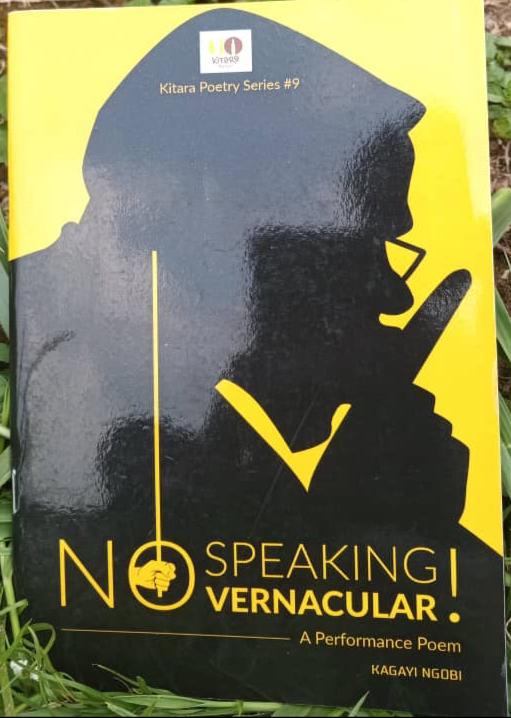
I have watched Kagayi perform several times in the theatre and/or at different poetry events and stages. Once again, we ask: Who is a poet? Should a poet be able to perform their content at different venues or stages? How should they perform their content? While reading Kagayi’s No Speaking in Vernacular, I noticed something irregular which envoked a nostalgic moment. I recalled back then, in primary school, we would be forced to wear sacks and bones whenever we spoke our mother tongues (vernacular). This collection of performance poetry is a real comic masterpiece. I enjoyed each interval when the Headmaster of “John Speke High School” reminded different students how Dambya said “GWE”. It is filled with real vivid imagery of what goes on in most of our schools. That is the exact portrayal of our teachers – we love them anyway! Perhaps, if it were not for them, we would not be writing this colonial language with ease. Nevertheless, why should you punish and suspend a child from school because of speaking their native language?
Therefore, Kagayi as an artist mirrors our society that depresses young children and sets them as examples or trophies of victory and control. This is the best book I have read from Kagayi, so far. No filters, just the bold comical truth. It is a reflection on school jargons reminiscing the glory days of school. How fun it was after classes! I mostly enjoyed his use of Uglish – a fusion of English and Ugandan native lingua blended with direct translation. This is typical mockery of the Master’s English, a victory that perhaps children will run away from the fetters of colonial mindset. Pulling all the strings together, and tailoring the concerns of Kagayi, the Artist, he exhibited a well-coordinated plot. He again asserted in his content that he is an artist – he has reinvented performance poetry for us to enjoy in theatre. This second persona of Kagayi rings yet the throbbing concern; Who is a poet? Kagayi is an artist who performs all his content. Should it be deduced that for one to be recognized as a poet, they should be an artist? The ability to stress out one’s emotions on stage? There are other Ugandan poets who perform their pieces on stage such as Sssebo Lule, Jason Ntaro, Wake the Poet, Caroline Afroetry (The Unapologetic), Mich et al. However, does reciting one’s poetry on stage make them artists? How should these be categorised? Do they qualify to be called poets because of their beautiful “voice-overs”?
Kagayi, The Writer
In all aspects of life, Kagayi is a manifestation and lives the talk. He is a writer. There is proof to these kinds of sentiments. A poet should be a writer. You cannot call yourself a poet without adequate proof that you are a writer. But who is a writer?
“I play football. Should I call myself a footballer?” Kagayi asked during our discussion. This is an analogy I wish to throw to you, readers. Is everyone that can kick a ball a footballer?
It is very difficult to exclude Kagayi from politics. He writes majorly about what hurts him as a Ugandan. Take for instance his maiden book, For my Negativity in which he describes how different things in his country are amiss, and he is bombarded with a lot of negativity; thinking that perhaps his pessimism can be positive one day if things go well. I, therefore, find Kagayi more of a political writer. Political writers are shrewd and a little brave to handle the possible ramification of their content. For instance, Jack Mapanje and his political poetic writings. Kagayi employs his native language and elaborates his pleas, perhaps thinking that, if they can’t understand my simple English, perhaps my Lusoga will ring a bell. For my Negativity reminds me of the Kasese children murdered and burned by terrorists. Who is safe in Uganda? While many Ugandans choose to be apolitical, Kagayi chooses speaking truth to power without fear or favour – a real comendable spirit, I must admit.
Concisely, weighing the different persona of Kagayi, do you think you qualify to identify as a poet?
Similar Posts by The Mt Kenya Times:
- Mt Kenya Times ePAPER October 24-25, 2026
- Muturi calls on IEBC to keep election technology tender clean and on schedule
- Ruto meets UAE minister in push to deepen trade ties
- Gideon Moi breaks silence on Ruto fallout, cites broken promises
- The doctor who refused to abandon a sick Uganda
About the Author