Public concern rises as Kenyans say nation has lost direction
With the 2027 election less than a year away, a damning new poll lays bare a crisis of confidence that reaches from State House to the streets — and hands the opposition both an opportunity and a test it has yet to pass
By David Kimani
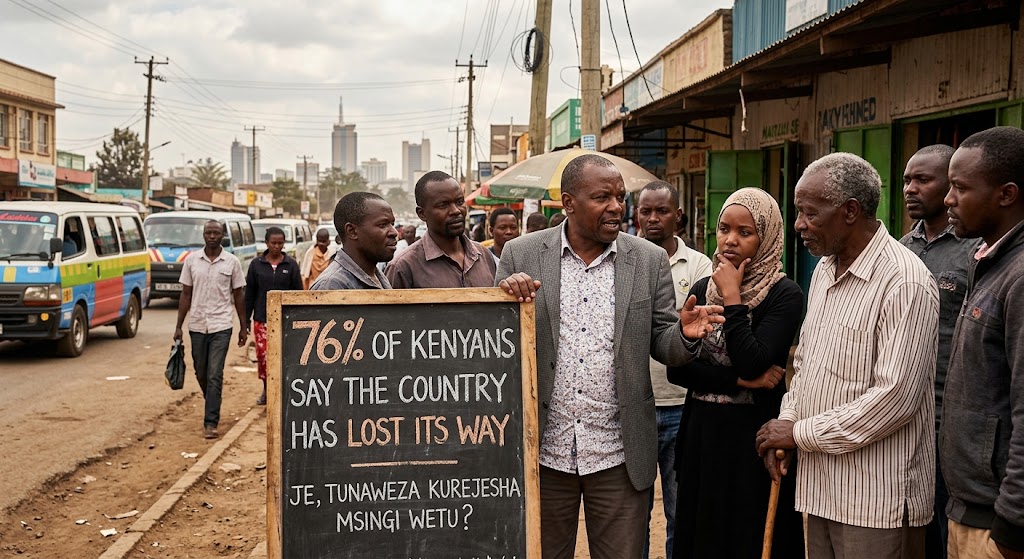
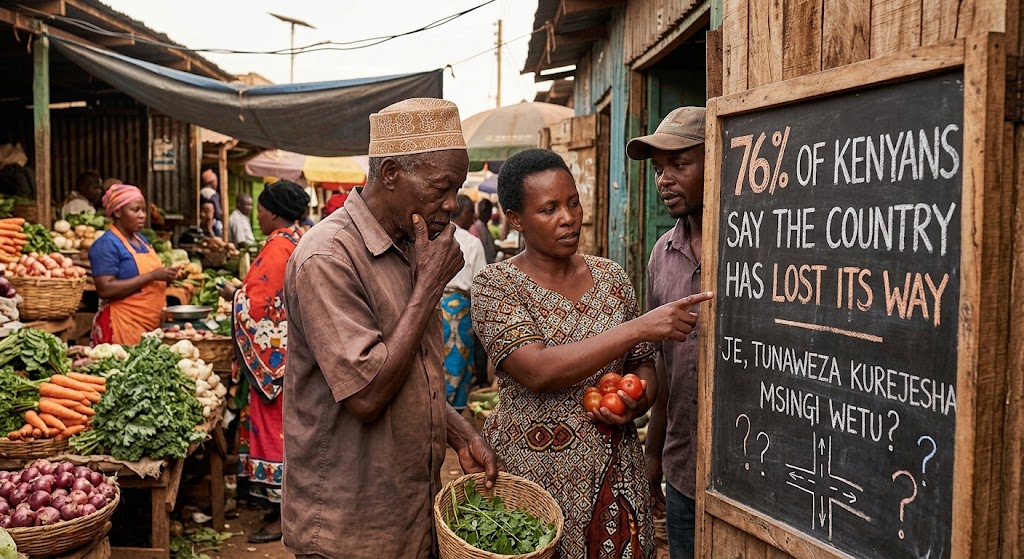
Three in four Kenyans believe their country is headed in the wrong direction, according to a sweeping new TIFA Research poll released on Wednesday that delivers the starkest public verdict yet on President William Ruto’s administration and sets the tone for what promises to be one of the most consequential election cycles in Kenya’s post-independence history.
The survey, conducted between June 13 and 22 among 2,048 adults across all 47 counties, found that 76 per cent of Kenyans believe the country is moving in the wrong direction — the highest level recorded in TIFA’s tracking period — while only 14 per cent said Kenya was on the right track. The numbers represent more than a data point. They are a political earthquake arriving eleven months before Kenyans return to the polls in August 2027, and they raise a question that will define the coming campaign season: can any leader — or coalition of leaders — convert this tidal wave of disillusionment into a credible mandate for change?
The deterioration in public sentiment is particularly striking when placed in historical context. Dissatisfaction has risen from 68 per cent in November 2025 to the current 76 per cent, with TIFA describing the trend as evidence of a “sustained and increasingly entrenched negative public mood.” The trajectory is not a blip. It is a direction of travel, and the data offers no comfort to a government that came to power in 2022 on a platform of economic transformation.
The regional breakdown is equally sobering for the Ruto administration. Mt Kenya recorded the highest level of pessimism at 90 per cent, followed by Nairobi at 89 per cent, Lower Eastern at 83 per cent and South Rift at 82 per cent. That Mt Kenya — the region that delivered Ruto his electoral bedrock in 2022 — now leads the country in disillusionment is not merely a political embarrassment. It is a structural warning that the President’s core coalition is fracturing under the weight of economic disappointment. Even in the most optimistic regions, the numbers offer little reassurance. In Northern Kenya, which recorded the strongest positive sentiment, only 38 per cent said the country was moving in the right direction.
The economic dimension is central to understanding the poll’s findings. Sixty-five per cent of Kenyans said their personal or family economic situation had worsened since the 2022 general election, while only 12 per cent reported an improvement. For a government that staked its legitimacy on the promise of a bottom-up economic transformation, those figures represent the sharpest possible public rejection of its record. Jobs, food prices, fuel costs and the persistent weight of taxation have combined to produce a household-level misery that no amount of infrastructure ribbon-cutting can obscure. The ordinary Kenyan is not experiencing policy through press conferences. They are experiencing it through an empty wallet.
The poll’s findings on institutional trust add an even more troubling dimension to the political landscape. Not a single major public institution commands the trust of a majority of Kenyans, with the presidency, the Independent Electoral and Boundaries Commission and the National Police Service all struggling to earn the confidence of even a third of the population less than a year before the 2027 general election. The Judiciary ranked highest at 36 per cent, followed by county government leadership at 31 per cent. The IEBC recorded 30 per cent, while the presidency and police hovered around 29 per cent, and Parliament ranked last at 27 per cent.
The significance of the IEBC figure cannot be overstated. An electoral body trusted by fewer than one in three Kenyans is an institution whose legitimacy is already contested before a single vote is cast. Opposition leaders have demanded electoral reforms and greater confidence in the IEBC, arguing that the credibility of the 2027 election will depend on the integrity of the electoral process. If those demands go unmet, the risk of a disputed result — and its attendant instability — grows considerably.
The Broad-Based Government, the political arrangement that brought Ruto’s UDA and the late Raila Odinga’s ODM into a de facto coalition, has fared no better in public opinion. Fifty-two per cent of Kenyans oppose the arrangement compared to 30 per cent who support it, with TIFA noting that nearly twice as many Kenyans oppose the BBG as support it. TIFA said the stability in BBG support — unchanged at 30 per cent since May 2026 — could be linked to divisions within ODM over the matter of supporting the President’s re-election bid, suggesting a fairly stable ceiling on how much public backing the arrangement can attract.
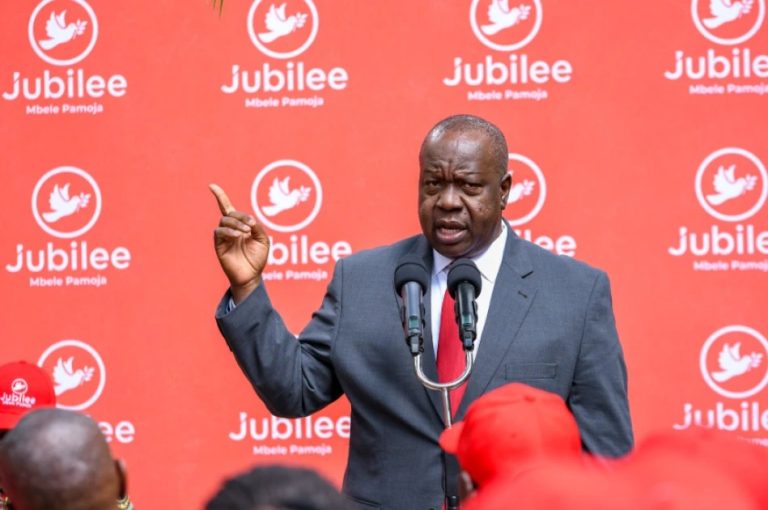
For the opposition, the poll is simultaneously a gift and a gauntlet. The public mood is more favourable to change than at any point since Ruto took office. The question is whether the leaders seeking to channel that mood are capable of the unity required to do so. The latest opposition consultations on September 1 brought several principals together again, including Wiper leader Kalonzo Musyoka, People’s Liberation Party leader Martha Karua, Jubilee’s Fred Matiang’i and DAP-K’s Eugene Wamalwa, with the meeting serving as yet another indication that coalition-building remains a continuing process rather than a decision already reached.
The opposition’s central problem is one of fragmentation. TIFA’s own data showed opposition backing split among Nairobi Senator Edwin Sifuna at 15 per cent, Matiang’i at 14 per cent, Kalonzo at 13 per cent and former Deputy President Rigathi Gachagua at seven per cent — a fragmented landscape that continued to work in the President’s favour. Political analyst Martin Oloo has argued the point plainly. “For Ruto and Raila to lose in 2027, there needs to be one big coalition — an alternative political juggernaut such as Narc against Kanu in 2002,” he has said. “If the opposition does not come together and front one candidate, Ruto and Raila will sponsor minority presidential candidates who will chip away enough votes to give them a clear win.” The arithmetic of Kenyan elections is unforgiving of division.
DAP-K leader Eugene Wamalwa, one of the coalition’s senior figures, has acknowledged that the process will take time. “Coalition building is not an event. It’s a delicate process that takes time, patience, consistency, perseverance and persistence,” he said following the September consultations. That measured counsel is pragmatic. It is also a luxury the opposition may not have much longer. With the IEBC having already warned aspirants that campaigning cannot begin before May 29, 2027, the window for building a credible, unified alternative to the government is narrowing.
What September 9’s poll ultimately reveals is a Kenya at a political crossroads. Public dissatisfaction of this magnitude, spread this uniformly across regions, age groups and economic classes, does not simply evaporate. It searches for an outlet. In 2002, it found one in a united opposition and produced the most peaceful transfer of power in the country’s history. In 2007, division squandered a similar moment with catastrophic consequences. The lesson of those two elections has never been more relevant than it is today.
Ruto’s administration still has time to shift the trajectory. Economic conditions can improve, policy communication can be sharpened, and the weight of unpopular measures can, in theory, be replaced by tangible results. But the data suggests that the room for manoeuvre is shrinking with each passing month. A government that has lost the trust of 90 per cent of its own Mt Kenya base is not simply managing a public relations problem. It is managing a political emergency.
Kenya’s voters have delivered their interim verdict clearly and loudly. Eleven months remain to determine whether their leaders — on both sides of the political divide — are equal to the moment the country is demanding of them.
Similar Posts by The Mt Kenya Times:
- Mt Kenya Times ePAPER September 10, 2026
- Ruto tells Rift Valley “I love you” — but a million unregistered voters tell a different story
- Counties foot the bill for health deals they never signed
- Matiang’i breaks silence on DCP’s Mt Kenya grip, Jubilee’s future and the Nyoro war
- Methu demands action on Ruto’s idle Moyale gold mine order
About the Author