Iran buries Khamenei as world leaders converge on Tehran for historic farewell

A seven-day state funeral spanning three countries marks the end of the Ayatollah’s 37-year rule, as Tehran stages one of the largest public gatherings in modern history
By Diaspora Times Team
Millions of mourners have filled the streets of Tehran this week as Iran bids farewell to Ayatollah Ali Khamenei, the Supreme Leader killed alongside several family members in a US-Israeli air strike that opened the war on Iran in February. What began as a delayed burial has become a sprawling, seven-day state funeral stretching across Iran and Iraq, drawing foreign dignitaries from more than a hundred countries and testing the fragile ceasefire that ended months of conflict.
Khamenei, 86, ruled Iran for 37 years before being killed on 28 February in a joint US-Israeli strike on his residence in central Tehran, an attack that also killed his daughter, son-in-law and three-year-old granddaughter. His burial had originally been scheduled for March, but the months-long conflict delayed the funeral rites until this week. His son, Mojtaba Khamenei, was severely wounded in the same strike and has since been named the new Supreme Leader, though he has yet to appear in public.
 A funeral of unprecedented scale
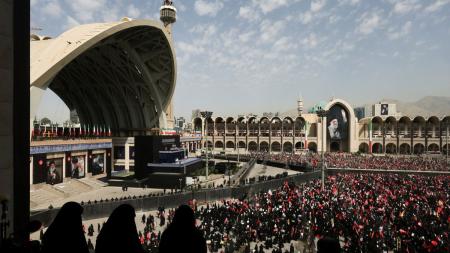
Iranian officials have not been shy about the scale of the send-off they intend to give their longtime leader. Officials in Tehran say they expect between 15 and 20 million people to attend, a figure that, if realised, would make this the largest state funeral in the country’s history, surpassing even the funeral of Khamenei’s predecessor, Ayatollah Ruhollah Khomeini, in 1989. That 1989 funeral drew around 10 million mourners, a scale Iranian officials say Khamenei’s farewell is set to eclipse.
The ceremonies opened on Friday with Khamenei’s coffin, alongside those of relatives killed in the same strike, lying in state at Tehran’s Grand Mosalla, the great prayer hall built to honour Khomeini. Public viewing began the following morning, with crowds queuing for hours before dawn. The coffin itself was draped in a flag that previously flew over the Shrine of Imam Hussein in Karbala, which Iranian authorities described as a symbol of resistance and sacrifice.
The itinerary is deliberately expansive. According to Al Jazeera’s reporting from Tehran, the funeral processions move south towards the city of Qom early in the week, before crossing into Iraq for an official reception at Najaf International Airport, followed by public processions in Najaf and Karbala. The body then returns to Iran for burial at the shrine of Imam Reza in Mashhad — the city of Khamenei’s birth — closing a farewell that has taken the Ayatollah’s remains across two countries and five cities.
Who came, and who stayed away
The list of attendees reveals as much about Iran’s current alliances as it does about the funeral itself. Pakistan’s Prime Minister Shehbaz Sharif, who has played a central mediating role between Washington and Tehran, led his country’s delegation, with Pakistan’s foreign ministry confirming his attendance days in advance. Russia sent former president Dmitry Medvedev as a special envoy for President Vladimir Putin, while China dispatched He Wei, vice-chairman of the standing committee of its top lawmaking body. India’s delegation was represented by a deputy foreign minister and a state governor. Delegations were also confirmed from Iraq, Afghanistan’s Taliban government, Tajikistan, Turkmenistan, Namibia, Georgia, Serbia, Cuba, Turkey and Indonesia, alongside a delegation from Hamas.
By Iranian officials’ own account, the diplomatic reach extended even further. Officials said representatives from around 100 countries had been invited, spanning presidents, prime ministers and parliamentary speakers, while religious leaders from more than 90 countries were also expected to attend separately from the political delegations.
Notably absent, however, were most Western governments. Iranian officials made clear this was by design. According to Euronews, countries that Tehran judged to have taken “an inappropriate position” on the strikes were not invited to the funeral at all. Those who did attend, an Iranian official said, were standing on the right side of history, while European governments were accused of having taken a shameful stance on the US and Israeli military action against Iran.
Saudi Arabia — a longtime rival of Tehran with its own history of tension, including an Iranian attack on a US military base in the kingdom in March — nonetheless sent a delegation, a notable gesture given the decades of hostility between the two states. Qatar and Oman, both of which have played mediating roles in the broader US-Iran standoff, also sent representatives.
Mourning at home, defiance on the podium
Inside Iran, the funeral has doubled as a display of both grief and political resolve. Iran’s Parliament Speaker, Mohammad Bagher Ghalibaf, used a funeral address to rally the public, telling mourners to demand retribution for their leader’s death. “I call on all members of the Iranian people to create a glorious page in the history of Islamic Iran with their impressive presence,” Ghalibaf said, framing the moment as a test of national unity. Major-General Amir Hatami, commander-in-chief of Iran’s armed forces, struck a similarly defiant note on the sidelines of the ceremonies, pledging revenge against Washington and Israel for the killing of the Supreme Leader.
Military officials also used the occasion to issue warnings. Ali Abdollahi, commander of the Khatam al-Anbiya headquarters, cautioned the United States and Israel against any further military action during the funeral period, warning that Iran’s armed forces would respond harshly to any threat or aggression against the country. The warning came against the backdrop of a heightened security posture across Tehran, with the country’s Civil Aviation Organization confirming that Tehran’s airspace would be closed entirely on the day of the funeral procession, permitting no flights during the ceremony.
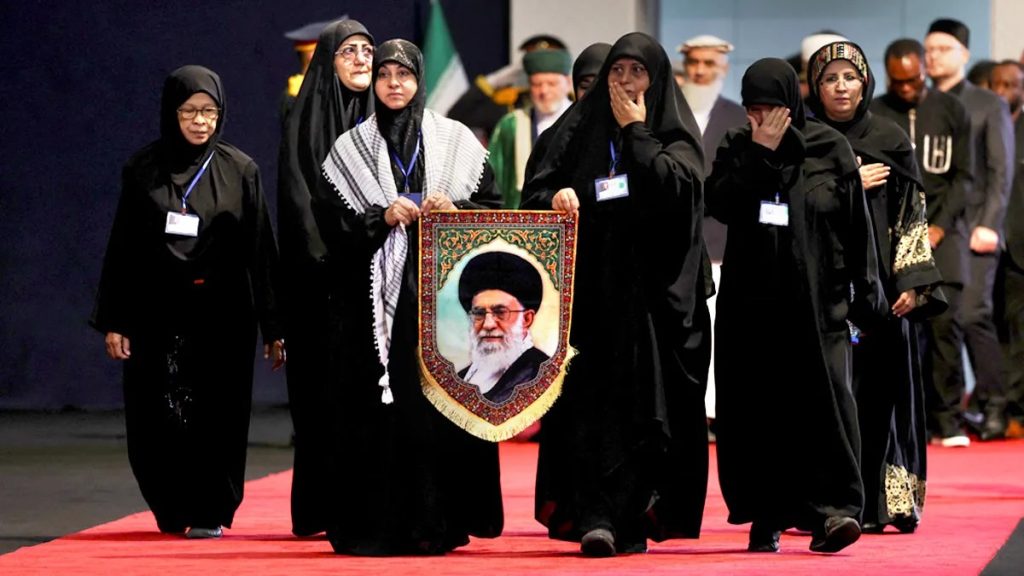
For ordinary Iranians, the mood at the Grand Mosalla was one of raw grief mixed with defiance. Crowds, segregated by gender in keeping with tradition, filled the complex under a summer heatwave, with mist sprayers deployed to cool mourners as temperatures climbed toward 36 degrees Celsius. Men beat their chests rhythmically in a ritual common at Shia funerals, while chants of “death to America” rang out across the complex, according to multiple wire reports from the scene. One mourner, Hananeh Mousavi, 27, told the Associated Press she had come to say goodbye to a leader she never expected to lose in this way. “I am here to say goodbye to my beloved leader Ali Khamenei,” she said.
Not every Iranian mourner shared unqualified devotion. NPR reported that some younger attendees felt conflicted about a leader whose death has plunged the country deeper into uncertainty. One woman in her 30s, who asked to be identified only by her first name, Fatmeh, out of fear of government retaliation, said she frequently argued with her mother over how to view the late leader’s legacy, telling the broadcaster that even in death, the Ayatollah still caused her torment, even as she acknowledged her mother would attend the funeral regardless.
A leadership in limbo
Perhaps the most consequential absence from the week’s proceedings has been that of Khamenei’s own successor. Mojtaba Khamenei, formally named the new Supreme Leader in the weeks following his father’s death, has not appeared in public since the strike that killed his mother and wife and left him seriously wounded. Iranian media have suggested his continued absence is due to security concerns, following what CNN described as an Israeli threat to assassinate him should he surface publicly. His silence has fuelled open questions inside Iran about who is truly directing the country’s response to the war and its aftermath, with General Ahmad Vahidi, the recently appointed commander of the Islamic Revolutionary Guard Corps, seen by analysts as playing an increasingly prominent role in the small circle around the new Supreme Leader.
Vahidi himself made his first public appearance since the war began by sitting beside Khamenei’s coffin ahead of the funeral, having not been seen publicly for months. His re-emergence, coming as he is believed to be closely involved in shaping Iran’s position in ongoing negotiations with Washington, was widely read by observers as a signal of the military establishment’s continued influence over the country’s post-Khamenei direction.
A pause in diplomacy, not in tension
The funeral has arrived at a delicate moment in the broader US-Iran relationship. Negotiators from Washington and Tehran had travelled to Doha only days earlier for indirect talks tied to a memorandum of understanding reached in June, an agreement that has underpinned the fragile ceasefire following the 12-day war between the two countries. Those talks have been paused for the duration of the funeral proceedings.
In Washington, President Donald Trump struck a characteristically blunt tone when referencing the funeral during a speech at Mount Rushmore, telling the crowd that America had “knocked the hell out of Iran,” before turning to the funeral processions themselves. Elsewhere, the United Kingdom and France issued a joint statement reaffirming their commitment to regional stability, warning Iran against any move to disrupt shipping through the Strait of Hormuz, a waterway that has remained a flashpoint since the conflict began, even as commercial traffic through it shows signs of recovering to pre-war levels.
What comes next
The funeral’s final stages will play out over the coming days, with the body due to cross briefly into Iraq before its return to Iran for burial in Mashhad. Iranian authorities have framed the week as a demonstration of national unity and defiance in the face of what they describe as Western aggression; foreign delegations attending have, for the most part, been careful to frame their presence as an act of diplomatic respect rather than political endorsement of Tehran’s confrontation with Washington and Israel.
Whether the funeral marks a genuine turning point — a nation uniting behind a wounded and largely unseen new leader, or the first public airing of deeper uncertainty about who truly holds power in Tehran — remains, for now, an open question. What is not in doubt is the scale of what Iran has staged this week: a funeral procession spanning two countries, five cities, and by Tehran’s own reckoning, the largest crowd to gather for any event in the nation’s history. As the coffin makes its final journey to Mashhad, the eyes of the world — allies and adversaries alike — remain fixed on what Iran does next.
Similar Posts by The Mt Kenya Times:
- Mt Kenya Times ePAPER October 10-11, 2026
- Cabinet clears path for pending bills payout in relief for Kenya’s struggling suppliers
- Karanja quits UDA and targets Nakuru governorship on Gachagua’s DCP ticket
- Gachagua’s team plants DCP flag in Kiambu as 2027 battle lines harden
- A moment of recognition for service in energy
About the Author