One confirmed case and one death should be enough to demand honest answers about whether the country’s preparedness extends beyond Nairobi and beyond announcements

By Deborah Monari
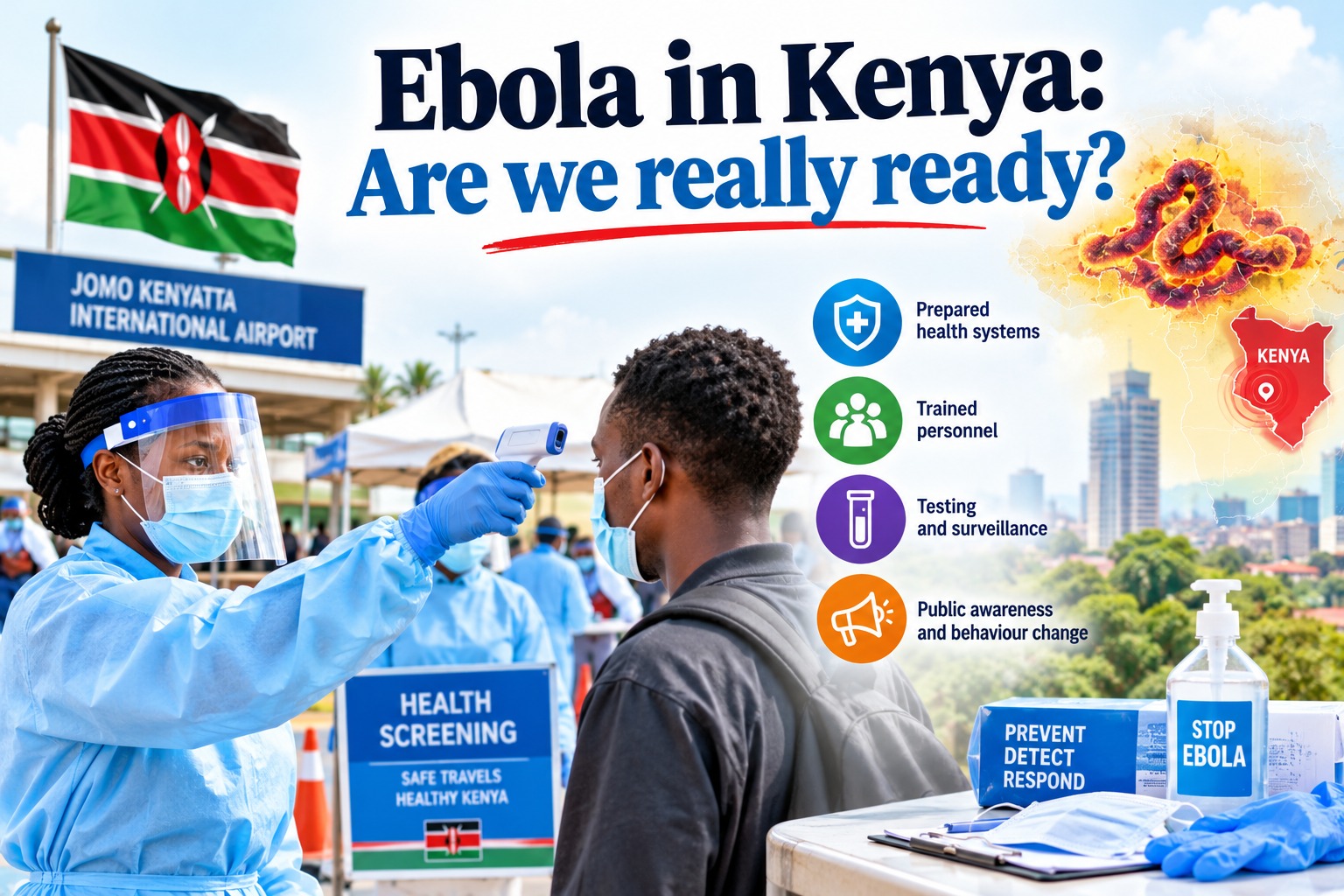
Kenya’s first confirmed imported case and fatality from the Bundibugyo strain of Ebola, recorded yesterday, should serve as a clear and urgent wake-up call. The Ministry of Health moved quickly — strengthening surveillance, initiating contact tracing and launching public sensitisation — but one question cuts through the official response: is Kenya genuinely prepared to contain an outbreak should this go further?
During a recent public webinar, the Ministry reported 241 isolation beds across five designated facilities, three of them in Nairobi. That figure is a starting point, but it immediately raises a concern that deserves direct attention: what about the rest of the country? Kenya’s porous borders create heightened cross-border risks in counties far from the capital, yet the concentration of isolation capacity in major urban centres leaves those areas exposed. Equitable preparedness is not a secondary consideration — it is central to any credible containment strategy.
Sensitising healthcare workers is necessary, but it is not the same as being prepared. The harder questions are more specific. Do healthcare workers across all counties have the training, the protective equipment and the practical experience to identify, isolate and safely transfer a suspected case? Are referral pathways clearly established? Are there adequate transport systems and regular simulation drills? Preparedness must extend beyond webinars and press statements to the actual, tested capacity to respond safely and effectively when a suspected case appears in a remote county at two in the morning.
The public response has added a layer of concern that cannot be ignored. A segment of Kenyans dismissed the initial announcement as fake news, a reaction shaped by political tensions, accumulated misinformation and a broader erosion of trust in public institutions. Kenya’s capacity for humour in difficult moments is a genuine cultural strength. But when serious public health threats become the subject of ridicule or political point-scoring, the consequences can reach well beyond social media timelines.
Public trust is itself a public health asset. When people do not believe the institutions responsible for protecting them, even well-designed interventions can fail. Transparent communication, verifiable information and demonstrated action — not assurances — are what rebuild that trust. Legitimate criticism of government preparedness is not only acceptable but necessary, particularly when it exposes real gaps in readiness. What matters is that criticism and personal public health responsibility are not treated as mutually exclusive. They are not.
Ebola demands vigilance precisely because of its potential for severe disease and the speed with which delayed detection can turn a manageable situation into a crisis. One confirmed case does not automatically mean widespread transmission, but it warrants urgent and proportionate action from every part of the system — not only the Ministry of Health, but county governments, border communities, healthcare workers and the media. Containment is a collective responsibility, and it works only when all parts move together.
Kenya may have taken important first steps. But preparedness is not a declaration. It is the demonstrated capacity to respond effectively when the next suspected case appears — wherever in the country that may be, and however inconvenient the timing.
The question every Kenyan should be sitting with is straightforward: what is more costly — demanding accountability while taking sensible precautions, or allowing distrust, misinformation and complacency to quietly undermine the very measures that could protect us all?
We can question the system and still protect ourselves. In fact, we must do both.
Similar Posts by The Mt Kenya Times:
- Opposition cracks widen as Nyoro and Methu trade Ruto bribery claims
- Why helicopters crash more often than aeroplanes
- Matiang’i tells critics: Leave Uhuru to do his continental work
- Strike pause, brooms out: Laikipia students clean up local market
- Kenya’s dairy crisis: Why the milk is running dry
About the Author