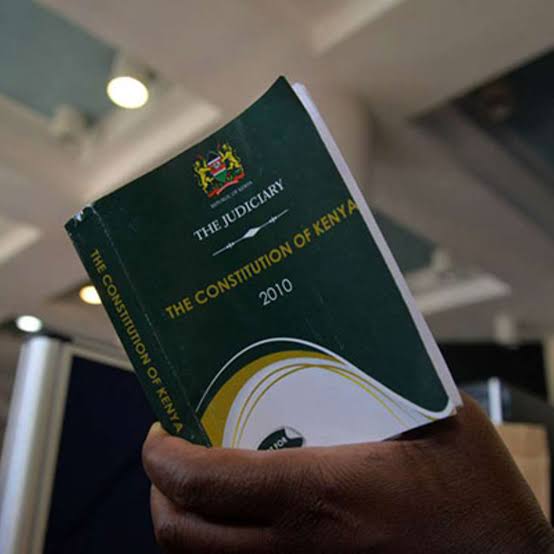
A Critical Analysis Of The Supreme Court Of Kenya’s Ruling On Locus Standi In SC Application No. E001 Of 2025: Retreat From Article 22 Of The Constitution Promise?
 The Mt Kenya Times
By Jerameel Kevins Owuor Odhiambo
On March 14, 2025, the Supreme Court of Kenya delivered a ruling in *Miiri Julius v The Chief Registrar of the Judiciary & 14 Others* (SC Application No. E001 of 2025), striking out a Notice of Motion filed by advocate Miiri Julius. The applicant sought to review the Court’s prior recusal orders of January 23, 2024, and January 22, 2025, which barred advocates from Ahmednasir Abdullahi Advocates LLP from appearing before it due to alleged denigration by the firm’s senior partner, Ahmednassir Abdullahi SC. The Court, presided over by Chief Justice Koome and six other justices, found the application procedurally flawed under Rule 31 of the Supreme Court Rules and Section 21A of the Supreme Court Act. Additionally, it held that Miiri lacked locus standi to challenge the recusal decisions as he was not a party to the original proceedings. The respondents, including Ahmednassir and his associates, did not file substantive responses, citing the Court’s “ban” as incapacitating them. The decision upheld the recusal orders, reasoning that only aggrieved parties from the original cases could seek review. No costs were awarded, reflecting the Court’s discretion under prior precedent.
The Court’s reasoning displays an alarming reversion to a formalistic approach that prioritizes procedural rectitude over substantive justice, contravening the constitutional imperative enshrined in Article 159(2) (d) that “justice shall be administered without undue regard to procedural technicalities.” The Court’s insistence that the application should have been anchored in the original proceedings where recusal decisions were made exemplifies a rigid procedural framework that potentially obstructs access to justice. Professor Yash Pal Ghai, in his seminal work “Kenya’s Constitution: An Instrument for Change” (2018), argues that such procedural barriers “constitute a significant impediment to the realization of constitutional rights when applied mechanistically without regard to context or consequence.”
Article 22 of the Constitution of Kenya represents a revolutionary departure from the traditional common law approach to standing by explicitly providing that “every person has the right to institute court proceedings claiming that a right or fundamental freedom in the Bill of Rights has been denied, violated or infringed, or is threatened.” The provision further stipulates that proceedings may be instituted by “a person acting in the public interest,” fundamentally reconceptualizing standing in constitutional litigation. According to Dr. Willy Mutunga, former Chief Justice, in his treatise “The 2010 Constitution of Kenya: A Transformative Agenda” (2015), this provision was deliberately crafted to dismantle exclusionary standing doctrines that had historically limited access to constitutional justice.
The Court’s reliance on Law Society of Kenya v. Communications Authority of Kenya & 10 Others [2023] to establish a restrictive interpretation of locus standi represents a problematic jurisprudential trajectory that seems incongruous with the expansive vision of Article 22. Distinguished scholar Prof. Migai Akech in “Administrative Law in Kenya” (2021) contends that “courts frustrate constitutional objectives when they import common law restrictions on standing into a constitutional framework explicitly designed to transcend such limitations.” The Court’s insistence on a “designed, subsisting, direct and substantive interest” as a prerequisite for standing potentially undermines the constitutional provision for proceedings instituted in the public interest.
The South African constitutional jurisprudence offers a stark contrast to the approach adopted by the Kenyan Supreme Court in this case. Section 38 of the South African Constitution, which shares remarkable similarities with Article 22 of the Kenyan Constitution, has been interpreted with remarkable liberality by South African courts. In Ferreira v. Levin NO and Others 1996 (1) SA 984 (CC), the Constitutional Court of South Africa held that “it is incumbent upon the courts to adopt a broad approach to standing,” further emphasizing that “constitutional litigation is of particular importance in our country where we have a large number of people who have had scant educational opportunities and who may not be aware of their rights.” This jurisprudential orientation privileges substantive justice over procedural formalities.
The Supreme Court’s decision evokes uncomfortable parallels with the infamous Wangari Maathai case of the 1990s, where the environmental activist was denied standing to challenge the construction of a sixty-story building in Uhuru Park because she was deemed to lack sufficient interest in the matter. Justice Dugdale’s assertion that Maathai had “no more right than any other Kenyan” to challenge the development crystallized a restrictive standing doctrine that systematically excluded citizens from meaningful participation in governance. Professor J.B. Ojwang in “Constitutional Development in Kenya: Institutional Adaptation and Social Change” (2013) observes that this case “epitomized judicial abdication at a critical juncture when environmental protection required judicial courage.”
The Court’s interpretation that Article 159(2)(d) cannot be invoked to “correct a deviation from clear and well laid out procedure” represents a troubling hierarchy that potentially subordinates substantive justice to procedural compliance. Professor Karuti Kanyinga in “Democracy and Political Participation” (2014) argues that such interpretations “risk calcifying procedural requirements into insurmountable barriers that ultimately defeat constitutional objectives of accessibility, participation, and responsive governance.” The Court’s distinction between constitutional imperatives and procedural requirements creates an artificial dichotomy that fails to appreciate their interdependent relationship in advancing constitutional objectives.
The Court’s interpretation of locus standi in public interest litigation demonstrates a concerning disconnect from comparative jurisprudence in other constitutional democracies. The Indian Supreme Court, for instance, has significantly liberalized standing requirements in public interest litigation. In S.P. Gupta v. Union of India (1982), Justice Bhagwati articulated that “where a legal wrong or a legal injury is caused to a determinate class of persons… and such persons have… difficulty in approaching the Court for relief, any member of the public can maintain an application for an appropriate direction.” This jurisprudential innovation has facilitated meaningful public participation in governance and accountability mechanisms.
The restrictive approach to standing adopted by the Supreme Court potentially undermines public trust in judicial institutions by creating a perception of institutional insularity. According to the Kenya National Commission on Human Rights report “Access to Justice in Kenya” (2022), “procedural barriers to judicial review create a perception among citizens that courts are inaccessible institutions that protect power rather than rights.” This perception can substantially erode public confidence in the judiciary as an effective guarantor of constitutional rights and freedoms. The Court’s dismissal of a matter concerning judicial recusal on technical grounds may inadvertently reinforce perceptions of institutional self-protection rather than principled adjudication.
The Court’s reliance on Aramat & another v. Lempaka & 3 others [2014] to distinguish between constitutional imperatives and procedural requirements raises questions about jurisprudential consistency. While time limitations in election petitions serve the constitutional objective of electoral finality, procedural requirements regarding the format of applications serve primarily administrative convenience. Professor Makau Mutua in “Kenya’s Quest for Democracy: Taming Leviathan” (2008) argues that “courts must distinguish between procedures that advance constitutional values and those that inadvertently obstruct them.” The Court’s failure to make this crucial distinction potentially elevates form over substance in constitutional adjudication.
The Court’s decision signals a troubling doctrinal regression toward pre-2010 constitutional jurisprudence that privileged procedural technicalities over substantive justice. Professor Ambreena Manji in “The Struggle for Land and Justice in Kenya” (2020) observes that “restrictive standing doctrines have historically functioned as mechanisms of exclusion, particularly for marginalized communities seeking judicial intervention against powerful interests.” The potential consequence of this approach is not merely the dismissal of individual cases but the systematic exclusion of significant constitutional questions from judicial scrutiny because potential litigants lack the technical capacity to navigate procedural complexities.
The Supreme Court’s adjudication in Miiri Julius v The Chief Registrar of the Judiciary & 14 Others (SC Application No. E001 of 2025), stands as a lamentable forfeiture of an opportunity to buttress Kenya’s constitutional edifice, particularly its resolute commitment to unfettered access to justice as enshrined in the 2010 Constitution. By adopting a rigidly formalistic lens clinging to the strictures of Rule 31 of the Supreme Court Rules and Section 21A of the Supreme Court Act, the Court eschewed the expansive ethos of Article 22, which vests every person with the right to institute proceedings in defense of the Bill of Rights, whether in personal or public interest. This mechanistic approach, which dismissed the applicant’s standing for want of direct involvement in the antecedent recusal proceedings, starkly contravenes the transformative vision articulated in the Constitution’s preamble and fortified by Article 159(2) (d), mandating that justice be administered without undue fealty to procedural niceties. Far from advancing the democratic ideal of participatory justice, the Court’s ruling entrenches a jurisprudential conservatism that harks back to the pre-2010 era, where access to the courts was a privilege jealously guarded rather than a right universally bestowed. The decision thus represents a judicial retreat from the constitutional imperative to democratize legal recourse, imperiling the very promise of a judiciary responsive to the citizenry’s legitimate grievances. In doing so, it risks calcifying procedural impediments into insuperable barriers, thereby frustrating the Constitution’s ambition to serve as a living instrument of social justice. As Lord Denning famously intoned in Gouriet v Union of Post Office Workers [1978] AC 435, “The law must not stand still while injustice flourishes”; yet, in Miiri Julius, the Kenyan Supreme Court appears to have done precisely that.
This judicial posture stands in stark contradistinction to the enlightened approach of South Africa’s Constitutional Court, which, under the aegis of Section 38 of its Constitution, has cultivated a jurisprudence suffused with magnanimity and attuned to the exigencies of substantive justice. In Port Elizabeth Municipality v Various Occupiers (2004) 1 SA 217 (CC), Justice Albie Sachs eloquently expounded that “the spirit of the Constitution requires courts to infuse elements of grace and compassion into the formal structures of law,” a dictum that resonates with the South African judiciary’s steadfast refusal to allow procedural formalism to eclipse the vindication of rights. Unlike the Kenyan Supreme Court’s parsimonious interpretation in Miiri Julius, the South African approach exemplified in cases such as Ferreira v Levin NO (1996) 1 SA 984 (CC) embraces a capacious conception of standing, ensuring that public interest litigants are not summarily excluded from the judicial arena by arcane technicalities. The Miiri ruling, by contrast, elevates the minutiae of filing protocols over the profound question of whether the recusal order disproportionately curtails advocates’ and clients’ access to the Apex Court, thereby undermining the constitutional compact to facilitate meaningful participation in governance. Had the Kenyan judiciary embraced Sachs’ admonition, it might have seized the opportunity to interrogate the recusal’s collateral consequences, aligning its jurisprudence with the transformative aspirations of the 2010 Constitution rather than perpetuating a legacy of exclusion redolent of the Wangari Maathai v Kenya Times Media Trust Ltd debacle of the 1990s. Such a course would have reaffirmed the judiciary’s role as a guardian of rights rather than a gatekeeper of privilege, fostering a legal culture where procedural mechanisms serve as conduits to justice rather than as bulwarks against it. The failure to do so not only diminishes the Constitution’s emancipatory potential but also casts a pall over the judiciary’s legitimacy in the eyes of a public yearning for a more inclusive judicial dispensation.
The Kenyan judiciary would be well-advised to recalibrate its interpretative compass, drawing inspiration from such progressive precedents to ensure that the strictures of standing and procedure do not ossify into impediments to the realization of substantive justice. The Miiri Julius decision’s insistence on a narrow locus standi buttressed by an overly literal reading of subsidiary legislation flies in the face of Article 22’s purposive intent, which, as elucidated by Mutunga CJ in Trusted Society of Human Rights Alliance v Attorney General [2012] eKLR, seeks to “open the doors of the courts to all who seek to enforce rights, irrespective of personal stake.” This constitutional mandate, reinforced by scholarly exegesis such as Gathii’s The Contested Empowerment of Kenya’s Judiciary (2017), demands a judiciary that prioritizes the spirit over the letter of the law, lest it risk entrenching injustice under the guise of procedural fidelity. The Supreme Court’s refusal to entertain Miiri’s application, which raised cogent public interest concerns about the recusal order’s ripple effects, signals a troubling reticence to engage with the broader implications of its own edicts a reticence that threatens to erode public trust in an institution constitutionally tasked with upholding the rule of law. By contrast, the South African judiciary’s willingness to imbue legal formalism with compassion offers a salutary lesson: courts must remain agile instruments of justice, not rigid enforcers of technical dogma. For Kenya to fulfill the transformative vision of its 2010 Constitution, its judiciary must eschew the Miiri ruling’s myopic formalism and embrace a jurisprudence that breathes life into the constitutional promise of access and participation. Only then can it hope to transcend the shadows of its pre-constitutional past and emerge as a true bulwark of democratic governance and equitable justice.
The writer is a legal scrivener.
Similar Posts by The Mt Kenya Times:
- Diaspora Times Global Sep 19 – Sep 25, 2026
- Tibet’s glacial catastrophe: Behind Beijing’s wall of silence, a climate disaster reshapes a region
- Museveni says Uganda overpaid for fuel through Kenyan middlemen as new terminal breaks ground
- Court orders throw KPL season kickoff into doubt
- Can Kenyans abroad become the untapped force that transforms Kenya?
About the Author