Breaking the silence: How Kenya’s schools can heal the hidden wounds of mental stress
 The Mt Kenya Times
From Nyeri to Nairobi, teachers and pupils carry emotional burdens that remain largely unspoken — and the cost of continued silence is rising
By Wanjohi P Mugambi
Every morning, children walk into classrooms carrying more than books. Look closely and you will see it. Some carry hunger like a stone in their pockets. Some carry fear from home like a cold wind that never leaves their backs. Some carry the pressure to perform like a tight uniform that no longer fits. Many carry a quiet storm of thoughts they have no words to explain. In the staffroom, teachers arrive with their own weight — low pay, overcrowded classrooms, family expectations and the exhausting responsibility of being strong for everyone else.
For years, we have treated mental stress as a private weakness rather than a shared human experience. In many Kenyan communities, the instruction has been consistent: endure, be strong, pray harder and keep going. Resilience is powerful — as deep-rooted as a mugumo tree — but silence is dangerous, like a wound covered without cleaning. When stress is not acknowledged, it does not disappear. It transforms into exhaustion, anger, poor concentration, physical pain and broken relationships. Healing must begin where silence ends.
Mental stress is simply the body and mind’s response to pressure. In small doses it is not harmful — it can motivate a student to prepare for examinations or push a farmer to finish planting before the rains. Think of it as a small fire that warms the house. The problem begins when that fire grows too large, burns too frequently and is given no time to cool. The mind shifts into a state of permanent alert, like a guard dog that never sleeps. Sleep becomes difficult. The heart races. Thoughts turn repetitive and negative, like a song stuck on a single chorus. A student who was once active becomes withdrawn. A teacher who was once patient becomes easily irritated.
In schools — and I have taught in both Nyeri and Nairobi — the sources of stress are many and deeply tangled. Academic pressure, fear of failure, bullying, peer rejection, poverty, school fees arrears, grief, exposure to domestic violence and the relentless comparison culture of social media all take their toll. For parents and teachers, the sources are equally complex: economic hardship, caregiving responsibilities, unresolved personal trauma and the lonely experience of having no one to confide in.
Research in Kenyan primary schools shows that many children display clear signs of anxiety and stress, yet these signs are routinely misread as laziness, rudeness or a lack of discipline. A child who cannot concentrate may not need more punishment. That child may simply need someone to listen. Behaviour is often a language used when words have failed.
The cost of leaving stress unaddressed is significant and spreads like weeds across a shamba. In learning, stress reduces memory and concentration — a stressed brain struggles to retain information like a leaking jerrycan. This leads to poor academic performance, which in turn creates further stress, perpetuating a painful cycle. Physically, chronic stress weakens immunity and causes headaches, stomach problems and constant fatigue. Many unexplained hospital visits have their roots in prolonged emotional pressure. In relationships, stress makes people reactive — quick to shout at those they love, quick to withdraw from friendships. Families break apart not always because love is absent, but because the emotional tools to manage pressure are missing. Across communities, unhealed stress fuels substance abuse, school dropout and intergenerational trauma. Children learn to manage emotions by watching adults. If adults cope through silence, violence or alcohol, children absorb those same patterns. The World Health Organization has noted that mental health challenges among young people in Africa are rising sharply, yet stigma continues to prevent many from seeking help.
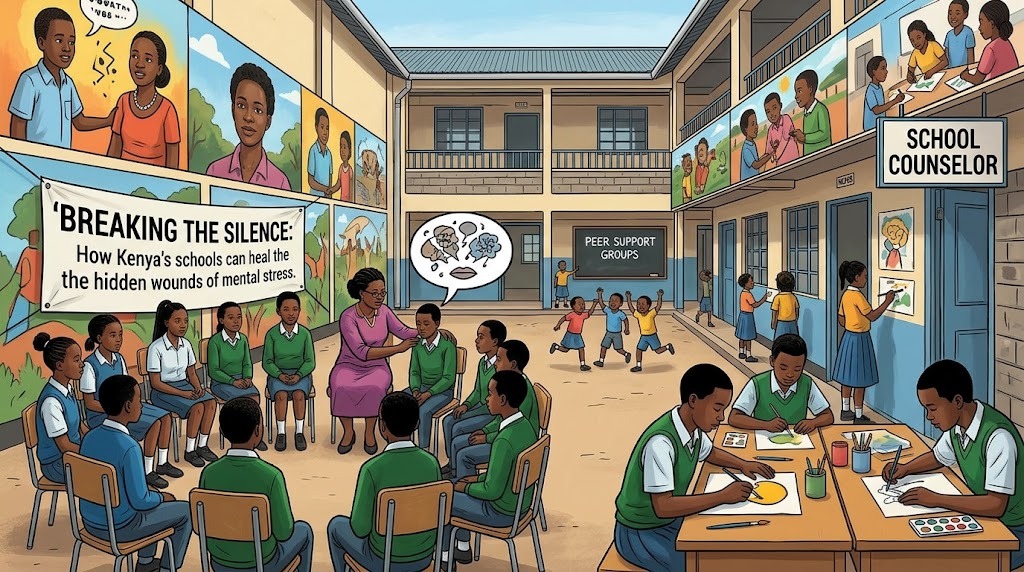
Healing from mental stress is not about finding one dramatic solution. It is about small, consistent practices that restore balance — much like daily sweeping keeps a house clean. The first and most important step is breaking the silence. Not every person in distress needs a professional counsellor immediately, but every person needs someone safe to talk to. In schools, this can be a trained guidance and counselling teacher, a trusted peer support club or a regular class circle where students are permitted to say they are not coping without fear of judgment. Creating just five minutes of genuine listening time in a busy school day can prevent a crisis — the way a small stitch prevents a tear from spreading further.
Rebuilding daily routines also matters. Stress thrives in chaos, while healing grows in structure. Consistent sleep patterns improve emotional regulation. Teaching children four slow, deliberate breaths when anxious can calm the nervous system in under a minute. Physical movement — play, walking, farming, football, dance — releases tension that words cannot reach. Journaling and storytelling help to externalise pain. In Kiswahili, there is a phrase worth remembering: kuandika ni kutibu — to write is to heal. Literature and drama in schools are not luxuries. They are healing tools.
No one heals in isolation. Schools need to build genuine partnerships with parents, religious leaders and community health workers. A referral pathway that allows a teacher to confidentially connect a struggling pupil to a local counsellor or health facility saves lives. For teachers themselves, peer support groups — spaces to discuss personal wellbeing rather than lesson schemes — are essential. You cannot pour from an empty cup.
If we teach mathematics and agriculture, we must also teach emotional literacy. Lessons in empathy, conflict resolution, self-awareness and coping skills belong on the timetable, not as an afterthought. When a child learns to say “I feel disappointed” rather than simply “I am angry,” that child gains a measure of control over their own responses. The theme of this year’s World Mental Health Day — Break the Silence, End the Stigma — calls on schools to treat mental health as routinely and seriously as physical health. A wound in the mind deserves the same care as a wound on the leg.
Seeking professional help is not weakness. Just as we go to hospital for malaria, we should seek counselling for persistent stress and trauma. Community counselling centres, church counselling departments and county health facilities increasingly offer affordable support. Normalising their use reduces stigma the way light reduces darkness.
A healed classroom produces better learners. A healed teacher nurtures a healed generation. A healed community breaks the cycle of pain passed from parent to child. The work begins with each of us — listening more, judging less and building spaces where it is safe to say: I need help. Strength is not about never breaking down. It is about knowing how to rebuild together. Let us heal our schools, our communities and our continent — one mind, one conversation, one classroom at a time.
Similar Posts by The Mt Kenya Times:
- Mt Kenya Times ePAPER October 28, 2026
- Ruto breaks ground on KSh70B cement plant that will create 3,000 jobs in Kitui
- Ruto orders Magadi soda ash monopoly broken as new investors set to enter
- Ruto heads to Moscow seeking trade deals and investment as Kenya eyes Russia partnership
- Waititu begs for mercy as Sh588M corruption sentencing looms
About the Author