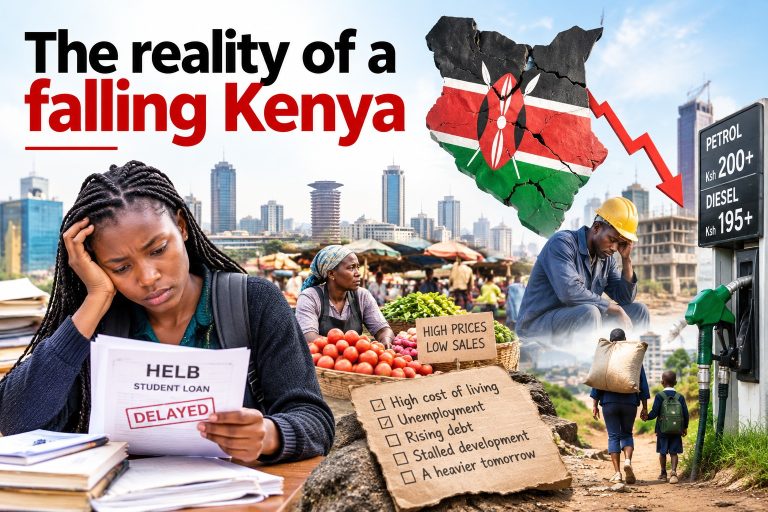
Does Gen-Z Rage Largely Emanates From Believe That President Ruto Is Pushing The Agenda Of IMF?
 The Mt Kenya Times
By: Joseph Mutua Ndonga
Worth Noting:
- He is now championing the selfish agenda of our colonial masters and imperialists. The matter took a worst turn when International Monetary Fund (IMF) released a statement which stated. Our prediction that Kenyans will rise up has come to pass.
- We are however asking the Kenyan government to remain firm and ensure the Finance Bill 2024 sails through in its original form.
- Notably, Dr Ruto is not the first President of Kenya struggling to balance between meeting the expectations of Kenyans and tough conditionalities imposed by IMF.
- His predecessors Daniel Arap Moi, Mwai Kibaki and Uhuru Kenyatta also found themselves sailing in the same boat.
I have been following with keen interest the ongoing Generation-Z led protests. The protests started when the Finance Bill 2024 was tabled in parliament.
This explains why the youths coined #RejectFinanceBill2024 which have since become the main chant during the demonstrations.
President William Ruto ceded the ground soon after members of parliament passed the controversial Bill.
He said he will not sign it because the young people have spoken. They have told me they do not want me to assent to this Bill to become the law.
Prior to the tabling of financial report, the talk doing round indicated that this Budget had been crafted by US and International Monetary Fund (IMF).
Those making these claims would aver that since he become the President Dr William Ruto has signed a raft of agreements with Bretton Wood Institutions- IMF and World Bank-which were being controlled by US.
As such, this budget does not reflect our wishes and aspirations as Kenyans.
This budget is punitive and forced down our throat.
We elected President Ruto to champion our course but he has abandoned us.
He is now championing the selfish agenda of our colonial masters and imperialists. The matter took a worst turn when International Monetary Fund (IMF) released a statement which stated. Our prediction that Kenyans will rise up has come to pass.
We are however asking the Kenyan government to remain firm and ensure the Finance Bill 2024 sails through in its original form.
Notably, Dr Ruto is not the first President of Kenya struggling to balance between meeting the expectations of Kenyans and tough conditionalities imposed by IMF.
His predecessors Daniel Arap Moi, Mwai Kibaki and Uhuru Kenyatta also found themselves sailing in the same boat.
As per law, the mandate to prepare the national budget squarely rested with parliament.
The house did its job and it gave public participation a priority.
According to the chairpersons of Budget and Appropriation and Finance and National Planning, public committes, the views gathered were factored in the final report that was tabled in parliament.
Some taxes had been removed, some were zero-rated and exempted.
Therefore, it was wrong to drag the name of the President Ruto.
There was no evidence that he had lured and arm-twisted MPs to vote in a certain way.
We heard similar claims being made during the reigns of the previous governments.
The law allows the President to give his opinion during budget making process.
In this regard, President Ruto’s position was very clear. He fully supported the views gathered from members of public.
Generation-Z, were these Kenyans falling under the age of 18-34 justified to take to the streets?
Yes, but the protests are supposed to be peaceful as envisaged in Article 37 of the constitution of 2010.
At some point, these protests turned chaotic, bloody and destructive. It was sad and painful to see young people losing their lives. May the Almighty God rest their souls in eternal peace.
It is worth noting the protests continued even after President heeded the call of Generation-Z and declined to sign the Bill into law.
As required by the law, he has since returned the Bill to parliament with a memorandum explaining his decision.
During the campaigns, Dr Ruto used to emphasize that borrowing is not a bad idea. Even developed countries resort to borrowing to rebuild their economies.
It becomes a problem when you resort to reckless borrowing and eventually take loan money that exceeds or at par with Gross Domestic Product (GDP)
As we know, the rules governing IMF and World Bank requires the two institutions to engage the sitting President.
It is worth noting that the IMF and World Bank have been partnering with many countries across the world.
In Kenya, the two institutions have been working with leaderships of the successive governments of Independent Kenya.
IMF made the most memorable interventions during the era of President Daniel Arap Moi.
Upon realizing our economy was doing badly, they started to engage Moi and his administration.
This led to Bretton Wood unveiling Structural Adjustment Programmes (SAPs).
The public opinion was divided. Some supported the conditionalities and others argued they had been imposed terming them as a bitter pill.
President Moi had formed a team, dubbed the Dream Team, to coordinate and oversee the implementation of the SAPS. The team was led by Richard Leakey.
So, the lesson we learn here is that the pain of the IMF and World Bank prescriptions is for a while. The situation improves and get better thereafter.
Each administration in Kenya would also prioritize on the issue of enhancing and expanding tax collection base. This is by drafting and enacting tax regime to fast track the process. President Kibaki is the one who had coined a slogan ‘Kulipa Ushuru Ni Kujitegemea’.
A day had been set aside to cerebrate and reward Kenyans who paid their full taxes on time, thus complying with tax laws and regulations. Just like Ruto, Kibaki and Uhuru would mince no word in calling on tax man to pursue tax defaulters. Every Kenyan must pay their taxes.
Joseph Mutua Ndonga is a writer and political analyst based in Nairobi
Similar Posts by The Mt Kenya Times:
- Mt Kenya Times ePAPER October 24-25, 2026
- Muturi calls on IEBC to keep election technology tender clean and on schedule
- Ruto meets UAE minister in push to deepen trade ties
- Gideon Moi breaks silence on Ruto fallout, cites broken promises
- The doctor who refused to abandon a sick Uganda
About the Author