Eating the elephant: Governance, corruption, and the Kenyan state’s long war against itself
 The Mt Kenya Times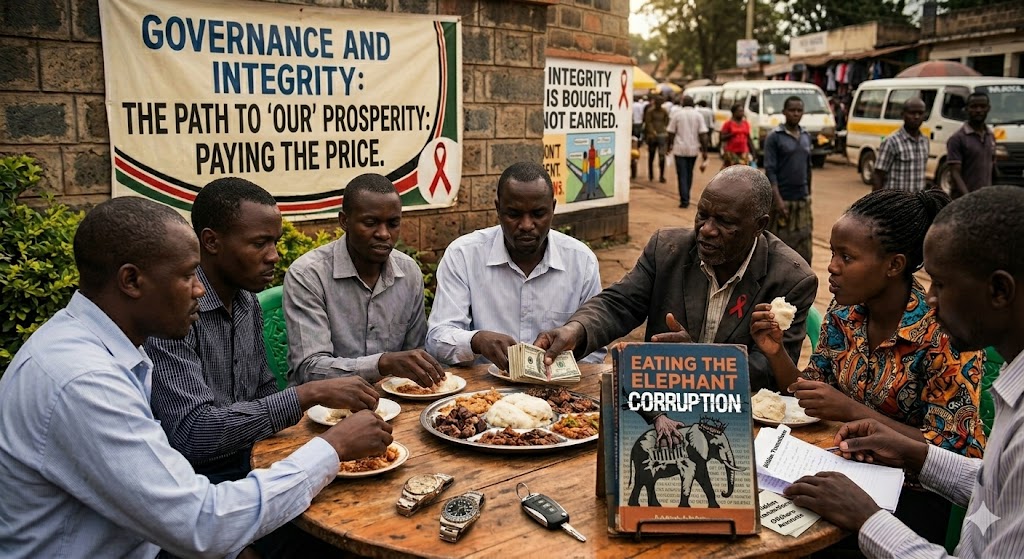
By Jerameel Kevins Owuor Odhiambo
There is a scene in Chinua Achebe’s A Man of the People that ought to hang, framed and laminated, above the entrance of every Kenyan ministry, county assembly, and constitutional commission. Chief Nanga, politician, rogue, and beloved son of the soil declares with magnificent, unembarrassed candour: “A man who has just come in from the rain and dried his body and put on dry clothes is more reluctant to go out again than another who has been indoors all the time. Our ancestors were right when they said that a man should not, out of pride, cause his in-law to carry a heavier load than necessary.” Nanga, of course, had just looted the treasury. He said so cheerfully, as a man confessing to a minor dietary preference. The village applauded. Kenya, four decades after Achebe wrote those words as satire, seems to have mistaken them for a governance manual.
Let us be precise, because precision is the first casualty when the powerful discuss their own conduct. Effective public governance the kind contemplated by Article 10 of the Constitution of Kenya 2010, which consecrates transparency, accountability, integrity, and sustainable development as binding national values is not a luxury dispensed at the discretion of those who hold office. It is a constitutional obligation, a jurisprudential imperative, and a moral contract with citizens who, in the language of Article 1, retain sovereign power and merely delegate its exercise. The Constitution does not whisper these values. It thunders them. And yet the distance between constitutional aspiration and Kenyan administrative reality has become so vast that one could lose an entire government manifesto in the chasm and nobody would notice.
The theoretical scaffolding is elegant and established. Scholars of transformative constitutionalism, from Karl Klare’s foundational intervention in the South African post-apartheid literature to the Kenyan school of thought represented by jurists like Willy Mutunga, argue consistently that constitutions of this generation are not merely descriptive instruments they are transformative projects. They envision a rupture with the past and the construction of a new social contract. Article 73 of Kenya’s Constitution, which demands that public officers act in public interest and demonstrate integrity, is not decorative text inserted to beautify a document. It is the juridical expression of a civilization’s aspiration to govern itself with honour. To violate it is not merely a breach of professional ethics; it is a constitutional tort against the people.
Even so, governance in Kenya has developed an almost artistic genius for violating the spirit of these imperatives while observing, with lawyerly pedantry, their letter. The Ethics and Anti-Corruption Commission exists on paper, in buildings, with staff and budgets. So does the Controller of Budget. So does the Office of the Auditor-General, whose annual reports read like literary tragedies: billions unaccounted for, procurement irregularities of Shakespearean proportion, financial management so creative it ought to be eligible for the Booker Prize. The institutions are present. The accountability is absent. This is governance as theatre and Kenyans have been seated in the stalls for so long that many have confused the performance for the thing itself.
Accountability, properly understood, operates on two inseparable axes. The first is procedural: open and transparent management of public resources, with clear chains of authority and consequence. The second is substantive: an actual change in outcomes for citizens, schools that teach, hospitals that heal, roads that do not swallow vehicles whole. Kenya has invested heavily in the procedural vocabulary of accountability frameworks, taskforces, anti-corruption units that multiply like bureaucratic rabbits while the substantive outcomes remain stubbornly, insultingly unchanged. As the Committee of Experts that drafted Kenya’s 2010 Constitution observed in its final report, the crisis of governance in Kenya was never primarily a problem of legal architecture. It was a problem of political will. One cannot engineer integrity through institutional design alone when the designers are themselves among the beneficiaries of its absence.
This is where Achebe becomes not merely metaphorical but prophetic. Chief Nanga is not an aberration in A Man of the People; he is the system operating exactly as designed. He steals, but he also builds. He loots, but he is generous at funerals. He is corrupt, but he is useful and usefulness, in the transactional calculus of patronage democracy, purchases silence far more effectively than any anti-corruption statute. The Kenyan variant of Chief Nanga has perfected this formula. The harambee is held. The bursary cheque is distributed. The crowd roars. And meanwhile, the public officer who signed away a public land title for a private developer receives his handshake in an envelope so discreet it is practically invisible to the naked eye of the law.
One must not be naive about the structural dimensions. Corruption is not, as the moralists would have it, merely a failure of individual character. It is the predictable product of systems that concentrate power without accountability, that reward proximity to the state over productive activity, and that have never resolved the foundational question of whose Kenya this actually is. The devolution architecture established under Chapter Eleven of the Constitution was a deliberate attempt to fracture that concentration, to push resources and decision-making towards communities who would exercise direct oversight. That the county governments have, in several instances, simply replicated at smaller scale the corruption architectures of the national government is not evidence that devolution has failed. It is evidence that corruption is not a problem of level it is a problem of culture, incentive, and impunity.
Integrity and transparency, the twin tenets of any governance system worthy of the name, cannot be wish-listed into existence. They require three conditions that Kenya has consistently struggled to sustain simultaneously: first, institutions with genuine independence, not merely nominal independence disrupted by executive displeasure the moment they become inconvenient; second, citizens with the information, literacy, and political consciousness to exercise meaningful oversight; and third, a legal framework that punishes corruption not merely in principle but in practice, with sentences that descend upon the powerful with the same velocity they descend upon the petty thief. When a Kenyan is jailed five years for stealing a chicken and a cabinet secretary walks free after misappropriating a hospital’s entire drug budget, the state has communicated its hierarchy of values with devastating clarity.
The path forward is neither mysterious nor unknown. It has been charted, repeatedly, in reports that gather dust with a dedication that suggests they were designed for precisely that purpose. It requires, at minimum, the genuine insulation of oversight institutions from political interference; the full implementation of the Public Finance Management Act, 2012, with sanctions that bite; the operationalisation of whistleblower protections robust enough to actually protect; and a citizenry that demands, rather than merely requests, that its sovereignty be respected.
There is, in the end, a question that every governance framework must answer not in its preamble but in its practice: who pays the price when the state fails? In Kenya, the answer has been consistent across governments, across decades, across constitutional moments. The poor pay. They pay in the clinics with no medicine. They pay in the schools with no books. They pay in the bridges that collapse and the water that does not flow. The architects of the failure, meanwhile, write their memoirs, attend their grandchildren’s graduations at foreign universities, and occasionally return to offer, with the breezy authority of experience, advice on governance reform.
Achebe concluded A Man of the People with a military coup the logical terminus of a democracy that had eaten itself from within. Kenya has, thus far, resisted that terminus. But constitutions, however beautifully drafted, do not enforce themselves. The Republic will be governed with integrity or it will be governed by those who have made peace with its absence. There is no third option. And the clock, as it always has, runs only in one direction.
The scholar is a social commentator
Similar Posts by The Mt Kenya Times:
- Mt Kenya Times ePAPER October 1, 2026
- Museveni backs Lamu but keeps Uganda’s money at home
- Sifuna’s party wins its name — and Kenya’s opposition race begins in earnest
- Lamu’s $16B gamble: Africa’s biggest refinery divides the region
- Ruto launches KSh2.2 trillion Lamu refinery in East Africa’s biggest energy bet
About the Author