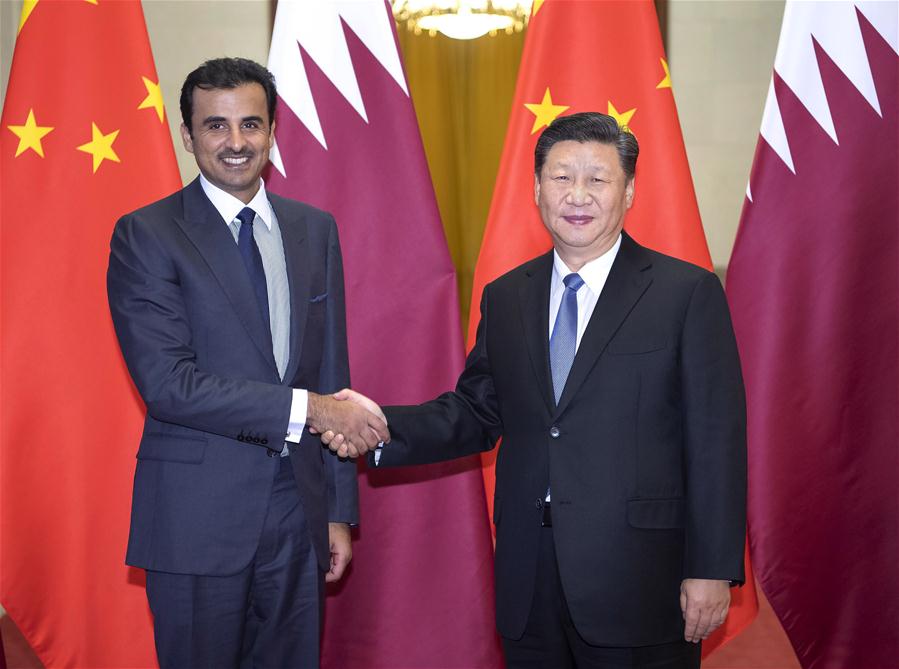
Chinese President Xi Jinping holds talks with Sheikh Tamim Bin Hamad al-Thani, emir of Qatar, at the Great Hall of the People in Beijing, capital of China, Jan. 31, 2019. Prior to the talks, Xi held a welcome ceremony for Tamim at the Great Hall of the People.

By Agencies
Worth Noting:
- Zhu Rui urged Qatari people to visit China in large numbers to explore possible avenues for economic interest. Later, the Chinese delegation visited Iraq and met Iraq’s Foreign Relations Committee representatives.
- The visit focused on activating the Iraqi-Chinese Parliament Friendship Committee. In the last leg, Zhu Rui led delegation visited Kuwait and held bilateral discussions with Foreign Minister and Deputy Foreign Minister.
- Expressing concern about slow pace of progress on Chinese projects under Kuwait’s ‘Vision 2035’, he expressed China’s readiness to cooperate with Kuwait in the development process. Separately, Zhu also met 50 Kuwaiti businessmen and a large number of representatives from various companies having business interests with China.
The resource rich West Asia and North Africa (WANA) region continues to grab Beijing’s attention.
Emboldened by its superior technical knowhow, China is making fast inroads in several countries of the region, especially in areas like infrastructure, weapons procurement, oil exploration, space research and sustainable development.
A flurry of visits by regional leaders towards mending ties with their arch rivals in the aftermath of China mediated Saudi–Iran deal marked important events in the region. A six-member Chinese delegation headed by Zhu Rui, Assistant Minister, International Department of the Central Committee of the Communist Party (CCCP) of China, visited three WANA countries (Qatar, Iraq and Kuwait) during February 2023 with the aim of strengthening bilateral relations.
In the first leg, the delegation visited Qatar and held bilateral discussions with Secretary-General of Ministry of Foreign Affairs underlining the importance of maintaining bilateral consultations and regular exchange of views between the two countries.
Zhu Rui urged Qatari people to visit China in large numbers to explore possible avenues for economic interest. Later, the Chinese delegation visited Iraq and met Iraq’s Foreign Relations Committee representatives.
The visit focused on activating the Iraqi-Chinese Parliament Friendship Committee. In the last leg, Zhu Rui led delegation visited Kuwait and held bilateral discussions with Foreign Minister and Deputy Foreign Minister.
Expressing concern about slow pace of progress on Chinese projects under Kuwait’s ‘Vision 2035’, he expressed China’s readiness to cooperate with Kuwait in the development process. Separately, Zhu also met 50 Kuwaiti businessmen and a large number of representatives from various companies having business interests with China.
Interestingly, Kuwaiti businessmen were unimpressed as they opined that Zhu’s speech at the event was more about “muscle flexing” rather than announcing any attractive offer to enhance business.
With Saudi Arabia, China is looking to augment its overall cooperation. China Harbor Engineering Company (CHEC) has bagged one of the seven contracts worth US$ 2.1 billion by ROSHN, a real-estate developer, to develop infrastructure facilities in Saudi Arabia including construction of housing units, schools etc.
Besides, two officials of China’s largest state-owned media and cultural organization, Shanghai Media Group, visited Riyadh in mid-March to explore the possibility of setting up their bureau office in Saudi Arabia.
The office will promote Chinese interests in the Gulf including the benefits of Belt and Road Initiative (BRI). In Egypt, Arab Industrialization Organization and China’s ‘CACHC Group’ signed an agreement on transfer of technology and coproduction of three-dimensional radar system, which is specialized in detecting drones.
It was also agreed to provide training to 2 Egyptian in China on latest digital manufacturing systems and maintenance of this radar system. China has also stepped up its penetration in the defense sector of the Gulf Countries. China National Aero-Technology Import & Export Corporation (CATIC) is in negotiations with Abu Dhabi Police to sell AR-36 UAV System, a vertical take-off /landing UAV, which is equipped with all-weather image sensor and is capable of long-term reconnaissance and surveillance at low altitude.
Similarly, CATIC has also offered to sell to the UAE, an unmanned Helicopter UAV AR500, widely used by Chinese Police. The helicopter has Electronic Warfare (EW) capability, Maritime reconnaissance capability, and emergency communication.
Separately, Advanced Aviation Technology (AAT) of UAE has accepted a proposal sent by ALIT China for supply of thermal batteries. Thermal batteries are the current mainstay power source for military applications (e.g., missiles, rockets and bombs) and for nuclear weapons.
Though these agreements might appear lucrative for recipient countries in short term, in the long term these projects may lead these countries into ‘debt trap’ as has been the case with Pakistan, Sri Lanka etc.
The countries in the region need to be aware that Chinese agreements, which are ostensibly commercial in nature, also have political clauses. They go a long way in serving politico-strategic objectives of the Chinese state.
Similar Posts by The Mt Kenya Times:
- Mt Kenya Times ePAPER August 28, 2026
- Kenya is losing fifteen mothers a day — and the numbers are getting worse
- Consolata International University opens new academic year with call to humanise artificial intelligence
- Written in gold, wielded in iron: Katiba@16 and the realities of power
- Mang’eni challenges universities to put entrepreneurship at the heart of learning
About the Author