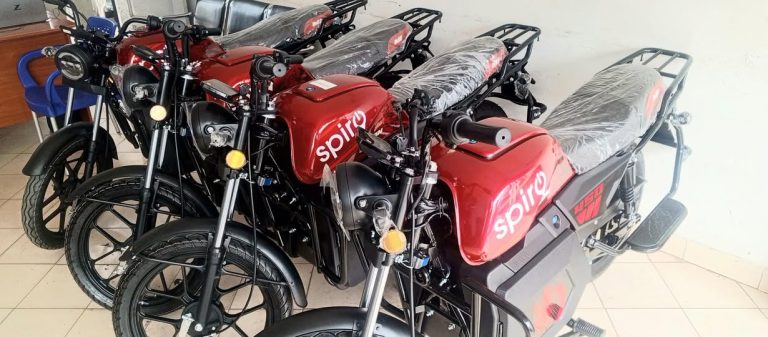
Jua Kali artisans painting and displaying their finished products at Daraja Mbili in Kisii town. Photo by Victor Ochieng.

By Lavina Aunda
Worth Noting:
- Eric Otieno, a Jua Kali artisan, started his business after he completed his primary education because his parents could not manage to facilitate his secondary education and he wanted to keep his mind busy to avoid engaging in criminal activities for survival.
- Otieno says that he joined a friend who taught him Jua Kali artisan skills and gained knowledge while helping him, which made him outstanding in making products that attracted buyers.
- He notes that he specialized in making metal boxes, French fries warmers, and jikos using iron sheets, tin snips, and rail metals which are hard to get since they are not readily available.
- From the income, Otieno states that he was able to provide for his family with food, pay for medical, school fees for his children, and saved at least Sh5,000 monthly.
The informal sector plays a major role in creating employment, production of goods and services, income generation to the persons involved, and represents an important part of Kenya’s economy.
The sector comprises informal traders and artisans commonly known as ‘Jua Kali’, Kiswahili words that can be directly translated to ‘hot sun’ who mostly work by the roadside in the scorching sun creating products.
According to the 2021 Economic Survey conducted by the Kenya National Bureau of Statistics (KNBS), the informal sector recorded 83 per cent employment in 2020, lower than in 2019 which recorded 91.7 per cent of the total employment.
The survey shows that the number of persons estimated to have been engaged in the informal sector in 2020 reduced to 14.5 million from 15.1 million persons in 2019 due to the restrictions that were put in place by the government to mitigate the spread of covid-19.
However, the Jua Kali sector at Daraja Mbili Market in Kisii town is picking up after the county government allowed the business to continue as it had closed markets to contain the spread of the covid-19 pandemic in the region.
Eric Otieno, a Jua Kali artisan, started his business after he completed his primary education because his parents could not manage to facilitate his secondary education and he wanted to keep his mind busy to avoid engaging in criminal activities for survival.
Otieno says that he joined a friend who taught him Jua Kali artisan skills and gained knowledge while helping him, which made him outstanding in making products that attracted buyers.
He notes that he specialized in making metal boxes, French fries warmers, and jikos using iron sheets, tin snips, and rail metals which are hard to get since they are not readily available.
From the income, Otieno states that he was able to provide for his family with food, pay for medical, school fees for his children, and saved at least Sh5,000 monthly.
“It is a different encounter here where the Kisii Artisans Self Help Group with 19 members, has a dormant participation compared to Shaurimoyo Jua Kali Association in Nairobi where I used to work, that assisted me with loans and credits in boosting my business,” narrates Otieno.
He pleads with the county government to help them market their products within and outside the country and build conducive working places to avoid disruptions by bad weather conditions.
Michael Ochola, also an artisan at Daraja Mbili says he was through with his primary school education and farmed at their family land for 2 years but later on he shifted to Jua Kali business because the land became inadequate when his siblings acquired their parcels.
Ochola states that he was forced to specialize in making metal boxes, gutters, oven jikos, and basic jikos because they were the products that are in demand in the area.
He notes that he did short contracts together with his small savings, he was able to generate enough capital to start his Jua Kali business after his employer died adding that he has been working for the last 16 years.
He further states that the cost of his products entirely depends on customer’s preference, their sizes, and the type of material used, noting that he sells smaller sizes at Sh1,200 while bigger ones go for Sh1,500.
The artisan further states that he did not go through any institution to learn his artisan work adding that he gained knowledge and various skills from an old man whom he worked with in making his products.
“Many students who have finished school want to join our Jua Kali manufacturing but learning the work is a big issue due to inadequate space. I request the county government to avail materials and expand the workplace where interested people can as well learn and continue gaining skills,” appeals Ochola.
Ochola points out the lack of enough materials as a major challenge in his business forcing him to suspend a lot of orders from his customers saying that transporting the raw materials from Nairobi and Mombasa is costly.
Mary Mong’ina, an elderly retailer at the market says the artisans depend on her for the money they use to get the raw materials and pay for labour to make the products as she also depends on them for the products they make.
However, l claims that some of the artisans are not trustworthy as they often end up not finishing her orders and even relocate to different places after being paid deposits to start the work.
According to her, the covid-19 pandemic has not affected the Jua Kali business as much because of loyal customers who kept on buying products despite the dawn to dusk curfew that shortened working hours.
Mung’ina urges the county government to ensure that security is heightened at working places as she recalls two fire incidents, without a known cause, that razed down their work stores making them incur losses.
Being a woman who solely depends on the business, she borrows loans from banks and merry-go-rounds as she pleads with the county government to consider helping them form saccos that would help them in loans and savings to boost the Jua Kali sector in the region.
Similar Posts by The Mt Kenya Times:
- Mt Kenya Times ePAPER October 27, 2026
- Sifuna draws hope from Serbia and Brazil as Kenya’s 2027 race heats up
- Uhuru calls for unity as he marks 65th birthday
- Kenya establishes international crimes division: Justice delayed, but will it be delivered?
- World marathon champion Jepchirchir suspended in fresh blow to Kenya’s clean sport drive
About the Author