Kucharova Ugiloy

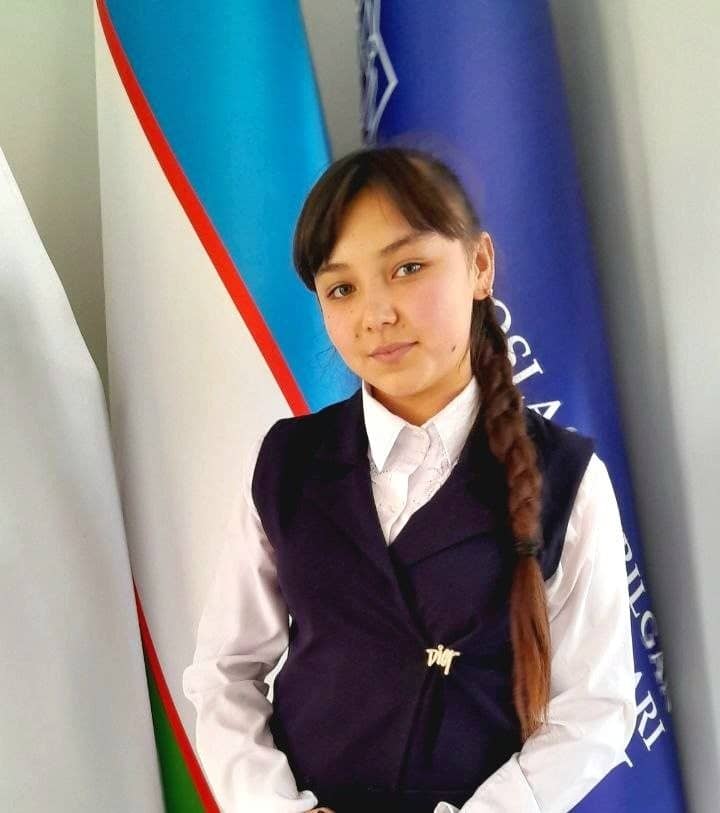
By: Kucharova Ugiloy, Uzbekistan
Our great-grandfather, the sultan of poetry, Alisher Navoi, said, “Language is the jewel that separates man from beast.” A person who does not know his mother tongue does not know his family tree or roots. Every nation calls the language it has used throughout its life as its mother tongue. The reason for this name is the mother’s role in raising a child and bringing it to adulthood. The language of each nation is called the mother tongue because the baby heard the sounds and words from his mother. In ancient times, our mother tongue was called Turkish. Our ancestors have preserved our language for centuries. Those who have done noteworthy work in order to strengthen the mother tongue. Among them, Amir Temur also enjoyed the poems and finished the stanzas. Husayn Boykara and Zahiriddin Muhammad are not only sultans of Babur’s time but also recognised poets. Just like every period has its own problems, in the 15th century, problems started to arise in the Turkish language. In Khurasan and Movorounnahr, poems were written in the easy and comfortable Persian language. Because Persian made things easier. There was enough literature in Persian. A person who writes poetry in the Turkish language had to search and puzzle over every word, phrase, and expression, as no significant literature was created in this language either. The honourable and responsible Alisher Navoi took responsibility to demonstrate the possibilities of the Turkish language scientifically and practically, to add the pride and honour of the nation to its rightful place. The great poet wrote a special work entitled “Muhokamat ul-luģatayin” (Discussion of two languages) and compared the Turkish and Persian languages. He showed the inexhaustible possibilities of the Turkish language with irrefutable scientific evidence. He demonstrated the richness of vocabulary, elegance, and melodiousness of the Turkish language with many examples. He proved this in practice with his colourful poetic work, which consisted of approximately one hundred thousand verses, first of all, with four divans called “Khazayin ul-Mani” (Treasure of Meanings) and “Khamsa”. These works, which have passed the test of centuries as examples of high art, were a unique collection of the culture of the Turkish peoples of the 15th century. Navoi writes:
Turk nazmida chu men tortib alam, Ayladim ul mamlakatni yakqalam (I raised the flag of Turkish poetry high and united the Turkic world.)
In this work, he received great help from one of Navoi’s contemporaries, Husayn Boykara. It is known that Husayn Boygaro issued a decree on writing works in Turkish. These verses can be quoted many times:
Agar bir qavm, gar yuz yo’qsa mingdur Muayyan turk ulusi xud meningdur Olib men taxti farmonimģa oson Cherik chekmay Xitoydin to Xuroson (The Turkish nation is mine, whether it is one nation, a hundred, or a thousand. I conquered the territory as far as Chindin Khurasan without soldiers).
We young people should always remember such examples and that the first characteristic of a nation is its language!
Similar Posts by The Mt Kenya Times:
- Muturi demands binding livestreaming rules for 2027 polls to prevent repeat of 2022 chaos
- NTSA calls for road safety to be declared a national disaster after 24 die in Mtito Andei crash
- Ruku turns on Waiguru over deputy president ambitions: ‘That seat is not being contested for’
- Instruments required for professional oral hygiene procedures and the requirements for these instruments
- Ruto courts Ukambani with roads and a KSh70B clinker plant as 2027 political contest heats up
About the Author