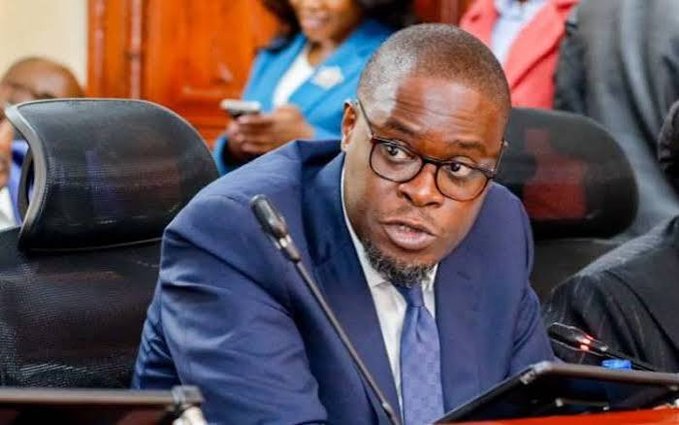
Speaker Moses Wetangula addressing the forum yesterday

National Assembly Speaker Moses Wetangula Said Boundary Delimitation Process Was The Biggest Casualty Of Delayed IEBC Reconstitution
By MKT Correspondents
Worth Noting:
- “It is indeed also true the delay in the reconstitution of IEBC, we have lost a lot of time because of being embroiled in court. We do not know whether there will be possibility in the boundaries delimitation once they the new commissioners assume office,” he added.
- However, he pointed out that demographic-based adjustments could allow the IEBC to redraw boundaries by redistributing populations within existing constituencies.
- “The only changes possible will involve demographic adjustments, but there will be no increase in the total number of constituencies,” he explained, urging Members of Parliament to support the IEBC in carrying out this task once the new commissioners are in office.

National Assembly Speaker Moses Wetang’ula has expressed fears that the boundary delimitation process may be the biggest casualty of the delayed reconstitution of the electoral agency.
Speaker Wetangula noted that while the delayed reconstitution of the Independent Electoral and Boundaries Commission (IEBC) has hindered the timely conducting of by-elections in various constituencies and wards, he also stated that it may be impossible to create additional constituencies.
The Speaker who made the remarks during a Mid-term retreat of the members of the National assembly in Naivasha, Nakuru County, pointed out that the Constitution establishes the current 290 constituencies, leaving no room for expansion due time constrains.
“The delay in the reconstitution of IEBC stalled crucial activities, including boundary delimitation, which is vital for the country’s electoral system, as well as the timely conduct of by-elections in constituencies and wards that have experienced vacancies,” said Speaker Wetangula.
He made the remarks on the second day of the 2025 mid-term retreat for members of the National Assembly, currently underway in Naivasha, Nakuru County.
“It is indeed also true the delay in the reconstitution of IEBC, we have lost a lot of time because of being embroiled in court. We do not know whether there will be possibility in the boundaries delimitation once they the new commissioners assume office,” he added.
However, he pointed out that demographic-based adjustments could allow the IEBC to redraw boundaries by redistributing populations within existing constituencies.
“The only changes possible will involve demographic adjustments, but there will be no increase in the total number of constituencies,” he explained, urging Members of Parliament to support the IEBC in carrying out this task once the new commissioners are in office.
“The importance of having a fully constituted commission cannot be overstated, as it directly affects the conduct of elections and the accuracy of electoral boundaries, which are crucial for fair representation in Parliament.”
Article 89 of the constitution on delimitation of electoral units, states that there shall be two hundred and ninety constituencies for the purposes of the election of the members of the National Assembly.
Article 97 (1) (a) (b) provides that the National Assembly consists of two hundred and ninety members, each elected by the registered voters of single member constituencies and forty-seven women, each elected by the registered voters of the counties, each county constituting a single member constituency.
It further states that the Independent Electoral and Boundaries Commission shall review the names and boundaries of constituencies at intervals of not less than eight years, and not more than twelve years, but any review shall be completed at least twelve months before a general election of members of Parliament.
“The Commission shall review the number, names and boundaries of wards periodically. If a general election is to be held within twelve months after the completion of a review by the Commission, the new boundaries shall not take effect for purposes of that election,” it states.
Wetangula stressed that a fully constituted commission is critical for ensuring the timely conduct of by-elections and advancing the vital process of boundaries delimitation going into the future.
He called on the Independent Electoral and Boundaries Commission (IEBC) selection panel to expedite the nomination and appointment of Commissioners.
The nine-member selection panel, gazetted by President William Ruto and sworn in on Monday, is tasked with recruiting nominees for the positions of chairperson and members of the IEBC.
The panel includes Kiome Lindah Gakii, Oloo Adams, James Evans Misati, Nicodemus Kipchirchir Bore, Koki Muli Grignon, Carolene Kituku, Tanui Andrew Kipkoech, Nelson Makanda, and Fatuma Saman.
The Speaker reckoned that there are constituencies and wards that have lost elected representatives due to various reasons, including death or resignation, are yet to conduct by-elections, leaving their residents without proper representation for extended periods.
“It is imperative that the IEBC selection panel speedily reconstitutes the commission to allow the people of Kenya to have full representation in Parliament and in their local wards,” Speaker Wetangula said.
He added: “The longer we delay the reconstitution of the IEBC, the more we risk disenfranchising citizens who are entitled to be represented by their elected leaders.”
On his part, Leader of the Majority Party Kimani Ichung’wah echoed the Speaker’s sentiments, noting widespread disquiet over the delays in reconstituting the IEBC.
He emphasized the National Assembly’s compliance with the High Court’s ruling by enacting the Independent Electoral and Boundaries Commission (Amendment) Act, 2023, which facilitated the formation of the selection panel.
With the panel now operational, Hon. Ichung’wah urged it to act swiftly and transparently to identify individuals of integrity capable of steering the IEBC effectively.
“There are various constituencies that remain unrepresented, leaving citizens disenfranchised for far too long. It’s imperative that these gaps are addressed as a priority,” he said.
Similar Posts by The Mt Kenya Times:
- Mt Kenya Times ePAPER October 24-25, 2026
- Muturi calls on IEBC to keep election technology tender clean and on schedule
- Ruto meets UAE minister in push to deepen trade ties
- Gideon Moi breaks silence on Ruto fallout, cites broken promises
- The doctor who refused to abandon a sick Uganda
About the Author