The ballot box’s bitter mockery: Electocracy’s iron grip on Kenya
 The Mt Kenya Times
By Jerameel Kevins Owuor Odhiambo
In August 2022, more than fourteen million Kenyans queued under sun and rain to mark their ballots. Twenty-two million one hundred twenty thousand four hundred fifty-eight citizens had registered. Official tallies recorded a turnout of sixty-four point seven seven percent. William Ruto secured seven million one hundred seventy-six thousand one hundred forty-one votes, fifty point four nine percent. Raila Odinga took six million nine hundred forty-two thousand nine hundred thirty, forty-eight point eight five percent. The margin stood at two hundred thirty-three thousand two hundred eleven votes. Power transferred through the formal machinery of counting. This is the cold fact. The issue rises from it like dust after a long dry season: the ritual of election has swollen into the whole of what we call democracy, while the living substance of democratic life withers.
Electocracy is the rule of the counted vote without the continuous sovereignty of the people. It is the stage on which ballots are celebrated as crowns while the crowned remain unaccountable. Democracy demands more. Democracy requires that power remain answerable every day, that institutions constrain the powerful, that the ordinary citizen’s voice carry weight beyond the five-year spectacle, that equality of dignity shape the distribution of opportunity. Electocracy offers only the spectacle. We have perfected the counting. We have not perfected the rule of the people.
History on this soil teaches the distinction with blood and patience. At independence the promise was self-rule. Jomo Kenyatta’s early years concentrated authority. Daniel arap Moi’s long Nyayo era perfected the art of controlled participation. Multiparty politics returned in 1992, and with it the ritual of competition. The 2007 election exposed the hollowness. Over one thousand Kenyans died. Hundreds of thousands fled their homes. Ethnic arithmetic turned the ballot into a weapon. The 2010 Constitution sought to rebuild the foundations: devolution, independent commissions, a stronger judiciary. The 2017 contests brought petitions and annulment. The 2022 contest produced a peaceful transfer. Each cycle refined the machinery of voting. Each cycle left the deeper structure of elite capture largely intact. Dynasties of name and network Kenyatta, Odinga, Moi, and the rising circles around them continue to shape the field. Ethnic blocs still deliver predictable majorities. The correlation is stark: high formal participation coexists with persistent elite insulation.
Look at the numbers that refuse to lie. Kenya’s electoral democracy index hovers around zero point five five on the Varieties of Democracy scale. The liberal democracy index sits lower, near zero point four three to zero point four five. Freedom House continues to classify the republic as Partly Free. Corruption Perceptions Index scores linger near thirty to thirty-two out of one hundred, ranking the country around one hundred twentieth. Poverty remains stubborn: estimates place between thirty-nine and forty-five percent of the population below international lines depending on the measure. Youth unemployment and underemployment crush the generation that should inherit the future. Surveys place unemployment and corruption as the top national problems. The same citizens who stand in long queues to vote return home to face those same problems with little change in the structure of power. The correlation is not accidental. Electocracy measures success by the smooth conduct of elections. Democracy measures success by the transformation of lived conditions and the real subordination of rulers to the ruled.
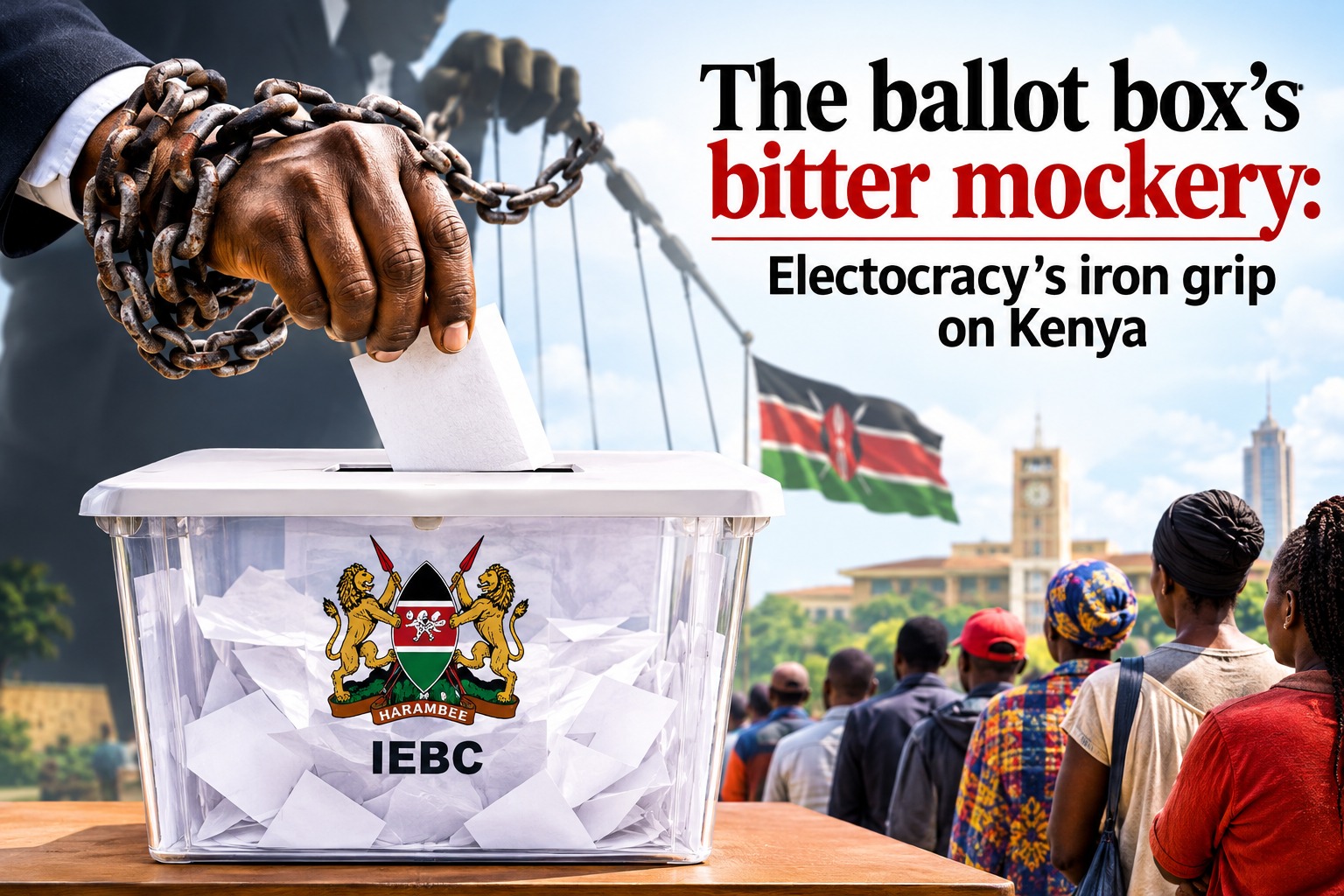
The literary image that fits is the hollow throne. Every five years the people are invited to place a new occupant upon it. The throne itself remains the same shape: elevated, guarded by networks of patronage, insulated by the very rituals that claim to open it. The ballot becomes a golden chain. It binds the citizen to the system while the system remains free of the citizen. Irony saturates the scene. We celebrate the inked finger as proof of freedom. We endure the same patterns of inequality, the same ethnic calculation, the same quiet capture of public resources. The theater is elaborate. The audience leaves with the same script.
This is not a call for cynicism. It is a call for clarity and action. Political leaders must abandon the comfort of electocracy. Winning an election is not a blank cheque for five years of unaccountable rule. It is a temporary mandate that demands continuous justification through transparent governance, measurable delivery, and genuine consultation. The Independent Electoral and Boundaries Commission must earn trust not only on election day but through open processes, clean registers, and resistance to political pressure. The judiciary must remain the final guardian of constitutional limits rather than an occasional referee of elite disputes. Civil society and the media must refuse the role of cheerleaders for the counting exercise and insist on the harder questions of accountability between elections. The youth, who form the largest demographic and face the sharpest edge of unemployment and exclusion, must reject the reduction of their citizenship to a single mark on a ballot. Their demand must be continuous voice, continuous opportunity, continuous justice.
Ordinary citizens carry the heaviest duty. We must stop treating the vote as the full measure of our power. Democracy dies when the people accept the ritual as sufficient. We must organise beyond the five-year cycle: demand budget transparency, track devolved funds, challenge ethnic mobilisation that reduces us to voting blocs, insist that public office serve the public rather than the network that installed the office-holder. Correlation again drives the point. Where citizens remain passive between elections, electocracy flourishes. Where citizens remain vigilant, the pressure for deeper democratic practice grows.
The original insight is this: electocracy reduces the citizen to a statistical input, a momentary participant whose only recognised power is the power to select among predetermined options. True democracy recognises the citizen as continuous sovereign. The difference is the difference between a plastic plant that looks green under artificial light and a living tree that draws strength from deep roots and changes with the seasons. Kenya has become skilled at manufacturing the plastic plant. The living tree remains underdeveloped.
We stand at a moment when the machinery of elections functions with increasing technical competence. That competence must not become the ceiling of our ambition. The republic deserves more than the regular transfer of crowns through counting. It deserves the daily practice of self-rule. Electocracy is not democracy. The ballot box’s bitter mockery must end. The people must reclaim the full meaning of their sovereignty, not only on the day the ink is applied, but on every day that follows.
The writer is a social commentator.
Similar Posts by The Mt Kenya Times:
- Kisii hosts World Cities Day 2026, as leaders urge counties to strengthen waste management and plan housing together
- Gachagua reveals tense exchange with Sifuna over 2024 impeachment as 2027 alliances take shape
- Comrades erupt in joy as lecturers’ strike comes to an end
- Fofana miss sends Liverpool past Chelsea into Carabao Cup quarter-finals
- Spanish football federation postpones 24 cup matches after Toledo train disaster
About the Author