The high cost of competency: How Kenya’s CBC Is straining families and schools
 The Mt Kenya Times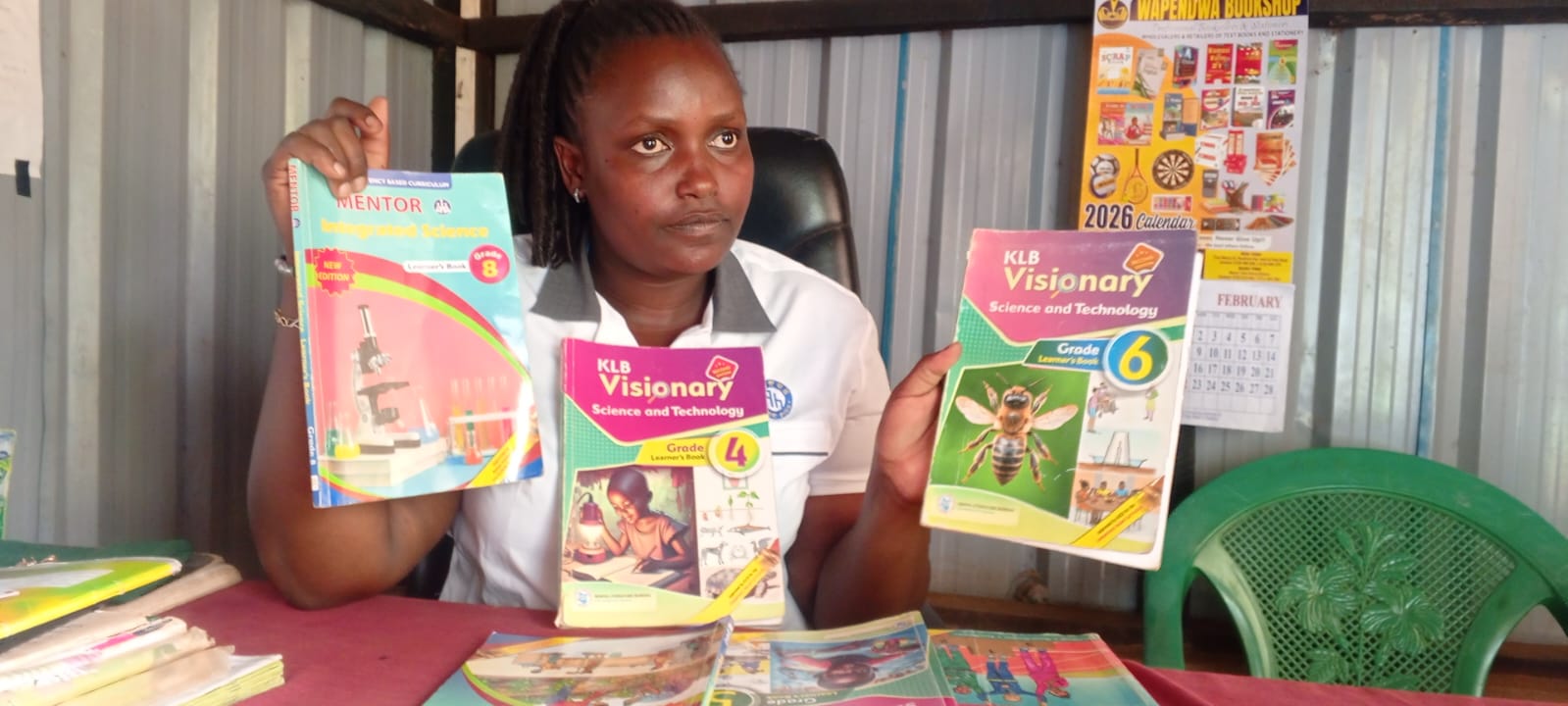
Maureen Kagwiria Headteacher in charge of KAN academy in Nchiru Tigania West shows some of the books used in the CBE. Photos/Dennis Dibondo.

By Dennis Dibondo
Kenya’s Competency-Based Curriculum (CBC) was introduced to nurture skills, talents, and practical knowledge among learners, but its implementation has sparked widespread concern among parents, educators, and stakeholders.
While many agree that the system has long-term benefits, its financial and structural demands are placing a heavy burden on families, especially in rural areas, raising questions about its sustainability and inclusivity.
Across the country, parents already grappling with rising living costs, climate-related challenges, and shrinking agricultural returns now find themselves spending more to support their children’s education.
With land becoming scarce and farming increasingly unreliable due to unpredictable weather, education remains the most viable path to a better future. However, the cost of accessing that opportunity has significantly increased under CBC.
John Kanampiu, a businessman in Kiriani market, Maara Constituency, and a parent of a PP2 pupil, highlights the infrastructure gaps that continue to hinder effective implementation. According to him, many schools lack sufficient classrooms and laboratories required for Junior Secondary School (JSS) learners. To bridge this gap, parents are often forced to contribute financially, such as through fundraising initiatives to build facilities.
Kanampiu also points to a shortage of trained teachers capable of handling CBC’s expanded and specialized curriculum. In some cases, teachers are overwhelmed, handling up to 14 subjects, which leads to an increase in assignments passed on to learners—and indirectly to parents. He notes that unlike the previous 8-4-4 system, CBC content is more complex, making it difficult for parents to assist their children with schoolwork.
The financial strain is further compounded by the continuous demand for new textbooks and holiday assignments, which frequently change. Additionally, the emphasis on digital literacy has exposed inequalities, particularly in rural areas where access to electricity, computers, and internet connectivity remains limited. Some parents are now expected to invest in smartphones, solar systems, and internet bundles to ensure their children keep up.
Kanampiu recounts instances where pupils were required to bring items such as live chickens and cooking ingredients for practical lessons—expenses that many families struggle to meet. He also notes the high cost of sports participation, uniforms, and transportation to facilities not available in local schools. In his view, the overall cost of educating a child under CBC—especially in pre-primary and junior levels—can exceed that of secondary school education in day schools.
Similar concerns are echoed by Janerosa Gacheri, a grandparent in North Imenti Constituency, who is raising and educating two grandchildren. She estimates spending about Sh30,000 per term on books and learning materials alone. Gacheri emphasizes that CBC demands a wide range of items, from foodstuffs to materials for practical subjects like home science. She adds that pupils who fail to bring required materials risk being excluded from lessons, further disadvantaging children from low-income households.
She also highlights the continued practice in public schools where parents provide food supplies such as maize and beans, adding to the overall burden. For families in rural areas, where income is often unstable, these cumulative costs are particularly overwhelming.
From a different perspective, cyber café operator Mutuma M’anjuri notes that the anticipated economic opportunities linked to CBC—such as increased demand for printing assignments—have not materialized as expected. While some parents do incur minor printing costs, he observes that many still struggle financially and question the system’s effectiveness due to limited engagement and awareness during its rollout.
School administrators also face significant challenges. Purity Nkonge, chief principal of Yururu Girls’ Comprehensive School, calls for increased government support in providing learning materials, particularly for Grade 10 learners. She advocates for the inclusion of more publishers to improve access and affordability of textbooks.
Maureen Kagwiria, head teacher at KAN Academy in Nchiru, Tigania West, describes CBC as financially demanding for both parents and private institutions. She explains that frequent curriculum changes render textbooks obsolete within short periods, forcing parents to repeatedly purchase new ones. In private schools, where parents bear the full cost of materials, this becomes a significant financial strain.
Kagwiria also points to inadequate infrastructure, noting that many schools lack laboratories and computer facilities necessary for practical learning. As a result, some teachers are forced to teach practical subjects theoretically, undermining the curriculum’s objectives. She further observes that private schools have largely been excluded from government training programs, despite playing a key role in educating Kenyan children.

Kiambi Atheru, a former Meru County secretary and owner of KAN Group of Schools, argues that the transition to CBC negatively affected private education. He notes that many private schools have closed due to declining enrollment and reduced emphasis on academic competition, which previously drove demand. Atheru believes the government failed to adequately consult stakeholders, particularly investors in the education sector, during the transition.
Despite these concerns, some stakeholders maintain that progress has been made. Caxton Miungi, executive secretary of the Kenya National Union of Teachers (KNUT) in Meru, acknowledges initial challenges but says improvements have been seen in staffing, classrooms, and learning materials. However, he admits that many schools still lack laboratories, forcing students to rely on nearby secondary schools.
Miungi downplays claims that CBC is overly burdensome, arguing that its practical approach is necessary to prepare learners for real-world challenges. He also notes that evolving textbooks reflect efforts by publishers to improve content quality.
Meru County Director of Education Joseph Ole Maki maintains that CBC is affordable, asserting that the government provides sufficient textbooks to public schools. However, he clarifies that private institutions are not covered under these provisions. Maki also acknowledges gaps in laboratory infrastructure but says schools are improvising by sharing facilities with neighboring institutions. He adds that teacher training programs are ongoing to support the transition.
North Imenti MP Rahim Dawood highlights efforts to address infrastructure challenges through government funding. He reveals that plans to establish mobile laboratories were shelved after assurances from the Ministry of Education. While some schools still lack facilities, Dawood encourages institutions to formally petition for support through public participation processes. He also notes that funds are being allocated to support examinations and related costs.
Economist Erick Mutwiri views CBC as a progressive reform aligned with global trends toward skills-based education. However, he criticizes the government for rushing its implementation without adequate infrastructure and planning. According to Mutwiri, the resulting gaps have shifted the financial burden onto parents, making education more expensive and widening inequality.
He advocates for increased government funding and better coordination to ensure that all necessary learning materials are provided within schools, rather than being sourced by parents. Mutwiri also emphasizes the need for a multi-sectoral approach to infrastructure development, particularly in building laboratories.
While acknowledging CBC’s potential to nurture talent in areas such as sports and the arts, Mutwiri stresses the importance of aligning education with Kenya’s economic priorities. He argues that a well-structured education system should support key sectors like agriculture and manufacturing, contributing to national development goals such as Vision 2030.
Overall, the CBC represents a significant shift in Kenya’s education system, with the promise of producing more skilled and adaptable graduates. However, its success depends on addressing the financial and structural challenges currently faced by families and schools. Without targeted reforms and increased support, the cost of competence may continue to outweigh its intended benefits for many Kenyans.
Similar Posts by The Mt Kenya Times:
- When young lives become disposable
- The day death refused to be scammed
- Statement win at the Gtech: Brentford outclass Chelsea to claim all three points
- When disability funds become a frontier for accountability: Kenya’s PWDs refuse to be invisible
- Public voices concerns over proposed education laws
About the Author