Dan
Dan 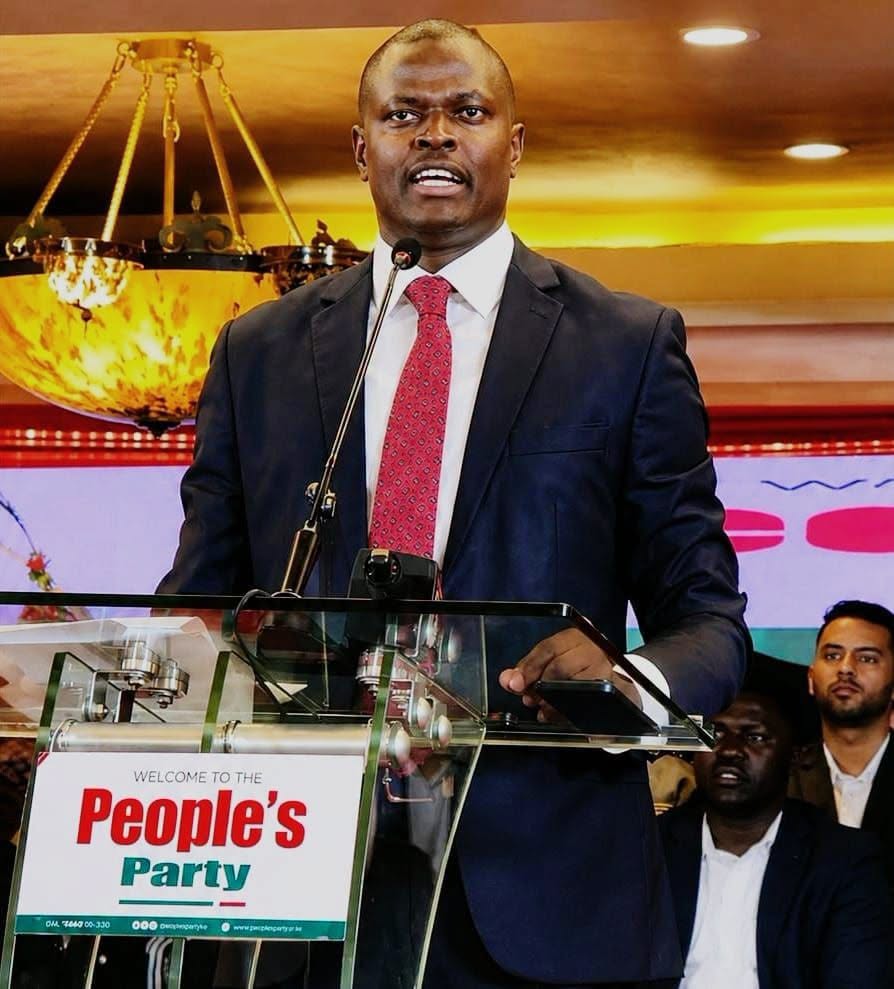
Kiharu MP Ndindi Nyoro

Kiharu MP’s dramatic defection to the People’s Party of Kenya splinters Mt Kenya’s political landscape and resurrects the ghost of a rivalry that defined Kenya’s turbulent return to multiparty democracy.
By Dan Mwangi
Kiharu MP Ndindi Nyoro yesterday formally abandoned the ruling United Democratic Alliance and joined the People’s Party of Kenya, delivering a nationally televised address at Safari Park Hotel in Nairobi that placed him squarely in the opposition camp and ignited fresh speculation about his presidential ambitions ahead of the August 2027 general election.
The announcement was as theatrical as it was politically significant. With cameras rolling live and a carefully assembled guest list that included Siaya Governor James Orengo, Kisii Senator Okong’o Omogeni and Wundanyi MP Danson Mwashako, Nyoro spoke with the measured composure of a man who has been rehearsing this moment for months. “For the avoidance of doubt, you all know we left government a long time ago and disassociated ourselves with UDA,” he said. “My people and I have joined the People’s Party of Kenya. I am glad that they have given me an opportunity, and I have accepted.”
For students of Kenyan political history, the echoes were immediate and unmistakable. The parallel to the late President Mwai Kibaki’s 1991 decision to break from Daniel arap Moi’s KANU and launch the Democratic Party is not merely cosmetic. It cuts deep into the structural DNA of Mt Kenya politics. Kibaki, an economist by training and a man of studied restraint, launched DP to offer Mount Kenya voters an alternative to Kenneth Matiba’s Ford Asili, which had swept through the region on a tide of popular anger. Today, with former Deputy President Rigathi Gachagua’s Democracy for the Citizens Party already occupying the insurgent lane, Nyoro’s People’s Party of Kenya inserts a third major vehicle into a regional political market that is, once again, fracturing along lines of ambition, geography and generational impatience.
The geographical symmetry is striking. Kibaki came from Nyeri; Matiba from Murang’a. Now Gachagua comes from Nyeri while Nyoro emerges from Murang’a. The unspoken argument running beneath the surface of Mt Kenya politics — that Kiambu has produced two presidents, Nyeri one, and Murang’a none — has found its latest and perhaps most polished articulation in Nyoro’s political project. Whether or not he states it directly, the arithmetic is not lost on anyone paying attention.
Nyoro entered Parliament in 2013 as the Kiharu MP on a TNA ticket, at a time when Uhuru Kenyatta and William Ruto were building the political alliance that would later become Jubilee. He was one of the most conspicuous young faces of the Kenya Kwanza mobilisation in 2022, defying then-President Kenyatta’s endorsement of Raila Odinga and throwing his considerable local influence behind Ruto. His reward was the chairmanship of the powerful Budget and Appropriations Committee — a post that placed him at the nerve centre of the government’s fiscal architecture. That position was stripped from him in a parliamentary reshuffle in July 2025, a moment widely read as the beginning of his formal estrangement from the presidency.
Nyoro made clear yesterday that he no longer considers himself part of the Kenya Kwanza administration, a position he said his sustained public criticism of the government’s economic management had long since established. His economic critique has been detailed and consistent. He called for measures to prevent foreign institutions from taking over Kenyan banks, arguing that the country should protect local financial institutions and help them expand across Africa, and said Kenya’s banking sector — with over 40 banks, all of them profitable — should be deliberately strengthened to ensure more wealth remains within the country. He has also criticised the government’s decision to sell a 15 per cent stake in Safaricom, arguing that the telecom giant was undervalued and that strategic national assets should not be surrendered at a discount.
This is the Kibaki mirror in its sharpest form. Like Kibaki, Nyoro is an economist by training. Like Kibaki, he practises a politics of deliberate calm — no theatrics, no inflammatory language, no chest-beating. He said the national conversation has become overly fixated on personalities rather than ideas, and declared: “I find it unfair to keep talking about what I may become. I would rather talk about what Kenya will become.” It is the kind of statement that sounds humble while simultaneously positioning its author as the adult in a room full of children.
The guest list at Safari Park told its own story. Orengo, Omogeni and Mwashako represent a political geography that stretches from Nyanza to the Coast — precisely the coalition architecture that any serious presidential challenger to Ruto must construct. The presence of figures affiliated with Kenya’s founding family networks — the same networks President Ruto has publicly accused of sponsoring surrogates through the Linda Mwananchi movement to destabilise his administration — added a layer of symbolism that was difficult to miss.
The announcement places Nyoro in an increasingly fluid opposition landscape, where several leaders are seeking to build alliances capable of mounting a credible challenge to Ruto in 2027. People’s Liberation Party leader Martha Karua has already signalled a second presidential bid, vowing to liberate Kenya from “all oppression” and declaring that she intends to try again. Gachagua’s Democracy for the Citizens Party continues to consolidate its hold on the Mt Kenya heartland. Former Cabinet Secretary Fred Matiang’i remains a significant factor, with Jubilee deputy party leader Jeremiah Kioni having repeatedly warned that if Matiang’i is not chosen as the United Alternative Government’s flag bearer, Jubilee will field its own candidate — potentially with Nyoro as a running mate.
Mt Kenya is a deeply unpredictable political region. Former Gatanga MP Peter Kenneth failed in his 2013 presidential bid despite genuine popularity. Karua was rejected three times in succession. Kenyatta himself was punished by the very voters who had elevated him when he endorsed Odinga in 2022. The mountain gives, and the mountain takes away. Nyoro knows this better than most.
Those close to him suggest his eyes may be fixed less on 2027 and more on 2032 — that the current manoeuvre is as much about building a national brand and a durable political infrastructure as it is about winning the next election. His development record in Kiharu, where he has twice been returned to Parliament and where his Constituency Development Fund performance has drawn consistent national recognition, gives him the kind of credible local foundation that many of his rivals lack.
While Nyoro has not explicitly declared a presidential bid, the launch of a political party, consultations with potential opposition partners and plans for a nationwide mobilisation give him the infrastructure to make one. For now, the cards remain close to his chest. But in Kenyan politics, the man who builds the machine rarely intends to let someone else drive it.
History does not repeat itself in Kenya. But as any veteran observer of the mountain’s politics will tell you, it has a habit of rhyming — sometimes with an eerie precision that makes the past feel less like prologue and more like prophecy.
Similar Posts by Dan:
- Ruto vs Uhuru: The war Kenya never saw coming
- Ruto’s reckoning: Gachagua puts four years on trial
- Mudavadi tells Sifuna: Dreaming about it won’t make you president
- Kalonzo builds a national outlook: Can Wiper’s mountain-to-coast gamble rewrite Kenya’s political map?
- Two visions, one region, one race against time
About the Author

 The Mt Kenya Times