A nation that keeps drinking its own poison and calling it medicine
 The Mt Kenya Times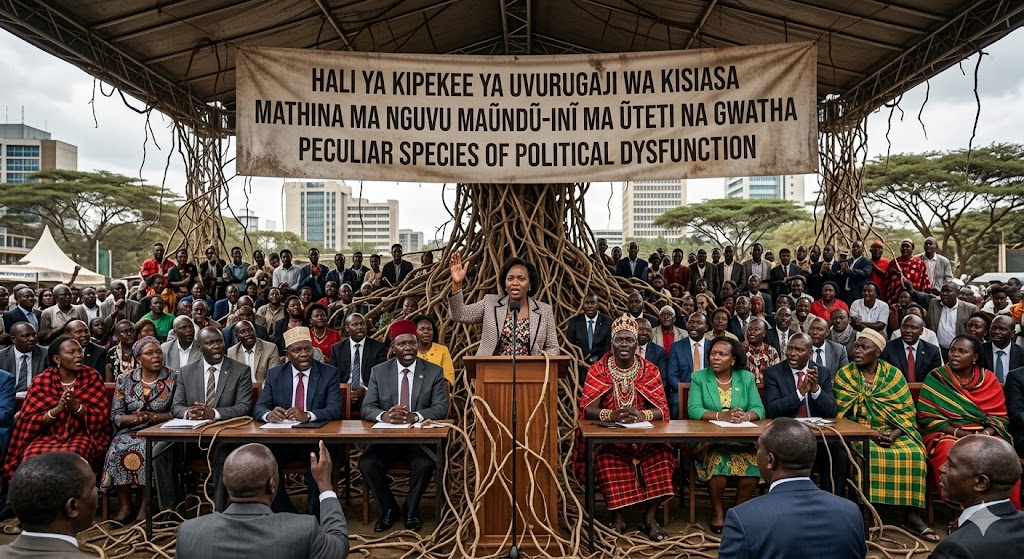
By Jerameel Kevins Owuor Odhiambo
There is a peculiar species of political dysfunction that does not announce itself with the theatrics of a coup or the spectacle of a collapsing state it arrives instead dressed in the unremarkable clothes of the ordinary, wearing the face of a neighbour, speaking in the voice of the evening news, sustained by the quiet agreement of millions who have collectively decided, without saying so aloud, that they deserve exactly what they tolerate. Kenya is not a broken state. It is something more philosophically disturbing: it is a functioning one that has chosen, with apparent enthusiasm and remarkable consistency, to function badly.
The first thing one must concede and concede without the charitable softening of diplomatic language is that the constitutional argument is a spent shell. We produced, in 2010, a document of extraordinary architectonic ambition: a text that codified rights, distributed power, entrenched devolution, and erected judicial independence with the kind of thoroughness that would make a Scandinavian legal draftsman weep with professional admiration. And then, having handed ourselves this instrument of transformation, we proceeded to treat it the way a gifted child treats a violin given by a parent who couldn’t afford it we put it in the corner, walked away, and went back to playing in the mud. The Constitution of Kenya 2010 did not fail Kenya. Kenya failed to be the Kenya that the Constitution assumed it was writing for. The problem was never the text. The problem is the reader.
What one encounters daily in the conversations of governance in the matatu arguments, in the X outrage cycles, in the WhatsApp groups that have replaced civic discourse is not political disagreement but cognitive theatre. People argue with the performative intensity of those who believe something, while behaving with the perfect consistency of those who believe nothing at all. They will catalogue the sins of the incumbent administration with the precision of a forensic accountant and the passion of a wronged spouse, and then, when the season of reckoning arrives, they will queue at the polling station and, with the solemnity of a liturgical act, hand power back to the very machinery of their suffering. This is not naivety. Naivety is forgivable. This is something colder; it is a negotiated transaction in which the voter receives psychological comfort in the form of ethnic solidarity and the politician receives everything else.
The biblical image is not merely apposite; it is, in the most clinical sense, exact. Proverbs 26:11 is not a metaphor deployed for rhetorical effect; it is a behavioural model with measurable predictive power on the Kenyan electoral calendar. The dog returns because the vomit, however repulsive, is familiar. Familiarity, in conditions of political uncertainty, functions as a surrogate for safety. The electorate does not vote for the candidate who promises the most, it votes for the candidate whose betrayal it has already absorbed, metabolized, and learned to survive. There is a grim evolutionary rationality to this: the known thief represents a calibrated risk; the principled stranger represents an unknown one. And in a system where institutions offer no reliable protection regardless of who holds power, the electorate’s behaviour is less irrationality than it is a rational response to irrational conditions. Which is, of course, the most devastating indictment of all that it makes a twisted kind of sense.
The opposition deserves no exemption from this dissection. The current crop of those who present themselves as alternatives to the incumbent fragmented, tribally indexed, constitutionally allergic to coalition arithmetic, incapable of sustaining a unified platform beyond the shared negative of not being the government represent less a political alternative than a collection of grievances looking for a vehicle. One does not build a coalition of the willing through ethnic arithmetic and hope that the numbers add up nationally, because Kenya, as any serious political analyst will confirm, is not a country of national numbers. It is a country of regional tallies dressed in national clothing. The opposition’s failure is not one of communication or resourcing it is one of categorical imagination. They are attempting to win a national election with a tribal psychology, which is precisely the same mistake they accuse the government of making, executed with considerably less competence.
And yet the most fascinating figure in the current landscape the one whom commentators mention with a certain reverence before trailing off into pragmatic resignation is the former senior public servant. The principled one. The no-nonsense one. The one with a record. He exists in the conversation the way a good idea exists in a bad meeting: acknowledged, even admired, and then efficiently ignored. The verdict on him is not delivered by argument it is delivered by geography. “He cannot persuade my grandmother in the village.” The grandmother, bless her, becomes the unwitting avatar of a collective epistemology: the belief that virtue, unattached to ethnic recognition, is a political disqualification. And so the principled man is filed under the category of things we appreciate in theory and decline in practice, like exercise, or honesty, or paying taxes willingly. The irony, savage in its precision, is that the very tax burden provoking the loudest outrage is the product of the same logic that keeps re-electing those who impose it.
The relationship between the Kenyan electorate and its political class is not merely toxic, it is structurally co-dependent in the clinical sense. The leader needs the voter’s manufactured consent; the voter needs the leader’s ethnic endorsement as a form of communal identity insurance. Each feeds the dysfunction of the other. The politician does not improve because there is no incentive to; the voter does not demand improvement because the demand would require first admitting the depth of the self-betrayal involved. And so both parties maintain the performance the leader performing governance, the voter performing outrage and the country performs the appearance of a democracy while conducting the business of a patronage oligarchy. The Constitution sits on the shelf, thoroughly unvindicated, watching.
What bewitches a people is rarely magic and almost always structure. It is the structure of an electoral system that rewards ethnic mobilisation over policy coherence. It is the structure of an economy so precarious that short-term patronage is worth more than long-term institutional trust. It is the structure of a civic education so impoverished that the connection between the ballot and the tax bill between the choice made in August and the salary deduction in September never fully registers as causation rather than coincidence. To diagnose this as bewitchment is to be poetic where one should be architectural: the house is not haunted, it is badly built, and the occupants have convinced themselves that the drafts are a feature. The hopeful observer and one must remain hopeful, for the alternative is mere despair dressed as realism must insist that the structure can be redesigned. But it cannot be redesigned by people who first refuse to see it.
There is a special category of civic sadness reserved for watching a country possess every instrument of its own liberation and decline, election after election, to use them. Kenya has the lawyers. It has the activists. It has the constitutional architecture. It has a young population whose demographic profile should terrify any incumbent with a rational risk-assessment capability. It has produced thinkers, writers, litigators, and public intellectuals who understand, with surgical clarity, exactly what is wrong and exactly what would constitute a remedy. And then, in the periodic ritual of the ballot, all of that understanding is set aside, and the vote goes to the man who slaughtered a bull in the home county. The intelligence exists. The will is what absents itself and the question of whether will can be cultivated without first suffering consequences sufficient to overcome the psychological comfort of familiar failure is the question that does not yet have an answer.
And here is the thing that keeps a thoughtful person awake not with despair, but with a quiet, unsettling watchfulness. Kenya’s dysfunction is not static. The taxes are not merely a grievance; they are a compressing force. The young generation is not simply restless; it is structurally excluded from the patronage networks that made the old bargain tolerable. The 2024 protests were not an aberration they were a system under stress beginning to speak in a language it has never used before. The cycle depicted above suffering, outrage, elections, tribal logic, return has run for decades because the pressure never quite exceeded the inertia. But pressure compounds. And there is a point, impossible to locate in advance but unmistakable in retrospect, at which a people stop returning to the vomit not because they have become wise, but because they have become hungry enough that even the unfamiliar looks survivable. The question is not whether Kenya will change. The question and this is the one no analyst dares to complete is whether the force that finally breaks the cycle will be one that the Constitution can absorb, or one that arrives with no interest in constitutions at all.
The writer is a legal researcher and writer.
Similar Posts by The Mt Kenya Times:
- Mt Kenya Times ePAPER October 27, 2026
- Sifuna draws hope from Serbia and Brazil as Kenya’s 2027 race heats up
- Uhuru calls for unity as he marks 65th birthday
- Kenya establishes international crimes division: Justice delayed, but will it be delivered?
- World marathon champion Jepchirchir suspended in fresh blow to Kenya’s clean sport drive
About the Author