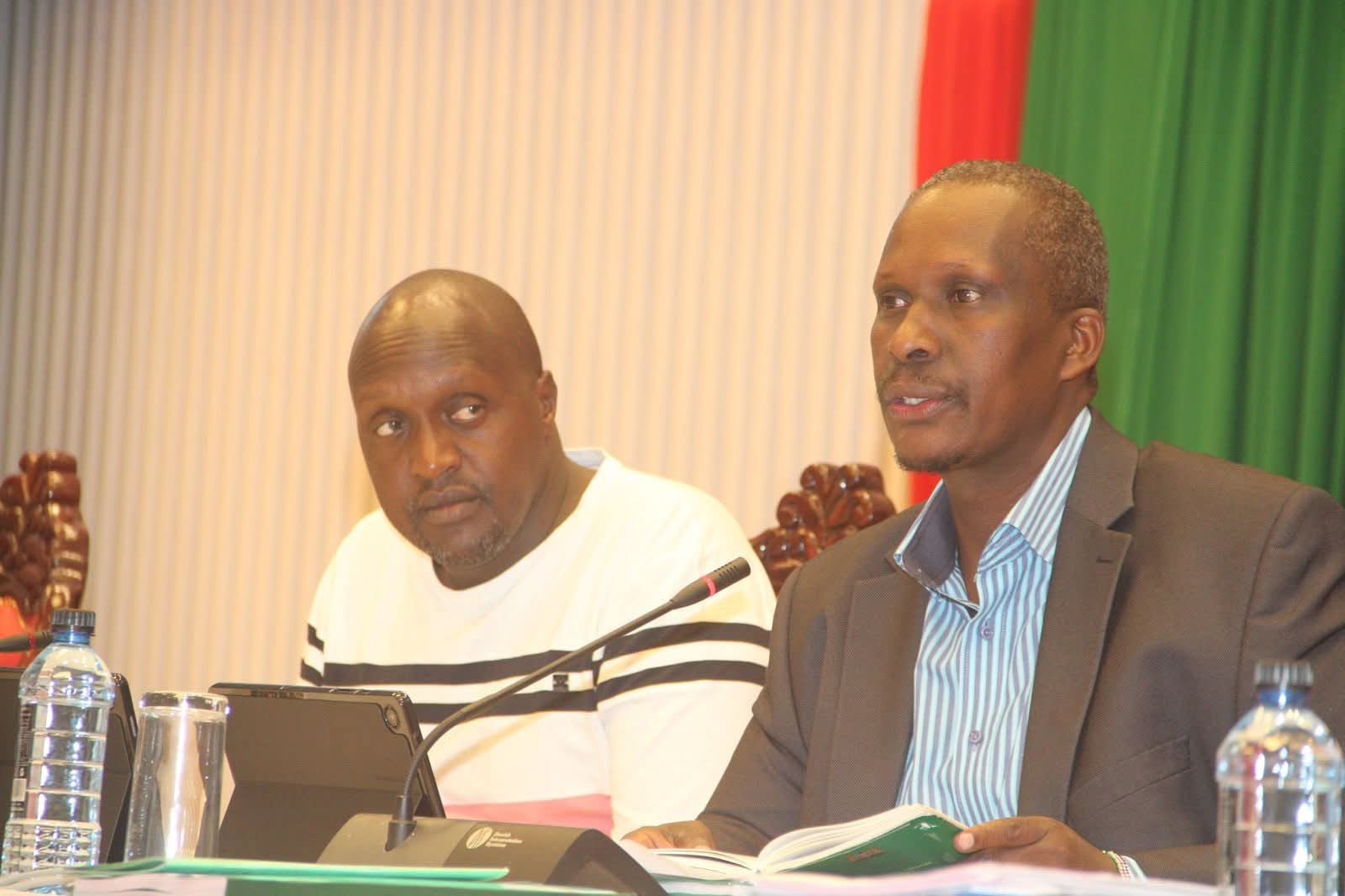
Finance Committee vice-chairman and AinaMoi constituency MP Benjamin Langat (right) with his Kesses counterpart Julius Rutto during the Saturday forum in Nairobi.
By MKT Correspondents
The Departmental Committee on Finance and National Planning over the weekend commenced public hearings on the Finance Bill, 2025 in counties, with an assurance to the public that their contributions will directly influence the Bill’s final proposals.
Committee vice-chairman and AinaMoi constituency MP, Benjamin Langat who was chaired session at the Edge Convention Centre in Nairobi on Saturday, emphasized the significance of public participation in the legislative process, pledging that all views would be integrated into the final report presented to the House.
“This is not an exercise in futility. It’s a very important exercise. This Finance Bill is a proposal to the National Assembly and it has to undergo the necessary legislative process including public participation to become law,” Langat explained during the exercise which marked the commencement of hearings in Nairobi County.
Drawing parallels with the public outcry surrounding the Finance Bill, 2024, Langat urged the public to consider the current Bill not in isolation but in conjunction with the proposed Budget Estimates.
“I want to implore upon the public to desist from looking at the Finance Bill in isolation. When you tell us to employ JSS teachers, or even more nurses, the money to cater for that must come from somewhere. This Bill is the instrument we use to raise such funds,” he stated.
Echoing these sentiments, Kesses MP, Julius Rutto, highlighted that the public participation exercise aims to enrich legislation. He noted that the country missed an opportunity to enact progressive tax laws when the Finance Bill, 2024, failed to pass.
Rutto advocated for a balanced approach when examining the proposed law, which seeks to reform the taxation framework and address revenue shortfalls.
“Last year, we collated various views on the Finance Bill and when we retreated to write our report, we ensured that all the proposals that did not sit well with the people were removed. However, due to misinformation, we ended up losing a good number of recommendations that were contained in our report,” he stated.
Various stakeholders from Nairobi County presented their views on the Bill.
Among them was a caucus representing former freedom fighters and their descendants; Mau Mau War Veterans Association which through its Patron Bishop Jane Mumbi Ng’ethe who was flanked by more than a dozen members called on the Bill to address high taxation in areas that affect most of Kenyans.

Bishop Ng’ethe who said was holding brief for the association’s Director General James Njuguna Mahuria noted that most citizens, including the elderly former freedom fighters were suffering due to high taxation, something he urged the parliamentarians to put in consideration.
Another organisation, The International Institute for Legislative Affairs (IILA), a non-profit organization focused on pro-people policies, proposed new taxation measures aimed at public health concerns related to tobacco, alcohol, and sugar-sweetened beverages (SSBs).
They cited the potential of these measures to improve public health and generate revenue.
“Non-Communicable Diseases (NCDs) are a growing burden in Kenya, currently responsible for 39% of all deaths and over 50% of hospital admissions. This escalating problem strains the healthcare system and hinders access to social health coverage,” Celine Awuor, CEO of the IILA, told the Committee.
The Institute cited tobacco use as a major risk factor for NCDs, causing over 8,000 deaths annually in Kenya, and asserted that taxation is a proven method for reducing tobacco consumption and increasing government revenue. They posited that Kenya has not fully leveraged this intervention, calling it a missed opportunity.
“The IILA highlights that current tax rates on tobacco products are below the World Health Organization’s (WHO) recommended threshold of at least 70% of the price share, with Kenya currently below 40%. Taxes on emerging nicotine products, such as oral nicotine pouches and electronic cigarettes, are also significantly lower despite being heavily marketed to youth,” they submitted.
Citing Sugar-Sweetened Beverages as a significant contributor to NCDs, the Institute recommended increasing the current excise tax rates for these products by at least 10%.
They urged the Committee to consider implementing a sugar-based excise tax on SSBs as part of a comprehensive NCD prevention strategy, which would also include public education, mandatory front-of-package labeling, and promotion of healthy diets and physical activity.
Regarding alcohol taxation, the Institute proposed increasing the excise duty on beer from Kshs. 22.5 to Kshs. 33 per centiliter of pure alcohol. They submitted that the increase would restore the excise tax share above 28 per cent while reducing youth initiation, and boosting government revenue.
Participants also encouraged the National Assembly to incentivize sectors that attract youth interest as a means to address youth unemployment.
“Try to make counties economically empowered to encourage rural to urban migration. Also, come up with friendly laws toward digital monetization to allow the youth to make a living out of that. Those are avenues where there are a lot of job opportunities,” Leonard Kahuthu, a resident, told the Committee.
The Kenya Youth Climate Advisory Council (KYCAC) submitted a memorandum focusing on a youth-centered perspective regarding certain provisions in the Bill.
They specifically pinpointed Clause 42(a)(vii) which proposes an excise duty of 25 per cent or Kshs. 200/kg on imported plastic films.
They argued that the provision could significantly increase costs for young enterprises offering sustainable packaging alternatives, potentially making eco-friendly products uncompetitive.
They stated that initial consultations with youth-led entrepreneurs in sustainable packaging, including those from the Mombasa Plastics Prize Incubator, had projected that such a duty would make their products uncompetitive.
KYCAC recommended amending the provision to create a differentiated excise duty. They further proposed a significant reduction to Kshs. 50/kg or 5 per cent for certified biodegradable or compostable plastic film imported by youth-owned enterprises, solely for direct use in sustainable packaging.
Calls for extended timelines and simplified information
Lilian Mutunda from Kiambu expressed reservations about the limited timeline for submissions, given the technical nature of the Bill. She urged the Committee to consider extending the deadline to allow more people to submit their views.
However, she commended the explainer published by the National Assembly on the Bill and called for an even more simplified version in the future.
“The Explainer on the Bill helped a bit but it was still too technical. Perhaps that’s the reason there is despondency among the youth because of the knowledge gap,” she explained.
The Committee is set continue with county hearings today in Migori and Trans-Nzoia counties.
In Trans-Nzoia, the former freedom fighters and their descendants, led by Mr Mahuria are expected to present a petition, calling for inclusion of their compensation in the next financial year’s budget.
Similar Posts by The Mt Kenya Times:
- Mt Kenya Times ePAPER August 29-30, 2026
- Old Mutual swings to KSh882M profit as insurance arm ends losing run
- US pumps KSh930M into Kenya police modernisation
- Kalonzo comes to the Coast with a simple, devastating message: You have been betrayed
- Tear gas, shuttered shops and a government out of touch: The KRA tax revolt that could define Kenya’s road to 2027
About the Author