The Mt Kenya Times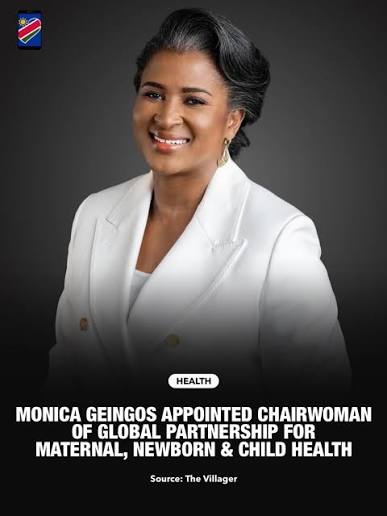
Appointment of H.E. Monica Geingos as PMNCH Board Chair
The Appointment of H.E. Monica Geingos as PMNCH Board Chair and What It Means for Namibia, Africa, and Women in Global Leadership
By Silas Mwaudasheni Nande
On 13 May 2026, an announcement echoed from Geneva to Windhoek, from the marbled halls of the World Health Organization to the dusty kraals and sun-baked communities of Namibia’s north: H.E. Monica Geingos had been appointed as the new Board Chair of the Partnership for Maternal, Newborn and Child Health (PMNCH), the world’s largest alliance for women’s, children’s, and adolescents’ health and well-being. In an era when global health governance is being reshaped by fiscal pressures, ideological contestation, and deepening inequities, this appointment is more than a biographical milestone. It is an institutional declaration, a continental affirmation, and a deeply personal signal to every African woman who ever dared to imagine that the seat at the global table could belong to her.
For a small country of just under three million people, perched at the southwestern end of the African continent, this moment carries extraordinary symbolic and practical weight. Namibia, a nation that only gained independence in 1990, that fought the bruising systemic degradation of apartheid colonial rule, and that has since embarked on one of the continent’s most progressive democratic experiments, has now placed one of its most formidable daughters at the helm of an institution that speaks for nearly 1,500 partner organisations spanning six global constituencies. The woman entrusted with this charge is no ordinary figure. Monica Geingos is a lawyer, a financier, a former First Lady, an entrepreneur, a youth advocate, an AIDS commissioner, and a public intellectual, a rare convergence of professional disciplines and lived experience that few leaders anywhere in the world can claim.
This analysis traces the significance of her appointment across three essential planes: what it means to Namibia as a nation, what it means to Africa as a rising voice in global governance, and what it means for the long arc of women’s leadership in international institutions. It also examines, with particular attention to the factual record of her career, the transformational leadership force that Monica Geingos is now poised to bring to the PMNCH and to the global health agenda.
1. The Anatomy of a Historic Appointment
The Partnership for Maternal, Newborn and Child Health is not merely another United Nations body housed in Geneva. Hosted by the World Health Organisation, it exists at the intersection of political will, civil society mobilisation, scientific evidence, and development finance. Its mandate is to mobilise, align, and amplify advocacy for the health and well-being of women, children, and adolescents across the world. In the current global moment, defined by declining aid flows, policy reversals on sexual and reproductive health rights, and widening health inequities across the Global South, the PMNCH Board Chair holds a uniquely consequential position.
The outgoing Chair, Rt Hon Helen Clark, former Prime Minister of New Zealand and one of the most distinguished public servants in the history of the United Nations Development Programme, set an extraordinary standard. In announcing Monica Geingos as her successor, Clark was characteristically precise in her assessment. She said that Geingos was ‘exceptionally well placed to lead the partnership at this moment, bringing together principled leadership with practical experience and a clear understanding that progress for women, children and adolescents depends on political courage, inclusive partnerships and sustained investment.’ These are not words of polite protocol. Coming from Helen Clark, they are a considered endorsement, the passing of a torch from one hemisphere of proven leadership to another.
WHO Director-General Dr Tedros Adhanom Ghebreyesus was equally emphatic, characterising Geingos as bringing a ‘rare combination of strategic leadership, public credibility and deep commitment to equity,’ and describing her future role as ‘a powerful force for progress for women, children and adolescents.’ The Executive Director of UNFPA, Diene Keita, added that Geingos is ‘a powerful advocate whose voice and leadership will be instrumental to global efforts to protect and expand access to sexual and reproductive health and rights.’
These are not small endorsements. They are the judgements of the most senior figures in the global health architecture, and they coalesce around a single Namibian woman who has spent her adult life building the kind of credibility that allows her to be trusted with this work at this moment.
2. What This Appointment Means for Namibia
2.1. A Nation That Punches Above Its Weight
To understand what the Geingos appointment means for Namibia, one must first appreciate the context of Namibian excellence in international public life. This is a nation that has produced leaders of unusual quality relative to its size. From founding President Sam Nujoma, who led a liberation struggle from exile and negotiated a constitutionally guaranteed peace, to Hifikepunye Pohamba, who won the Mo Ibrahim Prize for African Leadership, one of only a handful of African heads of state to do so, Namibia has repeatedly demonstrated that the quality of a nation’s contribution to the world is not determined by the size of its population or the wealth of its economy.
Monica Geingos adds to this lineage in a distinct and historically significant way. She is not a head of state. She did not rise through the structures of political party power in the conventional sense. She built her credentials across multiple professional domains: law, private equity, governance, public health advocacy, and her arrival at the PMNCH chairmanship is the product of earned international standing, not diplomatic appointment. This matters profoundly, because it represents a form of Namibian excellence that is not state-sponsored but organically produced: the global recognition of an individual whose competence, values, and vision transcend national boundaries.
For Namibians watching this appointment, there is justifiable pride that their country’s name, so often rendered invisible in the crowded geography of African nations, is now associated with the stewardship of the world’s most powerful alliance for women’s and children’s health. The PMNCH’s reach extends to nearly 1,500 partner organizations. Its advocacy shapes the health financing decisions of governments, multilateral agencies, private sector actors, and civil society institutions across the globe. When Monica Geingos speaks in that capacity, she carries Namibia’s flag into chambers where it has rarely been visible.
2.2. A National Role Model at a Critical Moment
There is also a profoundly domestic dimension to this appointment. Namibia faces its own formidable challenges in maternal and child health, adolescent sexual and reproductive health, and gender-based inequality. The country’s adolescent pregnancy rates remain a concern. Access to comprehensive sexual and reproductive health services in rural areas, particularly in regions like Ohangwena, Kavango, and Zambezi, remains uneven. HIV/AIDS continues to shape health outcomes in communities across the north.
Monica Geingos has not observed these realities from a distance. Her co-creation of the #BeFree youth development model, designed explicitly to respond to young people’s social, economic, and sexual and reproductive health needs, including access to information, services, and agency over their own bodies and futures, reflects a grounded understanding of what young Namibians, particularly young women, actually face. Her appointment now gives Namibia a direct conduit to global health policy conversations at the highest level, and it creates an opportunity for Namibian health and gender priorities to be articulated with authority in international forums.
For young Namibian women, and particularly for girls in rural communities who may never have seen a woman from their own country occupy a global leadership role of this stature, the significance cannot be overstated. Leadership imagination, the capacity of young people to envision themselves in positions of authority, is powerfully shaped by visible models. Monica Geingos is now one of the most visible Namibian women in the world. That visibility has consequences that reach far beyond the boardroom in Geneva.
3. What This Appointment Means to Africa
3.1. Africa’s Place in Global Health Governance
The African continent bears a disproportionate share of the world’s maternal mortality, neonatal death, childhood malnutrition, and adolescent health burden, yet it has historically been underrepresented in the leadership structures of global health institutions. Too often, the health priorities of African communities are defined, financed, and evaluated by institutions headquartered in Geneva, Washington, or New York, institutions whose leadership has been predominantly drawn from Europe and North America. This structural asymmetry is not merely symbolic; it shapes research agendas, resource allocation, and the terms on which accountability is demanded and measured.
The appointment of Monica Geingos to lead the PMNCH is, in this context, a correction, partial but significant. South Africa’s Minister of Health, Dr Pakishe Aaron Motsoaledi, recognised this explicitly, noting that ‘Africa needs strong and credible voices to champion investment in health, dignity and human potential,’ and affirming that Geingos has ‘demonstrated precisely that kind of leadership throughout her public life.’ He further observed that her appointment ‘sends a strong signal that women’s, children’s and adolescents’ health, including their sexual and reproductive health, must remain central to both continental and global health priorities.’
These words carry weight precisely because they come from South Africa, a country with its own considerable claims to continental health leadership. When a South African minister offers this degree of recognition to a Namibian leader, it reflects a genuine continental acknowledgement that transcends national competition. It signals that the African health community sees in Geingos something more than a Namibian success story: they see an African champion at the global level.
3.2. The African Women Who Carry the World’s Health Burden
The appointment also carries a message for the millions of African women who constitute the human face of the health challenges that PMNCH exists to address. African women are disproportionately represented among the world’s maternal deaths. African adolescent girls face rates of child marriage, teenage pregnancy, and limited reproductive choice that constrain their entire life trajectories. African mothers navigate health systems that are chronically underfunded, understaffed, and often indifferent to their needs and dignity.
To have a woman from Africa, a woman who has spent her career immersed in the realities of health equity, youth empowerment, and gender justice, lead the institution that advocates most powerfully for those women’s health on the global stage is a statement of profound symbolic and practical consequence. It says to the women of Senegal, Zambia, and Uganda and Mozambique, and Malawi that the institution which speaks in your name is now guided by a woman who looks like you, who comes from a context you recognise, and who has structured her entire public life around ensuring that your needs are central, not peripheral, to the world’s health agenda.
3.3. Continuity With the African Health Architecture Debate
Geingos’ appointment also arrives at a moment when Africa is actively asserting greater ownership over its own health governance architecture. The African Union’s Africa CDC, which has grown in stature since the COVID-19 pandemic, is increasingly articulating a vision of continental health sovereignty. Leaders across the continent are questioning the terms on which global health financing is delivered, conditioned, and evaluated. There is growing pressure for African institutions, communities, and voices to have genuine, not merely consultative, authority in the decisions that shape health outcomes on the continent.
4. What This Appointment Means for Women in Global Leadership
4.1. The Leadership Glass Ceiling in Global Health
Despite the fact that women constitute the overwhelming majority of the global health workforce, senior leadership positions in international health governance have historically been dominated by men, and, when occupied by women, by women from the Global North. The appointment of Monica Geingos is therefore doubly significant: she breaks not one but two of the most persistent glass ceilings in global institutional life, gender and geography.
Her appointment follows in the footsteps of the outgoing Chair, Helen Clark, who was herself a pioneering figure in women’s public leadership. That PMNCH should transition from one formidable woman to another, and in doing so, shift its leadership from the Pacific to the African continent, is a statement about the organisation’s values and its understanding of where moral authority in global health now resides. The PMNCH is not simply replacing its chair; it is actively choosing a form of leadership that reflects the demographics of the communities it serves.
4.2. The Professional Breadth That Defies Stereotypes
Monica Geingos also challenges the narrow and often patronising narrative that women’s leadership in global health institutions is primarily emotional or caregiving in orientation. Her professional record is one of extraordinary intellectual and institutional range. Before becoming First Lady of Namibia in 2015, she spent fifteen years in the financial sector, including as a private equity and governance expert. She brings to the PMNCH not merely advocacy credentials but genuine expertise in how capital flows, how governance structures determine accountability, and how private sector actors can be engaged as partners, rather than merely donors, in health systems strengthening.
This breadth is not incidental. It directly shapes the kind of leader she will be at PMNCH. One of the perennial weaknesses of global health advocacy is its tendency toward moral urgency without structural clarity, the ability to name problems with great passion but insufficient precision about the financial and governance mechanisms required to solve them. Geingos, with her background in private equity, governance, law, and development finance, brings precisely the structural clarity that moral urgency requires. She can speak the language of health ministers and the language of finance ministers in the same meeting without losing her footing in either.
4.3. A Model for the Next Generation of Women Leaders
Perhaps most importantly, Monica Geingos’ appointment provides a specific and credible model of what a globally influential woman’s leadership career can look like in the twenty-first century. She is not a leader who rose through a single institutional track or professional identity. She is a lawyer who became a financier who became a First Lady who became a development entrepreneur who became a UN ambassador who became a global health commissioner. Her career narrative refuses the straight line, and in doing so, it opens up imaginative space for young women who are themselves navigating multiple professional identities and refusing to choose between them.
5. The Transformational Leadership Force Monica Geingos Brings
5.1. From the Financial Sector to Global Health: The Strategic Mind
Transformational leadership, as conceptualised in leadership theory, is distinguished from transactional leadership by its capacity to elevate the aspirations, commitments, and capabilities of those it leads, not merely to manage processes and deliver outputs, but to inspire fundamental change in how institutions understand their purpose and measure their success. Monica Geingos exhibits all the defining characteristics of a transformational leader, and her particular configuration of those characteristics makes her exceptionally suited to the moment the PMNCH now faces.
Her fifteen years in the financial sector are the foundation of a strategic intelligence that has been repeatedly refined through application to complex institutional challenges. Private equity requires the ability to assess the underlying value of investments, identify structural weaknesses before they become crises, and build the case for transformation to skeptical audiences. Governance expertise requires an understanding of how authority is distributed, how accountability is enforced, and how institutions either calcify or adapt. These are not soft skills. They are the hardwired capabilities of someone who has spent years working at the intersection of capital, risk, and institutional change.
At the PMNCH, these capabilities will translate into a Board Chair who can engage credibly not only with civil society advocates and health ministers but with the finance ministries, multilateral development banks, sovereign wealth funds, and private sector health investors whose decisions determine whether health financing commitments are honoured or quietly abandoned. This is precisely the kind of leadership that global health advocacy has historically lacked.
5.2. The #BeFree Model: Innovation Rooted in Reality
One of the most telling indicators of a transformational leader is their capacity for institutional innovation, not the import of external models, but the creation of new approaches that are born from genuine engagement with the people they are designed to serve. Monica Geingos co-created the #BeFree youth development model not as an abstract policy exercise but as a deliberate response to the lived realities of young people navigating the intersecting pressures of poverty, limited education, early pregnancy, and constrained access to health information and services.
The model is integrative by design, addressing social, economic, and sexual and reproductive health needs simultaneously, recognising that these are not separate challenges to be addressed by separate programmes but deeply interconnected dimensions of adolescent experience. This integrative, systems-level thinking is exactly what the PMNCH requires as it attempts to maintain the coherence of its advocacy across an alliance of nearly 1,500 partners with varying priorities, mandates, and institutional cultures.
The #BeFree model also reflects a particular kind of intellectual honesty, a willingness to engage explicitly with adolescent sexuality, reproductive choice, and bodily autonomy at a time when many institutions retreat to euphemism or silence on these subjects. This directness, grounded in evidence and guided by a genuine commitment to the wellbeing of young people, will be an important leadership quality as PMNCH navigates the growing contestation of sexual and reproductive health rights in global and national policy arenas.
5.3. The AIDS Commission: Leadership Under Global Pressure
Geingos’ co-chairmanship of the Global Commission on Inequality and AIDS, alongside Nobel Prize-winning economist Joseph Stiglitz and epidemiologist Sir Michael Marmot, is another dimension of her leadership record that deserves particular attention. This Commission was not a ceremonial body. It brought together some of the world’s most rigorous analytical minds to examine the structural drivers of AIDS inequality and to develop evidence-based recommendations for addressing them.
To co-chair such a body alongside Stiglitz and Marmot, figures of global intellectual stature, Geingos had to be able to engage at the highest level of analytical rigour while also translating that analysis into the political and policy language accessible to the governments and institutions responsible for implementation. This capacity to move between the register of evidence and the register of political action without losing the integrity of either is one of the most valuable and rarest capabilities in global health leadership.
The Commission’s findings reinforced what the PMNCH has long argued: that health outcomes are inseparable from economic inequality, social exclusion, and political marginalisation. Geingos’ immersion in this body of work means that she arrives at the PMNCH not only with advocacy energy but with a deeply researched understanding of the systemic determinants of the health gaps she is committed to closing.
5.4. The UNAIDS Ambassador Role: Voice for the Voiceless
As UNAIDS Special Ambassador for Adolescent Sexual and Reproductive Health and Rights, Geingos has spent years giving institutional voice to the health and rights needs of adolescents, a population that is simultaneously among the most vulnerable in global health terms and the most frequently ignored in policy conversations dominated by adults with very different risk profiles and lived experiences.
This role has required Geingos to maintain credibility with adolescent communities and youth-led organizations while also engaging effectively with government health ministries, UN agencies, and civil society bodies whose instincts and institutional cultures do not always align with the priorities of young people. Navigating this complexity, being trusted by youth while respected by institutions, demands exactly the kind of relational intelligence and principled flexibility that characterises the best transformational leaders.
5.5. Equity as the Organising Principle
Across every dimension of her public career, Monica Geingos has returned consistently to a single organising principle: that the health, rights, and opportunities of the most marginalised cannot be treated as secondary concerns to be addressed when economic and political conditions permit. They are, in her own words, “defining measures of whether societies are just, resilient and future-ready.”
This is a profoundly transformational framing. It rejects the developmental logic that positions equity as a downstream benefit of economic growth and institutional stability. Instead, it insists that equity, in health, in rights, in access to information and services, is itself a precondition for the resilience and sustainability of societies and institutions. This is not merely a values statement; it is a structural argument, and it is backed by the evidence that Geingos has spent her career accumulating and synthesising.
At the PMNCH, this equity-first orientation will shape the organisation’s advocacy priorities, its partner engagement strategy, and its accountability frameworks. It will push the alliance to move beyond the measurement of average health outcomes, which can mask dramatic inequalities between wealthy and poor communities, between urban and rural populations, between educated and uneducated women, toward the measurement of distributional outcomes: who is left out, how far behind are they, and what structural changes are required to close the gap.
5.6. The Political Courage to Hold the Line
One of the most striking aspects of the announcement and of Geingos’ own acceptance remarks is the explicit acknowledgement that this appointment comes at a moment when sexual and reproductive health and rights are under sustained attack in multiple political contexts. Funding for family planning services has declined. Policy reversals have restricted access to safe abortion in several countries. Adolescent-responsive health services are being defunded or deprioritised in the name of fiscal austerity.
In this environment, the PMNCH Board Chair is not merely a convenor and strategist but a defender of rights, of evidence, and of the principle that health equity is a non-negotiable dimension of human dignity. The organisation’s outgoing Chair, Helen Clark, was explicit about this dimension of the role when she noted that Geingos’ appointment signals PMNCH’s determination to keep these issues ‘at the center of global health, development and accountability’ even under pressure.
The political courage this will require is not rhetorical. It is the courage to maintain clear institutional positions on contested issues when political winds shift, to hold governments and international institutions accountable when commitments are broken, and to amplify the voices of communities whose health rights are being eroded, even when the governments responsible for that erosion are sitting in the same room. Monica Geingos’ career record suggests she has exactly this kind of courage.
6. The Weight of the Moment
The world that Monica Geingos inherits as PMNCH Board Chair in November 2026 is not a world in transition toward greater equity. It is a world in which many of the gains of the past three decades, in maternal mortality reduction, in adolescent reproductive health access, in the normalisation of gender-responsive health services, are being contested, defunded, and in some contexts actively reversed. This is not a moment for incremental management. It is a moment for transformational leadership.
Geingos has described the international community’s obligations with admirable precision. She has said that hard-won gains must be protected, that growing inequities must be confronted, and that every woman and young person must have access to the information, services, and rights they need to make informed choices about their lives and health. These are not aspirational declarations. They are operational commitments, the criteria against which her leadership of the PMNCH must ultimately be measured.
She has also framed the broader stakes with unusual clarity. Societies that fail to ensure bodily autonomy, gender-responsive health systems, and equitable access to comprehensive services are not merely failing their women and children. They are demonstrating their own fragility, their inability to build the intergenerational human capital on which sustainable development and genuine resilience depend. In linking health equity to societal justice and resilience, Geingos is not merely making a moral argument. She is making the only argument that can consistently compel both finance ministers and health ministers to act: that the cost of inaction is ultimately borne by the entire society, not merely by the women and children who are most directly harmed.
For Namibia, for Africa, and for the global movement for women’s and children’s health, this appointment is both a recognition and a mandate. It recognises what Monica Geingos has built: a career of unusual breadth, intellectual rigour, and principled commitment across law, finance, public health, and social justice. And it mandates her to bring that career to bear on the most consequential health advocacy challenge of our time: ensuring that the world’s most vulnerable women and children are not sacrificed to the politics of austerity and reaction.
7. Conclusion: A Seat That Was Always Earned, Never Given
There is a tendency in commentary on women’s appointments to international leadership positions to celebrate the act of appointment as though it were itself the achievement. Monica Geingos does not need that kind of celebration. She does not arrive at the PMNCH chairmanship as a symbolic gesture or as a gesture of representational politics. She arrives as the most qualified available candidate for one of the most demanding and consequential roles in global health governance.
Her qualifications are not decorative. Fifteen years in the financial sector gave her the structural intelligence to understand how resources are mobilised and directed. Her co-creation of the #BeFree model gave her the programmatic credibility to speak with authority about what works for young people in practice, not merely in theory. Her UNAIDS ambassadorship gave her the institutional knowledge to navigate the complex terrain between UN mandates, member state politics, and civil society advocacy. Her co-chairmanship of the Global Commission on Inequality and AIDS gave her the analytical depth to understand the systemic drivers of health inequity at the global level. And her years as First Lady of Namibia, navigating public life with a consistent commitment to youth empowerment, gender justice, and public health, gave her the political acumen and public credibility that leadership at the global level demands.
This is not a combination of credentials assembled to qualify someone for a role. It is a coherent intellectual and professional biography, the accumulation of a life spent in earnest engagement with the most urgent equity challenges of our time. The PMNCH has not appointed Monica Geingos because she is Namibian, because she is African, or because she is a woman. It has appointed her because she is the right leader for this moment, and she happens to be all of those things.
For Namibia, that distinction is itself a source of national pride more durable than any ceremonial appointment could produce. It says that the nation’s contribution to global leadership is not the product of charity or tokenism but of genuine excellence, forged in the particular conditions of a small, independent, proudly African nation, and then offered to the world.
When H.E. Monica Geingos assumes the chairmanship of the PMNCH in November 2026, she will carry into that role the weight of every Namibian woman who has ever doubted that her country’s name could be spoken in the same breath as global leadership. She will carry the aspirations of every African girl who has been told that the world’s most important conversations happen in rooms that are not built for her. And she will carry the quiet, persistent conviction, evident in everything she has said and done throughout her public life, that health equity, gender justice, and the rights of women and children are not peripheral concerns that the world will get to when it is more prosperous, more stable, or more ready.
They are the measure by which the world’s readiness must itself be judged.
Similar Posts by The Mt Kenya Times:
- When young lives become disposable
- The day death refused to be scammed
- Statement win at the Gtech: Brentford outclass Chelsea to claim all three points
- When disability funds become a frontier for accountability: Kenya’s PWDs refuse to be invisible
- Public voices concerns over proposed education laws
About the Author